


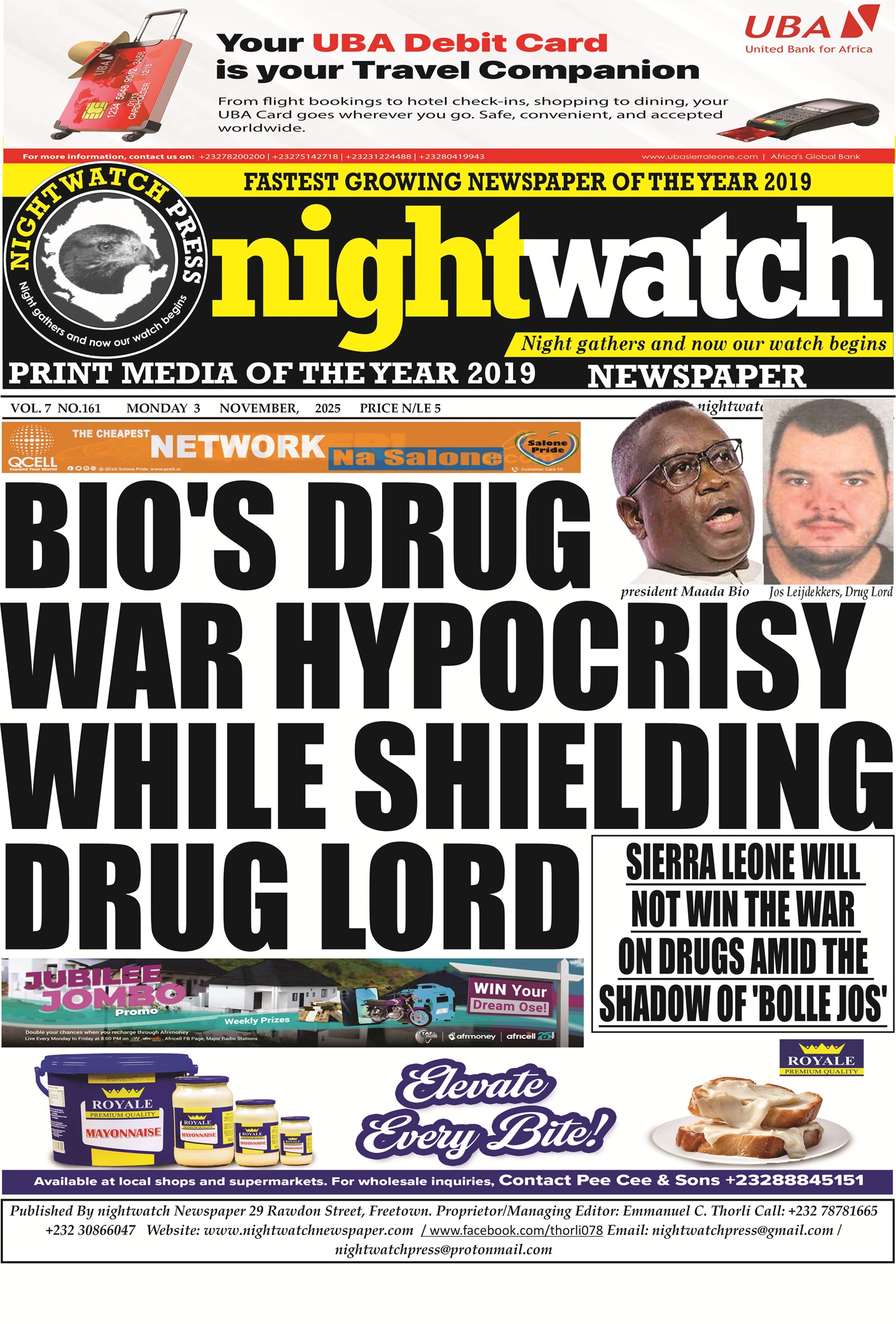
The Sierra Leone People’s Party (SLPP) government’s much publicized campaign against the deadly synthetic drug Kush is increasingly being viewed as a grand illusion a well-staged performance masked in deep hypocrisy.
While state media are highlighting rehabilitation centers and public awareness drives, growing reports and public whispers tell another story including one of selective justice, political protection and quiet complicity at the highest levels of power.
Behind the billboards, speeches, and presidential pledges for a drug-free generation, serious allegations persists that persons close to the ruling class are shielding or associating or aiding and abetting known drug traffickers and dealers. What is being enforced as a reinvigoration in the fight against drugs in the country, is a façade, a smokescreen aimed at distraction public resentment against this high-level protection of known importers and dealers of the various drugs and orchestrating a show on lesser retailers and users.
For many citizens, this contradiction exposes not just hypocrisy but moral decay an administration that condemns drug use in public while allegedly protecting its financiers behind closed doors.
Looking at the Public crisis and private compromise, across Sierra Leone, the Kush epidemic has left a trail of destruction broken families, rising crime, and young people losing their futures to addiction. Yet, while ordinary users are rounded up and sent to underfunded rehabilitation centers, those believed to be financing and distributing the drugs operate with apparent impunity.
Reports in local media have linked individuals within the country’s ruling establishment including members of the first family to figures associated with major international drug trafficking networks.
Among them is the notorious Dutch drug lord Jos Leijdekkers, who is said to enjoy protection within Sierra Leone’s borders. Despite widespread awareness of his presence, there has been little visible effort from the government to ensure his extradition or investigation.
This apparent inaction, many argue, signals a disturbing tolerance of impunity. It also raises fundamental questions about whether Sierra Leone’s so called “war on drugs” is truly about saving the nation’s youth or simply about saving political face. It is crystal clear that the fight focuses on symptoms, while ignoring sources.
At the center of the government’s anti-drug campaign is the National Drug Law Enforcement Agency (NDLEA), led by Andrew Jayah Kaikai. The agency has focused heavily on arresting Kush users and sending them to rehabilitation centers. While this might show some level of government activity, critics describe it as “pouring water on a leaky roof”, tackling the visible symptoms while ignoring the source of the leak.
By targeting mostly poor and vulnerable users instead of dismantling the networks that import, distribute, and profit from drugs, the government risks deepening public mistrust. It also reinforces a pattern familiar in Sierra Leone’s governance: a focus on optics and short-term publicity over genuine structural reform.
The Role of Parliament and Law Enforcement: Parliament has a key responsibility to hold the government accountable in the fight against drugs. Yet both SLPP and All People’s Congress (APC) lawmakers have faced criticism for failing to push for transparency and action. Some legislators from both parties have even been accused of benefiting, directly or indirectly, from the same trafficking networks they publicly denounce.
Meanwhile, the Sierra Leone Police (SLP), tasked with enforcing the law, has not escaped scrutiny. Senior officers are widely believed to know the main players in the drug trade, but many are said to turn a blind eye allegedly motivated by financial gain. Such complacency not only erodes public trust but allows the drug crisis to flourish unchecked.
Additionally, On Thursday, 30th October, 2025, a high level meeting at State House discussed plans to create a special court dedicated to handling drug related offenses or matters, but on the surface, this could mark a positive step toward accountability and faster justice.
However, legal experts and civil society activists have warned that such a court will be meaningless unless the government shows genuine commitment to prosecuting high-level offenders. Without decisive action including the extradition of Jos Leijdekkers and the investigation of complicit officials the new court risks becoming yet another symbolic gesture, like so many other commissions and task forces before it.
The SLPP government has made much of its ongoing effort to build rehabilitation centers across the country. These facilities are often showcased as proof of progress. Yet, on closer inspection, many are poorly equipped, underfunded, and lack professional staff. In some centers, patients are reportedly left with minimal medical or psychological support.
Rather than functioning as true recovery hubs, these centers often serve as evidence of the government’s obsession with visible projects the kind that can be photographed, televised, and praised even if they achieve little in practice. The focus, critics say, has been on appearance rather than impact.
Furthermore, the drug problem in Sierra Leone is more than a law enforcement issue. It reflects the country’s deeper governance crisis one marked by corruption, weak institutions, and selective justice. So long as individuals close to power are shielded from investigation, no amount of police raids or sensitization campaigns will make a difference.
Honestly, a sincere fight against drugs menace requires a multi-pronged approach including genuine investigations and prosecution of traffickers, regardless of political connections.
The Fight must also be transparent within law enforcement and the judiciary: Without these measures, the government’s drug policy will remain a hollow performance a show of action masking inaction.
Ultimately, Sierra Leone’s war on drugs is a test not of policing capacity but of political will. A government that protects drug financiers while punishing drug victims cannot credibly claim to fight for the nation’s youth.
Until the SLPP administration confronts the corruption and complicity within its own ranks, its campaign against Kush will remain little more than an act of political theater one that costs real lives.
Sierra Leone’s young people deserve more than speeches, banners, and half-built centers. They deserve a government that confronts the truth, dismantles the criminal networks poisoning their communities, and restores faith in justice. For now, that remains a promise unfulfilled and a tragedy unfolding in plain sight.