

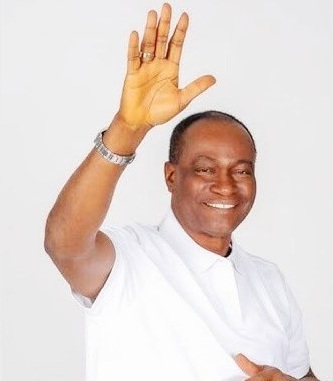
The Former All People’s Congress APC presidential candidate Dr. Samura Matthew Wilson Kamara has issued one of his strongest public criticisms yet on the direction of Sierra Leone’s democratic culture, warning that the country risks sliding into a dangerous era where “ballots become weapons” and political competition is replaced by institutional intimidation.
His remarks delivered in an address themed around safeguarding electoral integrity and democratic renewal has generated widespread discussion across political, civil society, and diplomatic circles.
Dr. Kamara’s latest intervention comes at a moment of heightened national introspection.
Additionally, with lingering grievances from the 2023 elections, and the country gradually orienting itself toward the 2028 electoral cycle, concerns about trust in public institutions, civic freedoms, and the credibility of electoral processes continue to dominate national conversation. For Kamara, these are not abstract concerns but clear and present threats that demand urgent national attention.
In the speech that has sparked headlines, Kamara accused Sierra Leone’s political environment of drifting into a space where elections are no longer embraced as the legitimate arena for contesting power, but rather as instruments for silencing dissent, legitimizing illegitimate outcomes, or enforcing dominance through the machinery of the state. “When ballots become weapons,” he declared, “democracy dies and with it, the hopes of our people for justice, prosperity, and peace.”
Kamara did not hesitate to frame his critique within a larger struggle for national renewal. He argued that Sierra Leone’s democracy stands at a crossroads one path leading toward deepening accountability and political maturity, and the other toward fragmentation, manipulation, and a collapse of public trust.
According to him, the country cannot afford to normalize electoral malpractice, nor can it continue to treat opposition voices as adversaries of the state.
While avoiding personal attacks, the former presidential candidate directed much of his warning toward what he described as “state-enabled distortions” of the political landscape. These include what he portrayed as biased governance practices, the blurring of lines between state institutions and partisan interests, and the erosion of democratic norms such as freedom of assembly, protection of civil liberties, and fair access to state resources during elections. Kamara insisted that elections must be competitive but fair, and that the power of incumbency must never be used as a shield against accountability.
One of the most compelling aspects of Kamara’s message was his insistence that democracy is not merely about holding elections but about creating conditions where citizens can express their political will without fear or coercion. He noted that “a vote should never be a tool of intimidation, nor a process manipulated to serve the ambitions of a few.” For Sierra Leone’s democracy to survive and flourish, he argued, the ballot must regain its sanctity as a symbol of the people’s authority not as a mechanism for consolidating political control.
Kamara also emphasized the importance of rebuilding trust between institutions and citizens. He observed that when the public begins to perceive elections as predetermined or unfair, the legitimacy of governance itself is weakened. This, he cautioned, opens the door to political alienation, public resentment, and a weakening of national cohesion. In such an environment, the risk of instability grows.
The former Minister of Finance and Foreign Affairs called for sweeping reforms aimed at strengthening democratic institutions. These include renewed commitments to transparency in electoral administration, de-politicization of security institutions, and the adoption of stronger mechanisms for independent oversight. He also advocated for a national political dialogue to address grievances and rebuild consensus around the rules of democratic engagement.
Importantly, Kamara’s message was not solely framed as an attack on the current political establishment. Rather, he positioned himself as a statesman seeking to restore confidence in a system he believes is veering off track. He appealed for collective national introspection, urging political leaders across the divide to prioritize country over party. “Democracy,” he stated, “is protected not by who wins elections, but by how we conduct them.”
His call resonated with civil society organizations and opinion leaders who have repeatedly expressed concern about rising political tensions, shrinking civic space, and the potential consequences of unresolved electoral disputes.
Many agree that without efforts to rebuild trust and ensure credibility in future elections, Sierra Leone risks entrenching a cycle of political mistrust and social fragmentation.
As Sierra Leone faces critical years ahead economically, socially, and politically Kamara’s message serves as both a warning and a call to action. His assertion that “when ballots become weapons, democracy dies” captures a central truth that cuts across party lines: that democracy cannot survive without fairness, transparency, and respect for the will of the people. Whether this warning will inspire meaningful reforms or simply fuel further political polarization remains to be seen. But for now, Kamara has reignited a conversation the country can no longer afford to ignore.
https://shorturl.fm/kJDzR