


By Janet A. Sesay
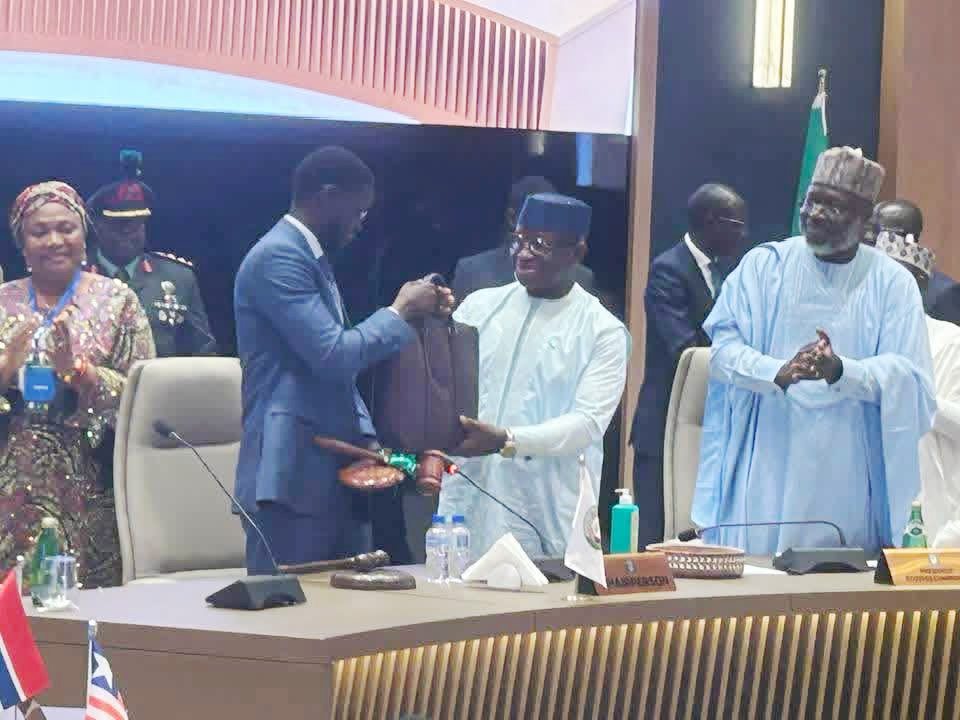
The 69th Ordinary Session of the Authority of Heads of State and Government of the Economic Community of West African States (ECOWAS) ended in Freetown on Sunday, 19th July, 2026 with Sierra Leone’s President Julius Maada Bio formally bowing out as Chairman of the regional bloc and handing over the mantle of chairmanship to Senegal’s President, Bassirou Diomaye Faye.
The Summit, which brought together West African regional bloc leaders, government officials, diplomats, private sector actors and development partners, was marked by calls for a renewed ECOWAS focus on peace, security, democratic governance, economic transformation and improved living conditions for West Africans.
President Faye accepted the chairmanship with a strong commitment to advancing the ideals of ECOWAS, pledging to lead the organisation at a time when the region faces growing security, economic and political challenges.
The Summit was attended by eight Heads of State, alongside senior government representatives from member countries. Nigeria and Côte d’Ivoire, two of the region’s largest economies, were represented by their Vice Presidents after Presidents Bola Ahmed Tinubu and Alassane Ouattara were unable to attend.
Also gracing the high-level gathering were senior ECOWAS officials, regional ministers, diplomatic representatives, international partners and prominent business leaders, including Africa’s industrialist, Aliko Dangote, who joined other stakeholders in witnessing discussions on the future direction of West Africa.
In his final address as ECOWAS Chairman, President Julius Maada Bio thanked member states, ECOWAS institutions, ministers, delegates and partners for their cooperation and support throughout his tenure.
He said the Summit provided an opportunity for leaders to reflect on the challenges facing the region and make important decisions aimed at strengthening regional integration.
“Today, we have reaffirmed our commitment to peace and security, constitutional governance, regional integration, and a better future for all of us in West Africa,” President Bio stated.
A major outcome of the Summit was the adoption of the Declaration of Commitment and Compact for the Future of Regional Integration, which President Bio described as “a collective pledge to transform ECOWAS for a new era.”
According to the erstwhile Chairman, the Compact focuses on stronger institutions, a competitive regional economy, greater resilience and improved accountability to citizens.
He warned that the success of ECOWAS would not be measured by declarations alone, but by the implementation of decisions that prevents crises, expands trade, creates opportunities and improves the lives of citizens.
“The true measure of our work will always be implementation,” he said, stressing that ECOWAS must choose preparation over delay and leadership over reaction.
Reflecting on the history of ECOWAS, the former Chairman recalled that the founding fathers understood more than five decades ago that West African nations would always be stronger together.
He called on current leaders to adapt that vision to the realities of the 21st Century by ensuring that borders protect sovereignty without becoming barriers to peace, trade and solidarity.
The outgoing ECOWAS Commission President, Dr. Omar Alieu Touray also used the occasion to reflect on his four-year tenure, describing his service to the regional institution as the greatest honour of his professional life.
Dr. Touray highlighted ECOWAS’ achievements in strengthening democratic governance, responding to security threats, advancing infrastructure projects and promoting regional economic cooperation.
He pointed to major initiatives including the West African Gas Pipeline, the Abidjan-Lagos Corridor Highway Project, regional electricity interconnections and trade facilitation programmes as examples of ECOWAS’ contribution to development.
He said the future of ECOWAS must be built around stronger solidarity, expanded digital transformation, improved energy access, empowered women and youth, and a renewed commitment to democracy and constitutional order.
President John Dramani Mahama of Ghana also delivered a strong message at the Summit, describing the ECOWAS Compact as a major opportunity to unlock the potential of regional integration.
He said the six pillars of the Compact — peace and security, sustainable economic transformation and regional prosperity, science, technology and innovation, youth and women empowerment, institutional reforms and strategic partnerships, as well as ECOWAS’ global positioning and commitment to democracy must be effectively implemented to benefit citizens.
President Mahama stressed that democracy must deliver tangible benefits, noting that citizens want more than elections every four or five years; they want jobs, accountability and social inclusion, and improved public services.
The Summit also heard remarks from United Nations Deputy Secretary-General, Amina J. Mohammed, who commended efforts to advance gender parity, women’s political participation and sustainable development across Africa.
She urged African leaders to take ownership of the continent’s future while building partnerships that support progress, climate action, and accountable governance systems.
As President Bassirou Diomaye Faye begins his tenure as ECOWAS Chairman, leaders expressed confidence that the new leadership will continue efforts to strengthen regional unity, tackle insecurity and move West Africa towards deeper integration and shared prosperity.