



By NAMATI Sierra Leone
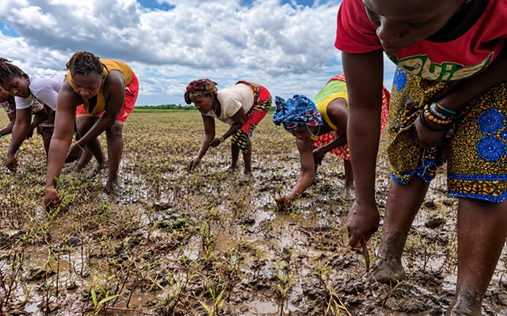
Chattering in the morning sun, a group of women farmers from Samu village emerges into a vast field that is dotted with seedlings as far as the eye can see. Their bare feet sink into the mud as they begin the day’s work of planting more seedlings. Barely ankle high, each shoot carries potentially life-changing promise. If their work is successful, this field will be transformed into a mangrove forest capable of capturing tonnes of carbon from the atmosphere. The carbon will then be used to generate carbon credits that can be sold to global corporations looking to reduce their carbon footprint.
Less than a mile away, Ibrahim Tarawally, the youth leader of Mai Village, is angry. The Southern-based Namati paralegal team travelled across many miles of inhospitable terrain to bring them an MOU allowing Namati to work with them in an upcoming review of their lease agreement with Africa Conservation Initiative (ACI). Tarawally takes one glance at the document and refuses to sign. As far as he is concerned, the community has already endured enough disappointment in its dealings with Africa Conservation Initiative (ACI), the company with which it entered into an agreement to restore the mangrove forest. “They promised us cookstoves and ovens for drying our fish… cold rooms,” Tarawally claims. “We were given jobs replanting the mangroves but after a short while, they told us to stop working and brought in other people from outside to do the work. Now, nobody from Mai is involved in the planting. The company gave no explanation. They told us nothing.”
Tarawally argues that if they can no longer cut down existing mangroves to earn their livelihoods and they can no longer participate in the planting of new ones, then their means of survival are severely limited. “I don’t think this project can work,” he asserts. “It cannot work.”
Sierra Leone’s vast rainforests and mangroves have been steadily attracting carbon project investment over the past few years. Due to its restorative nature, it is viewed as a much-needed alternative to the more established extractive and agribusiness industries. “The communities benefit from these projects, but the environment also benefits,” explains Namati CEO Vivek Maru. “They are not giving up their land to be destroyed. Instead, they are conserving their lands. The added value of mangrove conservation, for instance, is increased protection from flooding and the expansion of habitats that support fish populations.”
By protecting existing forests and restoring degraded ecosystems, carbon projects can help reduce greenhouse gas emissions and remove carbon dioxide from the atmosphere, contributing to global efforts to mitigate climate change. As the Country Director of Africa Conservation Initiative Dr James Harding explains, “we are a company that believes in community-centric development and mitigation of climate change using nature-based solutions”.
Tarawally eventually agrees to sign the MOU with Namati, but his concerns remain. Failure to deliver on promises made by companies to communities, especially in the area of employment, has been endemic within land-intensive industries such as mining and agribusiness. The emergence of these familiar problems in Sierra Leone’s relatively young carbon sector emphasises the need for a regulatory framework that builds on the protections established under the Customary Land Rights Act 2022, while specifically addressing carbon investments.
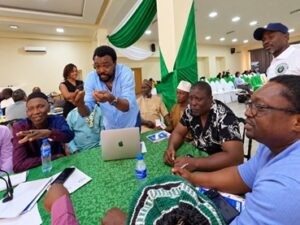
“Over a year and a half ago, we partnered with Invest Salone and the Sierra Leone government to begin developing Sierra Leone’s first National Carbon Strategy,” notes the Director of Namati, Sonkita Conteh. “We consulted with government bodies, Paramount Chiefs, Civil Society, representatives of communities hosting carbon projects, project developers and district councils to determine what should be laid out in the document.”
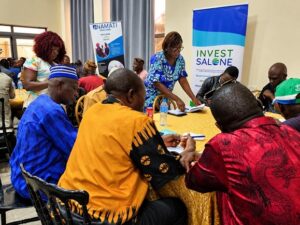
On the 8th of October 2026, a draft document was presented for validation. Among the most significant provisions of the draft strategy are measures intended to ensure that Samu and Mai and other communities hosting carbon projects, are fully involved in investments taking place on their land. The document proposes that residents of those communities be given priority for employment in project implementation, monitoring and data collection. “A common excuse made by companies is that they are unable to find the skills they want within the communities with whom they have an agreement,” observes Sonkita Conteh. “But the draft strategy is clear that community members must be provided with technical training and capacity building to close any skills gaps.”
The draft document also strengthens requirements for Free, Prior and Informed Consent (FPIC), while proposing that communities receive at least 45 percent of gross revenue from land-based carbon projects. Working groups that comprised a mix of stakeholder institutions reviewed the draft, with the objective of answering a total of 15 high-priority questions, which included:
- Who owns carbon rights, and who can authorise carbon agreements where multiple customary rights holders exist?
- Are Free Prior and Informed Consent (FPIC) requirements sufficient to guarantee genuine, inclusive community consent without unnecessarily obstructing investment?
- Are the proposed 45% and 25% minimum community revenue shares fair, practical and clearly defined?
- Are grievance mechanisms accessible and independent, particularly for serious violations requiring direct intervention?
- Does the model Carbon Partnership Agreement adequately protect community rights, livelihoods and future generations while providing investor certainty?
The proposed revenue-sharing arrangements proved particularly contentious. While one working group recommended reducing the minimum community share for land-based projects from 45 to 35 percent, the National Chairman of the Council of Paramount Chiefs, Paramount Chief Dr. Masakma Madibie II, argued that even the original 45 percent was relatively low. Nevertheless, he suggested that the figure could be accepted initially and reviewed as projects progressed.
Another group maintained that carbon rights should belong to landowners, but disagreements emerged over the duration of agreements, with investors seeking longer terms while landowners insisted on periodic reviews and the right to withdraw from agreements. There were also calls for government institutions to receive a share of carbon revenues through local councils.
Rewilding Group, which signed a reforestation deal with 3 chiefdoms in Port Loko District in 2024, was represented by the company’s Managing Director Mohamed Kamara. “I think the strategy is a very good starting point,” Kamara commented after the working group discussions, “but we the project developers representing the private sector, think a lot still has to be done before we can come to a conclusion. This current draft strategy does not adequately consider carbon projects that are already ongoing. We are concerned.”
Community representative, Chief Foday Sama Bunduka also represented the Gola Chiefdom Development Committee in Gaura Chiefdom, where forest edge communities have a benefit sharing agreement with the Gola Rainforest National Park. “I am happy because this is the first time we as community people are being called on to validate a document of this nature. We were involved in something that concerns us and I think that a lot of progress was made. I am extremely happy.”
The working group recommendations will inform further revisions to the draft strategy, which is expected to become operational in early 2027. But beyond the debates over carbon rights, revenue sharing and investment agreements lies a more fundamental question: will the promises of carbon investment translate into tangible benefits for the communities whose land and livelihoods sustain these projects? For the women planting mangroves in Samu and the frustrated youth leader in Mai, the answer will determine whether Sierra Leone’s emerging carbon industry delivers on its promise of protecting both the environment and the people who depend on it.