


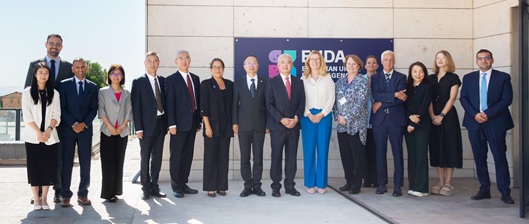
The European Union (EU) and China have moved to strengthen their international cooperation against drug trafficking, with particular attention to the growing threat of synthetic drugs, emerging psychoactive substances and the illegal chemicals used in drug production.
The renewed commitment followed the 5th EU-China Dialogue on Drugs, held in Brussels on September 22, 2026, bringing together more than 50 representatives from European and Chinese institutions to discuss the changing nature of the global drug trade and the need for stronger international responses.
The high-level engagement brought together representatives of the European Commission, European External Action Service, European Union Drugs Agency (EUDA), Europol, customs authorities and several EU member states, alongside Chinese officials from relevant drug-control, security and foreign affairs institutions.
The discussions focused on drug-control policies, emerging drug markets, synthetic substances, new psychoactive substances, precursor chemicals, law enforcement cooperation, drug prevention and treatment, as well as coordination in international drug control forums.
The meeting comes amid growing international concern that drug trafficking networks are becoming increasingly sophisticated, exploiting technological developments, international transportation systems, commercial supply chains and differences in national drug-control regulations to facilitate the production and distribution of illicit substances.
One of the central issues addressed during the dialogue was the rapid expansion of synthetic drugs and new psychoactive substances, which continue to present significant challenges to governments and law enforcement agencies.
Synthetic drugs are substances manufactured through chemical processes rather than obtained directly from natural plant sources. They include substances such as methamphetamine, MDMA and various emerging synthetic compounds.
Unlike traditional drugs, some synthetic substances can be produced in relatively small laboratories using chemical ingredients that may have legitimate industrial, pharmaceutical or commercial applications.
This makes it difficult for authorities to distinguish between chemicals intended for lawful industrial purposes and those diverted into illegal drug manufacturing.
The situation is further complicated by the emergence of new psychoactive substances, which are often developed or modified to produce effects similar to internationally controlled drugs.
Criminal manufacturers can alter the chemical composition of existing substances, creating new compounds that may not immediately fall under existing drug control classifications.
Consequently, governments are increasingly required to strengthen scientific monitoring, laboratory testing, intelligence gathering and regulatory systems to identify emerging substances before they spread widely through illegal markets.
The EU and China acknowledged that both sides are facing challenges associated with the continued spread of synthetic drugs, the emergence of new psychoactive substances and the diversion of chemical ingredients into illegal drug production.
They therefore emphasised the importance of strengthening communication, building mutual understanding and expanding practical cooperation to respond to these developments.
Another important area of discussion was the control of precursor chemicals, which are substances used in the manufacture of synthetic drugs.
Many precursor chemicals have legitimate uses in industries such as pharmaceuticals, agriculture, manufacturing and scientific research. However, criminal organisations can exploit weaknesses in monitoring and distribution systems to divert these substances into illegal production facilities.
The illegal diversion of chemicals has become an important concern for international drug-control authorities because the availability of such materials can support the expansion of clandestine drug laboratories.
The EU and China have consequently recognised the need to strengthen cooperation in monitoring chemical movements, identifying suspicious transactions and improving the exchange of information on substances that could be diverted for illicit purposes.
The 5th dialogue was preceded by the 10th Meeting of the EU-China Joint Follow-up Group on Drug Precursors, held in Brussels on September 21, 2026.
The two meetings formed part of a broader cooperation framework designed to address drug trafficking and the diversion of chemicals used in the manufacture of illegal substances.
The joint follow up mechanism is particularly important because it provides a specialised platform for discussing chemical controls and strengthening cooperation between the relevant authorities.
By improving coordination in this area, both sides seek to address vulnerabilities that criminal networks may exploit when obtaining chemicals and organising illegal production activities.
Beyond discussions on synthetic drugs and precursor chemicals, the dialogue also highlighted the importance of closer cooperation between law enforcement institutions.
Drug trafficking is increasingly a cross border criminal activity involving different stages of production, transportation, distribution and financial transactions across multiple jurisdictions.
A criminal network may obtain chemicals in one country, manufacture illicit substances in another and distribute the finished products through several international transportation routes.
This complex structure makes it difficult for individual national authorities to investigate and dismantle entire trafficking networks without assistance from their international counterparts.
Information sharing, coordinated investigations, forensic analysis and cooperation between law enforcement agencies are therefore essential components of international drug-control efforts.
The participation of Europol and other European security institutions alongside Chinese authorities provided an opportunity to exchange experiences and discuss approaches to addressing these challenges.
The partnership also builds on an existing history of cooperation. The European External Action Service reported that the EU and China reaffirmed the importance of the 2017 strategic agreement between China’s Ministry of Public Security and Europol during their 2025 engagement.
At the 4th EU-China Dialogue on Drugs, held in Beijing in September 2025, both sides agreed to exchange information regularly and promptly on drug policy developments, substance controls, prevention and treatment, drug monitoring, law enforcement and forensic drug analysis.
They also agreed to appoint contact points to facilitate communication and improve coordination between the relevant institutions.The September 2026 meeting represents a continuation of these efforts, with both sides seeking to respond to new developments in the international drug market.
Although law enforcement cooperation remains central to the fight against drug trafficking, the EU-China engagement also recognises that the drug problem cannot be addressed through arrests and seizures alone.
Drug abuse and dependency create serious public health and social challenges, affecting individuals, families and communities.People experiencing drug-related problems may require medical treatment, psychological support, rehabilitation and assistance with reintegration into society.
Prevention is equally important, particularly among young people who may be exposed to illicit substances through social networks, online platforms and other distribution channels.
The broader programme of EU-China drug cooperation included a meeting hosted by the European Union Drugs Agency in Lisbon on September 24, 2026, where representatives from China and the EU exchanged knowledge and experience on emerging drug-related challenges.
According to the EUDA, the Lisbon engagement addressed three major areas, including preparedness, health and social responses, and synthetic drugs, new psychoactive substances and precursor chemicals.
Discussions on health and social responses covered prevention, treatment, risk reduction, harm reduction, rehabilitation and recovery. The inclusion of these issues demonstrates the importance of balancing law enforcement measures with public health interventions.
While disrupting criminal networks is necessary, reducing drug demand, preventing substance misuse and supporting people affected by drug dependency are also important to achieving sustainable results.
The EU-China dialogue also addressed the importance of coordinating positions and exchanging views ahead of meetings of the United Nations Commission on Narcotic Drugs (CND).
The CND is a major United Nations policymaking body responsible for examining international drug-control issues and providing recommendations on global drug policy.
Its work includes reviewing developments in the international drug situation, considering emerging threats and contributing to international cooperation on drug prevention, control and related challenges.
For the EU and China, maintaining communication ahead of CND sessions provides an opportunity to discuss areas of common concern and contribute to wider international discussions.
Such engagement is significant because drug trafficking networks do not respect national boundaries, while the effectiveness of international drug control measures often depends on cooperation among countries with different legal systems, resources and policy approaches.
The involvement of major international partners can therefore contribute to discussions on improving chemical controls, strengthening law enforcement cooperation and responding to emerging drug threats.
Although the dialogue was organised between the EU and China, its implications extend beyond Europe and Asia. African countries also face challenges associated with drug trafficking, substance abuse, organised crime and the movement of illicit substances through international transportation routes.
The growing availability of synthetic drugs and the emergence of new psychoactive substances present additional concerns for countries whose drug control institutions may face limitations in laboratory facilities, intelligence capabilities, border surveillance and specialised enforcement resources.
For West Africa, the international drug trade remains an important security and public health concern. Countries in the region must contend with trafficking networks, the movement of illicit substances through land, air and maritime routes, and the social consequences of drug dependency. Sierra Leone, like other countries, has an interest in international cooperation that strengthens drug interdiction, intelligence exchange, prevention, treatment and rehabilitation.
The EU-China engagement offers an example of how countries and international institutions can establish structured platforms for discussing common drug-related threats.
However, African countries must also strengthen their own institutional capacity, improve cooperation among national security agencies and develop effective partnerships with international organisations.
The fight against drug trafficking cannot be left exclusively to major international powers. Countries affected by trafficking routes and drug consumption must be actively involved in shaping and implementing international responses.
Despite the renewed commitments, the major challenge facing international drug-control cooperation remains the translation of diplomatic discussions into practical and measurable results.
Information sharing must lead to timely intelligence that helps authorities identify suspicious activities, investigate trafficking networks and prevent the diversion of precursor chemicals.
Cooperation must also produce stronger institutional relationships, improved scientific capabilities and more effective responses to emerging synthetic substances.
The effectiveness of the partnership will depend on the willingness of both sides to sustain communication, respect their respective legal frameworks and address differences that may arise in the implementation of drug-control policies.
The European Union and China have confirmed that the 6th EU-China Dialogue on Drugs will take place in China in 2027, providing another opportunity to review progress and consider further areas of cooperation.
The next meeting will be particularly important in assessing whether the commitments made during the Brussels discussions have translated into stronger coordination and tangible progress against international drug trafficking.
Ultimately, the growing threat posed by synthetic drugs and organised trafficking networks requires a response that combines intelligence-sharing, effective law enforcement, chemical monitoring, public health interventions and international cooperation.
The EU-China partnership sends a message that the fight against illicit drugs requires sustained engagement among countries and institutions, rather than isolated national efforts.
As the global drug market continues to evolve, the real test for the two partners will not simply be the number of meetings held or agreements reached, but their ability to disrupt criminal supply chains, prevent the spread of dangerous substances and reduce the human and social costs of drug trafficking.