
By Musa Paul Feika
The United States is seeking to deepen its strategic and economic partnership with Sierra Leone, with critical minerals emerging as a major area of interest for the Trump administration as Washington looks to expand American access to strategic mineral resources and counter growing Chinese influence in the country.
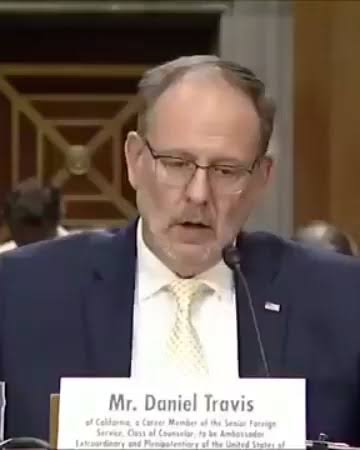
Speaking before the U.S. Senate Foreign Relations Committee, Daniel Travis, the administration’s designated representative for Sierra Leone, said that, if confirmed, he would deploy the full range of United States government tools, including the Millennium Challenge Corporation (MCC) Compact, U.S. Development Finance Corporation (DFC) investment and bilateral engagement to advance reforms and economic opportunities that would benefit American businesses.
Travis identified China’s growing economic and political influence in Sierra Leone as a major concern, particularly in sectors linked to mining, infrastructure and the media.
His comments point to a potentially significant shift in the U.S.-Sierra Leone relationship, with Washington seeking to use development assistance, investment and diplomatic engagement to secure a stronger position in the country’s strategic minerals sector.
“China’s overgrowing presence and influence in Sierra Leone is a top concern,” Travis told the committee, highlighting the need for the United States to offer what he described as a better value proposition to Sierra Leone.
The issue of critical minerals featured prominently in his testimony. Travis welcomed the Sierra Leone Government’s recent cancellation of a mining contract reportedly valued at about $300 million involving a Chinese company, saying the decision sent an important signal about the government’s willingness to scrutinize mining agreements and demand greater benefits for the Sierra Leonean people.
“I think that is an excellent signal from them and something that I hope to encourage deep looks at deals and making sure that they’re getting what they deserve out of them,” he said.
Travis indicated that, if confirmed, he would encourage Sierra Leone to pursue mining agreements that deliver greater economic value while creating opportunities for American companies to participate in the country’s mineral sector.
He also linked the U.S. interest in Sierra Leone’s mineral resources to ongoing power-sector projects, arguing that reliable electricity could help the country move beyond the export of raw minerals and develop greater domestic processing capacity.
“I think we’re already on the way with our power projects there, which will help Sierra Leone move up the value chain in mineral processing,” he said.
The proposed approach reflects a broader U.S. strategy of combining infrastructure investment with commercial engagement in countries possessing minerals considered strategically important to the global economy.
For Sierra Leone, which has significant deposits of iron ore, rutile, diamonds, bauxite, gold and other mineral resources, increased competition between major global powers could create opportunities for the country to negotiate better investment terms.
However, the development also raises questions about how Sierra Leone can ensure that competition between the United States and China translates into tangible benefits for its citizens, including employment, infrastructure, technology transfer, local processing and increased government revenues.
Travis further expressed concern about China’s growing presence in Sierra Leone’s media space, alleging that Chinese actors were replicating approaches that the United States had previously used successfully.
“The other thing, I think, is to pay closer attention to what they’re doing in the media space,” he told lawmakers. “They’re copying things we’ve been successful with in the past.”
He argued that Washington should respond by leveraging its own strengths and competing more effectively rather than allowing China to expand its influence without a stronger U.S. presence.
The comments suggest that Washington’s emerging strategy toward Sierra Leone extends beyond minerals and investment to include competition for influence across several sectors, including energy, infrastructure, business and media.
If Travis is confirmed, his mandate could therefore place Sierra Leone at the centre of a broader U.S. effort to strengthen economic and strategic partnerships in Africa while challenging China’s expanding footprint.
For Sierra Leone, the competing interests of global powers could provide an opportunity to attract better investment, technology and infrastructure. But experts and policymakers are likely to closely watch whether such competition ultimately produces stronger local participation and greater national value from the country’s mineral wealth.
The critical question for Sierra Leone will be whether it can leverage heightened American and Chinese interest to secure transparent, commercially viable and nationally beneficial agreements while maintaining control over its strategic resources.
As Washington prepares to intensify its engagement, Sierra Leone’s mineral wealth is increasingly becoming not only an economic asset but also a strategic interest in the growing competition between the world’s major powers for access to critical resources.