
By Janet A Sesay
As Mohamed Omodu Kamara’s aka Jagaban influence becomes increasingly visible in the APC’s internal elections, the bigger question is no longer whether Jagaban can compete, but whether his growing strength can help build a united party needed for the battles ahead.
The ongoing internal elections of the All People’s Congress are doing more than determining who occupies party positions.
They are also revealing the organisational strength, grassroots reach and political influence of the forces seeking to shape the APC’s future.
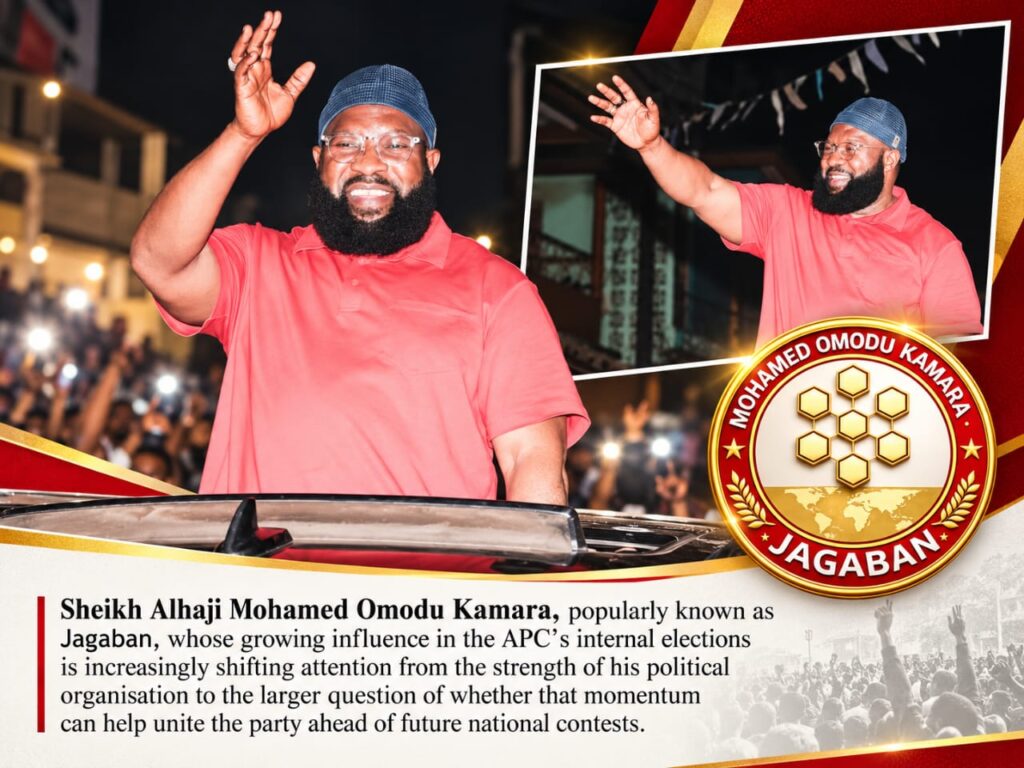
Among the clearest developments so far has been the growing presence of Sheikh Alhaji Mohamed Omodu Kamara, popularly known as Jagaban.
Across several areas, the Jagaban political machinery has demonstrated organisation, resilience and an increasing ability to compete effectively at grassroots level. The pattern is emerging from the internal elections shows it has strengthened and the perception that Jagaban is no longer merely one aspirant among many.
-HE IS INCREASINGLY BEING VIEWED AS A SERIOUS FORCE WITHIN THE APC.
Political strength creates political responsibility.
The next phase of Jagaban’s journey cannot be measured only by the number of internal elections his supporters win, the delegates associated with his movement or the structures his camp is able to secure but the bigger test is whether that strength can now be transformed into what the APC needs most which is “unity”.
“A politician can use strength to dominate opponents, A leader uses strength to bring people together.”
-THE BIGGER ELECTION COMES AFTER THE INTERNAL ELECTIONS.
Internal elections are naturally competitive. Candidates organise camps, mobilise and supporters fight passionately for positions but the APC’s ultimate objective is not to defeat one APC camp with another but the real objective is to build a party strong enough, broad enough and united enough to compete nationally.
When internal elections end, yesterday’s opponents must still be able to work together and supporters of different aspirants must still wear the same party colours and district and constituency executives must ultimately serve the same political institution which is the APC.
For Jagaban, this presents both an opportunity and a test of leadership as the transition now required is from camp leader to party bridge-builder which means reaching beyond loyalists, respecting those who supported rival aspirants and opening political space for experienced stakeholders, young people, women, grassroots organisers and those who may not currently identify with the Jagaban movement.
No single camp can deliver the APC the national victory it seeks.
-THE NATIONAL COALITION MUST BEGIN NOW.
Internal party victories matter, but they are not the final destination. The larger political battle lies beyond the party structures.
Sierra Leone’s electorate includes young people worried about jobs, families concerned about the cost of living, farmers seeking opportunity, entrepreneurs looking for access to capital, communities demanding infrastructure and citizens searching for leadership they can trust.
Winning internal party contests is therefore only one stage.
The APC’s eventual flagbearer must be able to speak not only to delegates and party loyalists, but to voters across the country that national coalition cannot begin after the flagbearer election but It must begin now.
If the grassroots organisation being demonstrated today becomes a platform for reconciliation, inclusion and party rebuilding, then its importance will extend far beyond internal victories.
-UNITY MUST BE MORE THAN A SLOGAN
Every internal party contest creates winners and losers but what matters is what happens next.
Real unity requires winning candidates to avoid triumphalism, t requires losing candidates to remain engaged, It requires party elders to mediate rather than inflame tensions and it requires flagbearer aspirants to remember that today’s opponent may be tomorrow’s strongest ally.
Jagaban’s growing influence gives him an opportunity to help set that tone. Where his supporters win, they should govern inclusively, where disputes arise, dialogue should replace retaliation, where political opponents are defeated, they should still be treated as part of the APC family and that is how political strength becomes institutional strength.
-A MOMENT BIGGER THAN ANY ONE ASPIRANT
The APC is approaching a defining period as different aspirants will continue to campaign, different camps will continue to compete and that is part of democracy.
The party must never allow the flagbearer contest to become more important than the APC itself.
For Jagaban, the questions are becoming increasingly important like can his movement expand beyond its original base? , Can his political organisation welcome those who previously stood on the other side?, Can his growing strength become a force for reconciliation rather than division?.
Those questions may ultimately matter more than any single district result.
Jagaban’s political strength is becoming increasingly difficult to ignore and his next challenge is larger to prove that the same organisation which is capable of winning political battles can also help bring the APC together.
-THE BIGGER ELECTION IS STILL AHEAD.
The APC will have a far greater chance of succeeding if it enters that contest not as competing camps, but as one party with one purpose.
-WHY THIS MOMENT MATTERS
FROM MOMENTUM TO RESPONSIBILITY.
Jagaban’s performance in the APC internal elections has strengthened perceptions of his grassroots organisation and national reach.
-FROM CAMP TO COALITION
The next stage requires expanding beyond core supporters and building relationships with members aligned to other aspirants.
-UNITY AFTER COMPETITION
Internal elections will produce winners and losers, but the APC’s strength will depend on how effectively both sides are brought back together.
-EYES ON THE NATIONAL CONTEST
The ultimate political battle is not within the APC but It is the wider national election where the party will need a broad coalition capable of reaching beyond its traditional base.