
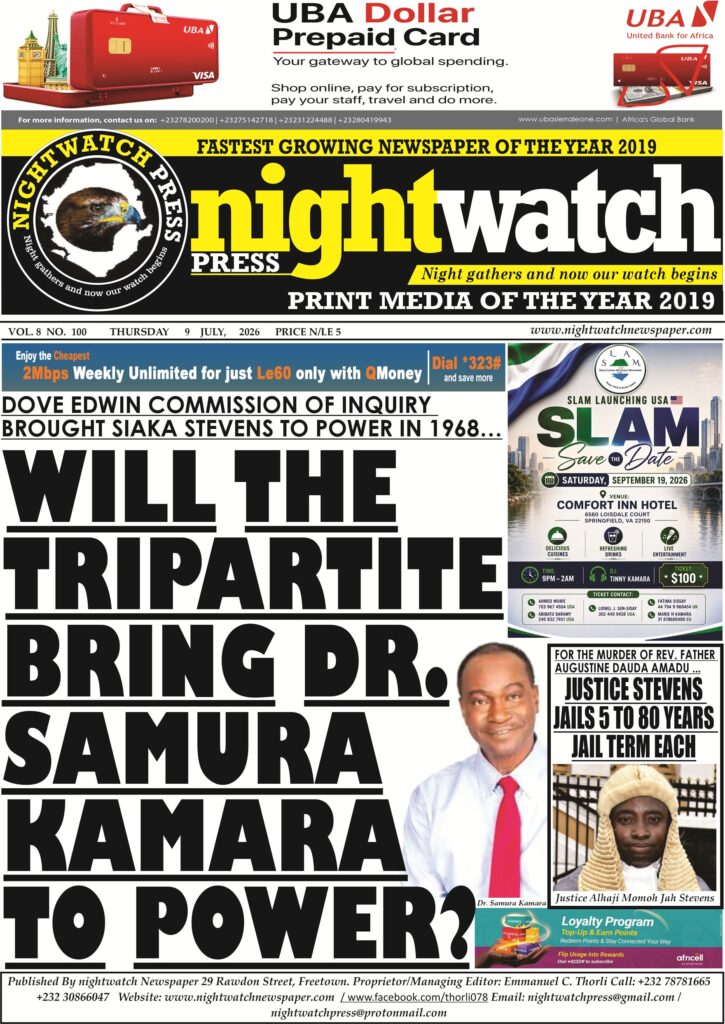
President Siaka Probyn Stevens came to power in 1968 through the help of the Dove Edwin Commission of Inquiry backed up by popular support.
Considering a glorious history for the All People’s Congress (APC), the people of Sierra Leone wonder if the the Tripartite Committee would bring the opposition leader, Samura Kamara to power.
President Stevens won the 1967 general elections by a narrow margin, but the political transition never went smooth.
Then Prime Minister, Albert Margai, a known SLPP hardliner kicked against handing over power to the winner with the help of the army commander, Brigadier David Lansana.
Lansana, a son-in-law to Albert Margai wanted to see the Margai regime in power at all cost but it came with a heavy cost.
Margai proclaimed a martial law across the country, placed the Governor-General under house arrest and attempted on Siaka Stevens life who escaped to neighbouring Guinea.
Historians maintain that the Margai regime refused to hand over power because it feared what it had created through the passage of bad laws to muzzle the then opposition, APC.
One of the worst laws was the one-party project which would have made SLPP the only recognised political party in Sierra Leone. Under the one-party system, people would participate in national politics only through SLPP, but eventually and sadly lost to the opposition.
The paranoia that APC would enforce that clause made Margai reluctant to relinquish power after his defeat in the ballot box.
At the peak of the political crisis and instability, the Dove Edwin Commission of Inquiry was set up to look into the conduct of the election with the main aim of establishing the winner who was expected to form a government.
It was a time Sierra Leone had a parliamentary system meaning the candidate who had majority in parliament would form the government.
At the end of the election investigation, the Commission found the ruling Sierra Leone People’s Party guilty of severe election rigging and fraud and that Siaka Stevens was the actual winner of the elections.
Coups and counter-coups, Siaka Stevens was installed Prime Minister and formed a government that ruled Sierra Leone for nearly two decades.
The inquiry of 1967 eventually led to the rise of the APC to glory and fame, and marked a period of significant political development in Sierra Leone.
Siaka Stevens governed the country and later handed over power in 1985 to Joseph Saidu Momoh who was said to be a handpicked successor that was not well cut out for the cut-throat politics of that age.
50 years down the line, a similar situation surfaced on June 24, 2023 when Samura Kamara contested a presidential election with the incumbent, Julius Maada Bio. The reports of local and international election observers showed that the 2023 election was rigged as it was marred with “mathematical inaccuracy” and “statistical inconsistency.”
It was against this backdrop that an election investigation body popularly known as the Tripartite Committee was set up to look into the alleged irregularities.
The committee has gone through its work, but failed to show who wins the election, a move that is at sharp contrast with the Dove Edwin Commission of Inquiry.
The Edwin Commission of Inquiry identified who won the election and accused SLPP of massive rigging thus paving the way for the installation of the rightful winner.
In somewhat contrary move, the Tripartite Committee however remains silent about who is the winner of the June, 2023 elections.
Instead, the commission has succeeded only in putting out a long list of 80 recommendations that has no bearing about who has won the election and who should form the next government.
The recommendations, according to analysts, speak only about electoral reforms which the PAOPA regime will trample on as they feel like.
The recommendations, according to legal practitioners, must be laid before parliament for ratification and possibly, domestication for them to have the force of law.
This rule was also ignored as the recommendations were outside the well of parliament years after they were proffered by the Tripartite Committee.
The members of parliament were however recently compelled to take the recommendations to parliament following a visit to Sierra Leone by the international moral guarantors.
The guarantors came after APC boycotted parliament over what they called a snail-pace implementation of the recommendations and the alleged flawed appointment of Edmond Alpha, Chief electoral Commissioner.
To date, there is no report to show that the recommendations have been tabled before lawmakers for appropriate action, and there is fear that the recommendations would still be discarded even if they become law.
One of the most popular arguments holds that there were good electoral laws and a national constitution to regulate the conduct of elections to make free, fair and credible, but the PAOPA regime deliberately and forcefully set them aside to achieve their political objective.
The fear that the PAOPA regime would embark on a similar pattern rents the air.
Even the remaining five recommendations which diplomats say constitute the accountability mechanism is often trumpeted on tv and radio stations.
While addressing the public through the media, former US Ambassador to Sierra Leone, David Bryan Hunt would say the recommendations is about electoral reforms and accountability thus raising Sierra Leoneans’ hope to a high peak.
But, such hope was shattered when allegations popped up that Ambassador Hunt had accepted bribes from the Bio regime.
Hunt who has been trumpeting accountability all over media platforms was immediately re-called from Sierra Leone leaving the people to wonder what is America’s next move.
A number of diplomats who were posted to Sierra Leone in the post-election stalemate are said to have been compromised by the SLPP government, a factor has left little hope in the minds of Sierra Leoneans.
The removal of former British Foreign Secretary, James Cleverley, according to reports, is linked to a downplay of Sierra Leone’s political crisis during briefing with the Prime Minister. Cleverley was in Sierra Leone at the peak of the post- election controversy.
Owing to the view that the Tripartite is nothing than a scam, the PAOPA regime smoothly moves on with their political processes.
SLPP has held its lower-level election during which party officers have been elected with Batilo Songa being the national chairman.
SLPP flagbearer aspirants embark on undercover campaigns for the coming National Delegates’ Conference where the party’s flagbearer will be elected if President Julius Maada will step down as his action insinuate a third-term bid.
President Bio, on several occasions, has questioned the usefulness of the Tripartite Committee by asking that “does tripartite have results,” adding that he will never hand over power to APC.
Bio’s Chief Minister, Moinina Sengeh usually remind APC that one cannot eat his cake and have it again while also referring to them as “unprogressive party.”
SLPP’s erstwhile Chairman, Prince Harding has told SLPP supporters during a meeting that a one-party state is possible in Sierra Leone drawing experience from Mexico where one party has ruled for over 70 years.
The stance taken at the top is cascading to the least and lowest SLPP supporter who vouch for a one-party state in Sierra Leone as a form of retaliation against the APC under President Siaka Stevens. Investigation conducted by this press has shown that SLPP grassroot’s stance for now is a migration from PAOPA to GBAGBATI.
The stance, though unpopular, is supported by what many refer to as “unscrupulous” APC politicians who blaze the trail for 2028 instead of standing with Samura Kamara to take back the people’s victory.
With 2028 polls in the offing, Samura Kamara’s chance of coming to power will be slim if APC gets a new flag bearer thus rendering the work of the Tripartite Committee a nullity as a contrast to the Dove Edwin Commission of Inquiry.