
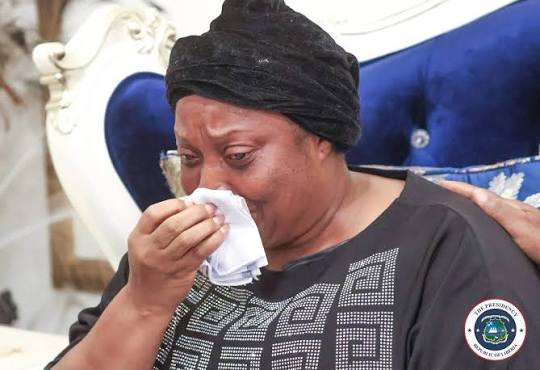
Liberia’s former Vice President has been transferred to a prison custody following a court order. Request by her defence team to be held in a medical facility owing to her deteriorating health condition was rejected outright by the court.
But, an application by the defence to review the evidence presented by the prosecution was granted by the court.
Jewel Howard Taylor’s transfer into prison custody came days after detention by the police, and it is expected that Sierra Leone would be next in the spree of drug investigation.
The former Liberian Vice President was arrested and detained by the police following telephone revelations in which she was said to have dealings with drug traffickers.
“What have you sent for the Pa,” former Liberian Vice President allegedly conversed with suspected drug traffickers asking what they had brought in for probably her former boss.
Jewel Taylor is the wife of former Liberian President, Charles Ghankay Taylor who is serving a 50-year jail term for his role in Sierra Leone’s civil war which recorded different forms of atrocities.
Mrs. Taylor, Liberia’s former Second-in-Command in the presidency of former President George Manneh Weah, has pledged to cooperate with the trial and cautioned her party supporters to stay calm.
But, posts on social media platforms, apparently spread by Mrs. Taylor’s supporters, indicated that “remaining calm does not mean silence and surrendering to the rule of law does not mean one cannot demand justice.” Whatever stance taken by either side, the investigation continues unabated, with the FBI team ready to get to the bottom of the investigation.
Sources in Liberia have shown that big names have appeared in the list of suspects for which more investigations will be conducted.
Former Liberian President, George Manneh Weah, reports state, is jittery and panic stricken as the phone conversation between Mrs. Taylor and the alleged drug traffickers indicates that he bears a hand in the proceeds of the drug trade.
The former Liberian President is currently in Liberia closely following the investigation and trial of his immediate former subordinate.
Recent reports in Liberia also showed that the headquarters of Mr. Weah’s political party, Coalition for Democratic Change (CDC), was raided by the Liberian police owing to suspicion that drugs were hidden there.
The response by the former Liberian President was tough and pledged to resist further attempts by the Liberian police by taking his men out on the streets.
Mr. Weah went ahead in complaining the current President to the sub-regional bloc, ECOWAS to stop President Joseph Boakai from harassing and intimidating him and his supporters through police raids in his party office. The police raid at the party office was temporally halted, but the fight against drugs secretly continued.
The move to ensure neutrality in the investigation process prompted the invitation of the US FBI to Liberia. FBI is US’s main domestic security and law enforcement agency in the United States.
The agency fights crime by preventing and fighting cyber-attacks, public corruption, civil rights and organized crime. It is also the lead agency that finds and stops terrorist plots inside and outside the United States.
As part of its mandate in fighting crime, the FBI team, recent reports stated, landed in Liberia in response to a request by President Boakai to investigate incidents of drug trafficking in Liberia.
As the drug trial under way in Liberia, top Sierra Leonean figures are also panic-stricken, fearing that their names would come up.
Credible sources have also intimated Nightwatch Press that a team from the FBI will land in Sierra Leone owing to the evidence gathered during the investigation of Liberia’s former Vice President as well as recent arrests of drug traffickers in foreign countries with Sierra Leonean passports.
The arrested traffickers, news reports said, had direct links to Sierra Leone. FBI’s operation would be a bit different from Dutch forces which made repeated attempts to arrest Jos Leijdekkers who is believed to be hiding in Sierra Leone.
Recent media interviews and discussions showed that the Sierra Leone government was not ready to cooperate with the Dutch authorities in respect of any investigation leading to his arrest.
Presidential Spokesman, Alpha Kanu said in an online interview that Sierra Leone government would resist any attempt by the Dutch authorities to invade Sierra Leone in the name of arresting a drug fugitive.
Leijdekkers’s alleged presence became topical among Sierra Leoneans’ discussion when his photos appeared on media platforms showing his attendance of a church service with the first family in Southern Sierra Leone.
A young girl, believed to be the President’s daughter was seen sitting by the right side of the drug fugitive, with reports indicating that the two are in a marriage.
Two drug traffickers arrested at an international airport in Qatar with Sierra Leonean passports show links to Sierra Leone. Investigations showed that one of the two suspects is a close relative of Jos Leijdekkers who is reportedly being sheltered in Sierra Leone.
Forensic analysis of the Cocaine discovered in the possession of suspects showed that it originated from Sierra Leone. Recently, a Dutch journalist who was in Sierra Leone to locate Jos Leijdekkers was held in custody and his fixer, Joseph Koroma chased out of the country.
Joseph Koroma who is one of Sierra Leone’s senior journalists and publisher of Public Review Newspaper, a local daily stands threatened with arrest and trial upon his return to Sierra Leone.
When the deal seemingly became clear and Sierra Leonean authorities pushed to the wall, senior SLPP politicians tacitly accepted hosting the Leijdekers and their government would welcome a fugitives’ swap.
They (unofficial sources) stated in clear terms that their government would extradite the drug fugitive only if Netherlands did likewise to the social media ventriloquist, Abdul Will Kamara aka Adebayor who was also similarly accused of inciting violent protest in Sierra Leone via online.
The August 10, 2022 protest which claimed the lives of 31 Sierra Leoneans including six policemen was said to have been incited by Kamara, and authorities had requested the Dutch government for his extradition to Sierra Leone to face trial.
Sierra Leonean authorities have insistently emphasised on the sovereign equality of Netherlands and Sierra Leone and that Jos Leijdekkers will remain in Sierra Leone as long as Adebayor continues to enjoy shelter on the Dutch soil.
Sierra Leone’s involvement in the Cocaine trade was also exposed following the arrest of Sierra Leone’s Ambassador to Guinea, Alimamy Bangura whose vehicle contained several parcels of Cocaine at the time of the arrest.
The former ambassador was placed under house arrest before given a persona non grata which warranted him to leave Guinea as his services were no longer needed there.
Back home in Sierra Leone, the premises of Admire Bio, a close relative of President Bio, have been repeatedly raided by police owing to tip-offs of drug trafficking. But, the searches have provided nothing substantial to warrant prosecution, a move that has caused amazement among the public. Police sometimes also blame the drug menace and trafficking on the porosity of Sierra Leone’s borders.
Drugs have caused a considerable death toll among Sierra Leonean youth despite police raids, arrest and detention.
Major streets in Freetown, Sierra Leone’s capital, are littered with drug-related corpses; a workload which FCC (Freetown City Council) authorities cannot not cope with.
The Mayor of Freetown, Yvonne Aki Sawyer said, in a recent media interview that FCC burial teams were overstretched in terms of resources to take care of the corpses.
The Mayor’s statement provoked a heated debate among the public, a situation which caused a strained relationship between the government and the FCC.
Currently, drug-related corpses are still on the streets of Freetown and other major towns in the country, creating an alarm which has warranted the intervention of US authorities.