

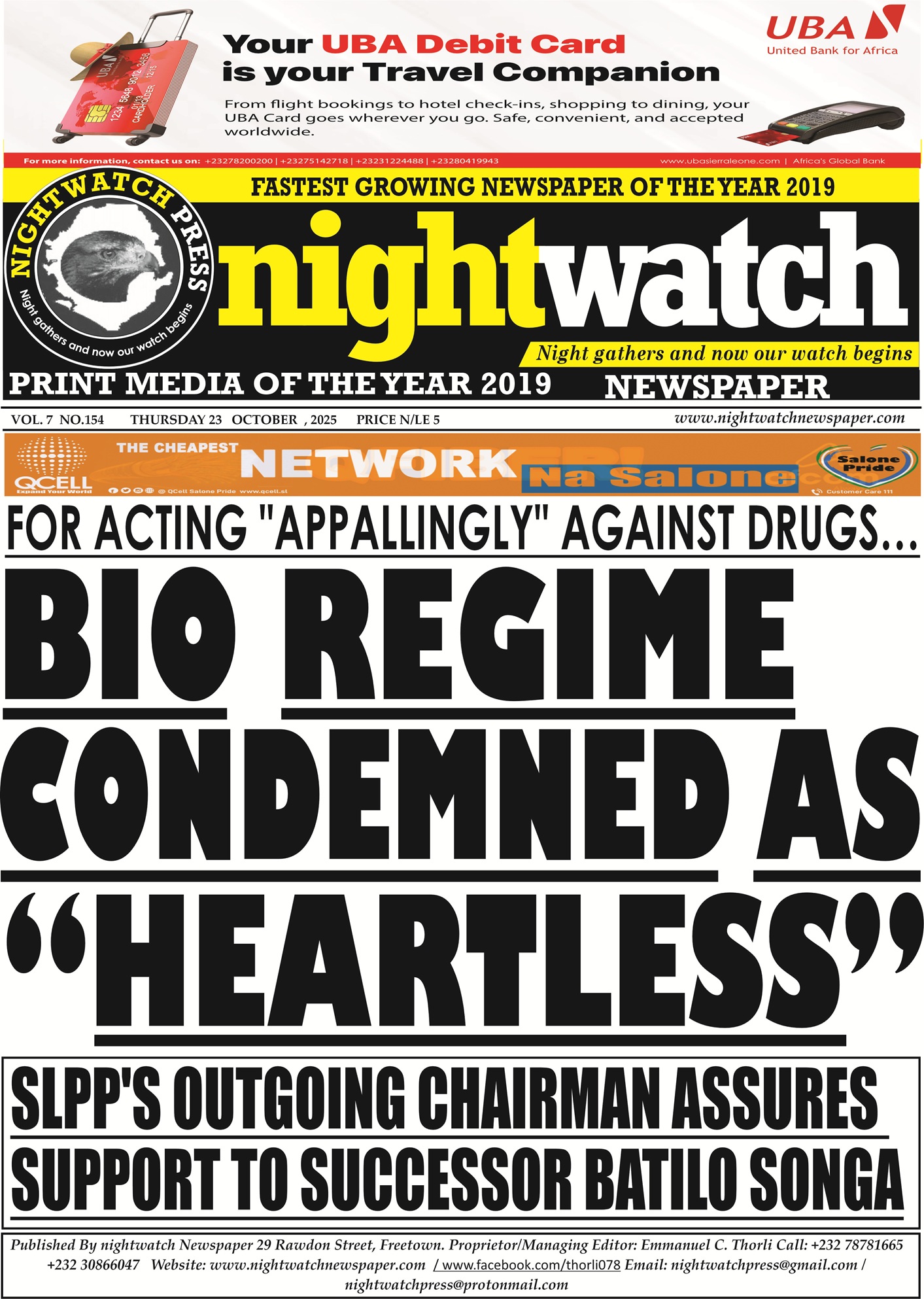
A Prominent political commentator and activist, Dr. Sylvia Olayinka Blyden OOR, has launched a scathing condemnation on President Julius Maada Bio’s SLPP-led government, branding it “heartless” for what she describes as an appalling lack of commitment to Sierra Leone’s drug enforcement fight.
In a detailed statement released on Monday, October 20th, 2025, Blyden accused the Bio administration of betraying the nation’s youth through deliberate budget cuts that has crippled the country’s anti-drug agency at a time when the country is battling an unprecedented narcotics misuse crisis.
According to Blyden, official budget records reveal that the National Drug Law Enforcement Agency (NDLEA), the key institution tasked with enforcing laws against illicit drugs such as Kush and Cocaine, was allocated a paltry NLE 2,075,100 (approximately US$89,000) in the 2025 National Budget.
Even more shocking, according to the erudite social critique, the supplementary budget document presented to Parliament by the Minister of Finance, Sheku Ahmed Fantamadi Bangura was subsequently slashed down to just NLE 1,470,600 (about US$63,000) for the entire year.
“This Maada Bio Government is heartless. They have betrayed the youth of this country. They reduced the national drug enforcement budget from a tiny $89,000 to only $63,000 for a whole year to fight the Kush crisis destroying our people. It is treachery,” Dr. Blyden declared.
Sierra Leone’s deepening drug epidemic, fueled by the spread of Kush a deadly synthetic narcotic widely consumed by unemployed and disillusioned youths has become a major social and public health emergency.
Across Freetown and provincial towns, the evidence is visible: young men slumped on street corners, addicts roaming half-clothed, and families torn apart by their addiction.
According to her, public hospitals are overwhelmed, social services are overstretched, and the police and NDLEA are chronically underfunded. In this grim context, Blyden argues, any reduction in the National Drug Law Enforcement Agency NDLEA’s already meager budget is a “national disgrace.”
“All respected States now spend millions to fight illicit drugs because it is now classified globally at the same level as fighting terrorism. But Sierra Leone’s SLPP government is going in the opposite direction slashing drug enforcement funds while our youths die on the streets,” she emphasized.
“Half a Million for Outreach, But $63,000 to Fight Drugs”
Blyden contrasted the NDLEA’s paltry allocation with what she described as extravagant spending by the Office of the Chief Minister, Dr. David Moinina Sengeh, who she accused of using public funds for political self-promotion and aggrandizement.
Citing official expenditure data, she revealed that the Chief Minister’s Office spent NLE 36,747,800 (about US$1.58 million) in 2024 including a massive NLE 11,227,700 (US$483,953) on “Outreach and Strategic Engagements.”
“Almost half a million dollars was spent on so-called outreach,” Blyden said. “That’s likely campaign work for Sengeh’s ambition to succeed Maada Bio in 2028,” she revealed.
Meanwhile, the agency fighting Kush across the whole country is left with only $63,000. This is why people in that office are so arrogant they’re chopping outreach money while our youths die.”
Her comparison underscores a growing public frustration over what many citizens perceive as misplaced government priorities.
The Bio administration has long prided itself on its “Human Capital Development” agenda emphasizing education, healthcare, and youth empowerment yet critics argue that the government’s handling of the Kush epidemic exposes a troubling contradiction between rhetoric and reality.
Looking at national outrage and political fallouts,
Blyden’s claims have sparked renewed outrage among citizens and civil society groups, whose view on the slashing of the budget of the National Drug Law Enforcement Agency NDLEA as an indictment on the government’s lack of seriousness in tackling drug abuse epidemic in the country.
Analysts have noted that this startling revelation comes at a politically sensitive time for the ruling party, which faces mounting criticisms for the economic hardship youth unemployment among a myriad of concerns that are causing serious decline in public trust.
“The optic is terrible,” one political observer noted. “You cannot be preaching human capital development while underfunding the very agency meant to save young people from drug addiction. It sends a message of indifference and hypocrisy.”
Blyden, who has a long history of exposing government excesses, insists this is more than a financial misstep it is a moral failure.
“This is a betrayal,” she said. “It shows a government that has lost touch with the pain of its people. They can afford luxury trips abroad, costing more than what National Drug Law Enforcement Agency NDLEA receives for the entire year, but cannot fund the fight against drugs killing our children.”
She referenced President Bio’s recent one-day trip to the Aqaba meeting in Rome, which she claimed likely cost the state “more than $89,000” roughly the NDLEA’s original full-year allocation.
Furthermore, Dr. Blyden’s statement also situates Sierra Leone’s failure within a broader international framework. She cited examples of countries like Turkey, which treat drug trafficking as a national security threat on par with terrorism, investing heavily in enforcement and intelligence coordination.
In sharp contrast, she argues, Sierra Leone’s current strategy is underfunded and unserious, leaving law enforcement officers demoralized and incapable of containing the drug trade.
“Other nations treat drug trafficking with the same seriousness as terrorism because it destroys societies from within,” she noted. “Yet here in Sierra Leone, the government cuts the budget of the very agency supposed to protect our youth.”
In addition, as Blyden continues to review the supplementary budget, she promises to unveil more “shocking revelations” about what she describes as the pattern of betrayal by the Bio administration. Her warning to the public is stark:
“Brace yourselves. The information I have uncovered will leave you breathless. This SLPP regime does not have a heart for our people. They are betrayers of our nation’s future,” she asserted.
Observers expect her forthcoming disclosures to further intensify the pressure on the government, especially as the 2026 budget season approaches and public debate over national priorities resurfaces.
Public Reaction and the Silence of the National Drug Law Enforcement Agency:
So far, neither the Ministry of Finance nor the Office (MoF) of the Chief Minister has publicly responded to Blyden’s allegations. The NDLEA itself has maintained a low profile, struggling to execute its mandate amid chronic logistical and financial challenges.
A senior law enforcement officer, speaking anonymously, confirmed that the agency’s operations are “near collapse” due to lack of funds. “We have officers willing to work,” he said, “but we lack vehicles, fuel, and basic operational tools. When you have a yearly budget that can barely cover one district’s operations, what can you really do?”
In conclusion, Dr. Sylvia Blyden’s explosive revelations strike at the heart of Sierra Leone’s governance debate the question of priorities, compassion, and accountability.
At a time when Kush continues to ravage communities and the nation’s future workforce, the alleged decision to slash funding for drug enforcement is not just a policy issue; it is a moral reckoning for a government that is packaging itself as the protector of the youth of this country.
As Blyden’s exposé continues to unfold, one thing is certain: the Maada Bio administration will have to confront rising public anger and answer tough questions about why, in the midst of a national drug emergency, it chose to weaken the very agency standing between Sierra Leone’s youth and destruction.