
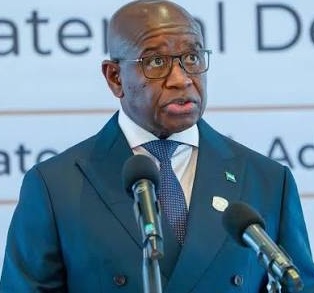
In his address to the nation on 7th August, 2026, President Julius Maada Bio assured the people of Sierra Leone that he would ensure a “peaceful transfer of power” to the opposition, All People’s Congress (APC).
The President’s assurance about the political transition is short and penetrating.
“My government remains committed to credible elections, constitutional governance and peaceful transfer of political authority,” President Bio assured Sierra Leoneans adding that his government would implement the electoral reforms arising from the Agreement for National Unity (ANU) and the recommendations of the Tripartite Committee.
The assurance comes at a time Sierra Leone’s two main political parties, the ruling Sierra Leone People’s Party (SLPP) and the opposition, All People’s Congress (APC) battles it out in parliament over the amendment of the 1991 Constitution.
The situation is also compounded by the seeming unwillingness on the part of government to implement the recommendations of the Tripartite Committee, a creature of the October, 2023 ANU between SLPP, APC and the Development Partners.
The President’s assurance of a power transfer before lawmakers has sparked discussions and debates among public, political and academic circles, leaving doubt about how the transfer of power would look like.
The people wonder if the political transition will be by the ballot or the tripartite recommendations, another subject for intense debate.
If the answer is in the latter, analysts, both social and political, argue that the transfer of power will occur only after the full implementation of the 85 tripartite recommendations with the 2023 flag-bearer, Samura Kamara peacefully and quietly taking over state governance.
The Tripartite Committee recently submitted 80 convergent recommendations bordering on electoral reforms in Sierra Leone with hope that the country’s future electoral processes will be free, fair and credible if they are implemented.
The two political parties in parliament, SLPP and APC agree on the 80 recommendations bordering on electoral reforms.
However, five divergent recommendations remain pending and also hinges mainly on establishing who wins the June 24, 2023 election. Showing who actually wins the election should be the main focus of the Tripartite Committee to ensure peace and stability in Sierra Leone.
Although key findings of the Tripartite Committee still remains a closely guarded secret, information gathered from credible APC sources show that Samura Kamara got over 57.15% of the total votes cast in the 2023 polls while the incumbent candidate, Maada Bio got a little over 37%.
The 2023 polls, by all standards, a first-round and landslide victory for Samura Kamara who is waiting to be sworn in President of Sierra Leone under the auspices of the international community (ECOWAS, AU, Commonwealth, UN EU, US, UK among others).
It is towards this direction that Samura Kamara had repeatedly called on the international community to fast-track the implementation of the tripartite recommendations especially the divergent-five.
Following the election of President Bassirou Diomaye Faye leader of ECOWAS, last month, Samura Kamara intensified his call for the restoration of democracy in Sierra Leone.
He appealed to the Senegalese President to showcase his strength in Sierra Leone by ensuring that the country returned to a democratic order.
Formed in May, in 1975, the sub-regional bloc, ECOWAS has been pivotal to the maintenance of peace, security, democracy and good governance in several West African countries, with the Gambia and Sierra Leone being shiny examples.
The world watched an attempted deployment of ECOMOG troops in the Gambia when then President Yayah Jammeh refused to hand over power to the winner of the 2016 presidential election, Adama Barrow.
Jammeh who had refused to relinquish power following his electoral defeat quietly stepped down and went into exile after his army chief, Osman Badji fled out of the Gambia.
Sierra Leone felt ECOWAS strength under General Sani Abacha when ECOMOG troops forcefully removed the AFRC (Armed Forces Revolutionary Council) in March, 1998.
The AFRC leader, Johnny Paul Koroma seized power in a coup against President Ahmed Tejan Kabba in May, 1997 and subjected the country to one-year reign of terror, killings, maiming, torture and other forms of human rights violations.
It was only ECOMOG’s intervention that offered freedom and hope to millions of Sierra Leoneans held in captivity by the brutal AFRC regime.
In a day, the AFRC military government was kicked out of power and President Kabba was installed again.
Looking back at such past glory, it is strongly hoped that ECOMOG troops would land again in Sierra Leone for the second time to restore democracy as Samura Kamara intensifies his appeals but without losing sight for the country’s peace and stability.
On the hand, if the transfer of power will be by ballot, the people of Sierra Leone as well as the international community should be preparing for the 2028 general elections as proclaimed by ECOWAS during its 69th Ordinary session in Sierra Leone in July, 2026.
ECOWAS urged the people of Sierra Leone to prepare for the 2028 general elections as shown 42nd and 43rd of its final communique. “…The restoration of serene political environment required for the impending electoral reforms ahead of the 2028 general elections…ECOWAS urges all parties to ensure inclusivity and transparency in the preparatory processes towards the next general elections,” the two paragraphs read in part.
ECOWAS’s recent call appears to be a confirmation of the 2028 general election, a move kicked against by the vast majority of Sierra Leoneans.
The people of Sierra Leone believe that the country cannot move on if the wrongs of the 2023 elections are not corrected.
A senior APC politician, Ambassador Foday Yansanneh once observed that the party would not get it right if the irregularities of the 2023 election are not corrected.
Despite the abnormalities, the ruling party, SLPP looks forward to 2028 general election with strong hope that they would remain power at all cost and against all odds.
The party in power, in connivance with some APC politicians, sources say, is exploring different avenues to have a smooth ride in the purported 2028 election.
One of the latest strategies embarked on by the ruling party is the rewriting of Sierra Leone’s constitution in the name of ‘constitutional amendment.’ SLPP politicians justify their move for an amended constitution by referring to the recommendations of the Lome Peace Accord of July, 1999 and the TRC (Truth and Reconciliation Commission) report, 2004.
SLPP’s main aim is to conduct the 2028 election and all future elections on the basis of proportional representation (district block system) and to end the 55% constitutional threshold of the general election.
The two systems represent a big advantage for the ruling party and it helps to tighten its grip on power.
By having a proportional representation system in place, the country will move away from the first past post system also known as constituency-based system, making it difficult for the people to predict who genuinely win the election. The electorate predicted a winning outcome for the APC in the 2018 election through the number of seats earned by the party in the constituency-based system.
APC, in the 2018 polls, had 69 seats while SLPP earned 39 seats, indicating that APC secured a presidential victory since it was extremely difficult for the voters to vote differently in the parliamentary and presidential elections.
The proportional representation will also shield SLPP from the pressure and criticism of the electorate over their failure to serve the people well.
Almost invariably, the ruling party also fights tooth and nail to get the 55% constitutional threshold replaced by the simple majority, a system which, opposition politicians say, will ease rigging.
SLPP, over the years, has got a notoriety for rigging elections, according to local and international election reports. The party’s erstwhile chairman, Alex Prince Harding publicly stated that “SLPP has never won an election by democratic means.” Put in other words, his party has never won an election freely and fairly.
The people of Sierra Leone, whatever the case, wait to see how the transfer of power will be by the ballot or through the tripartite recommendations.