


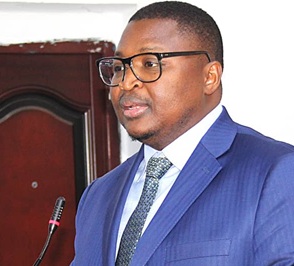
The Minister of Foreign Affairs and International Cooperation, Alhaji Musa Timothy Kabba, has underscored the central role of effective communication in diplomacy and international relations, describing it as an indispensable tool for promoting peace, stability, and cooperation among nations.
Minister Kabba made these remarks on Thursday 15th January, 2026, while delivering a public lecture at the Ministry of Foreign Affairs and International Cooperation Conference Room, at Tower Hill, Freetown.
The event attracted students and lecturers from the Faculty of Information and Communication and the Faculty of International Relations of Fourah Bay College (FBC), alongside media practitioners and international relations scholars.
“I am delighted to engage with students and professionals today because, in the world of diplomacy, communication is not cheap, but it is necessary. To be a diplomat, you must communicate,” the Minister stated.
Additionally, he encouraged graduating students from the Faculty of Information and Communication to uphold professionalism and ethical standards in their work, cautioning against untrained and irresponsible media practices that undermine public trust.
“Remain professional and do the right thing. Your work should contribute to peace, stability, and social cohesion in society,” Minister Kabba advised, urging students to distinguish themselves from what he described as irresponsible blogging.
The Foreign Minister emphasized that international relations is more relevant, noting that understanding global affairs requires rigorous academic study, research, and familiarity with international relations literature.
“Books on international relations help us make sense of what is happening in the world today,” he said.
Drawing attention to contemporary global developments, Minister Kabba highlighted emerging challenges to international law and state sovereignty. He referenced instances where sitting sovereign presidents have been forcibly removed from their countries by other states to face trial abroad.
“That is an abnormality,” he said, describing such actions as a complete breach of sovereign territorial integrity and political independence as enshrined in the United Nations Charter.
Providing historical context, the Minister explained that the United Nations was established in 1945 in the aftermath of the Second World War by countries that had suffered immense devastation, including the United States, Britain, France, Canada, and Australia.
“They came together to redefine humanity, sovereignty, independence, and how countries should relate to one another,” he said, adding that such relations are conducted through bilateral and multilateral diplomacy.
He explained that bilateral diplomacy involves engagement between two states, while multilateral diplomacy brings together several countries through international organizations based on shared values and common objectives.
“The United Nations became the first conventional multilateral organization established immediately after the Second World War,” he noted.
Furthermore, Minister Kabba highlighted Sierra Leone’s election to the United Nations Security Council in 2024 as a major milestone, describing it as a testament to the country’s journey from civil conflict to peace and democratic governance.
“Sierra Leone served a-two year tenure on the Security Council, contributing meaningfully to the promotion of international peace and security,” he said.
He disclosed that Sierra Leone assumed the presidency of the UN Security Council in August 2024, during which it chaired several high-level debates on youth and women’s participation in peace and security, preventive diplomacy, and global peace building.
The climax of Sierra Leone’s presidency, he noted, was a high-level debate chaired by President Dr. Julius Maada Bio with the theme: “Reforming the United Nations Security Council.”
Minister Kabba described the current structure of the UN Security Council as fundamentally unfair, noting that its permanent members wield veto power over resolutions.
“None of the permanent members are African countries, despite Africa having 54 member states nearly a quarter of the UN membership,” he said, describing the situation as unjust and historically flawed.
He explained that the African Union has adopted a unified stance known as “The African Position on UN Security Council Reform.”
According to him, when the Security Council was established in 1945, most African countries were still under colonial rule. “At that time, only Ethiopia and Liberia were independent,” he said, stressing that such historical injustices must now be corrected.
Minister Kabba concluded by reaffirming Sierra Leone’s commitment to multilateralism, international cooperation, and advocacy for a more inclusive and representative global governance system.
In his opening remarks a senior lecturer at the Mass Communications Department of Fourah Bay College, Dr. Isaac Massaquoi, assured students that efforts were ongoing to link them with relevant institutions and professionals ahead of graduation. He thanked the Ministry of Foreign Affairs and International Cooperation for hosting the lecture, describing it as a rare and valuable opportunity for students.
Also present were lecturers and media practitioners, including Sheku Putka Kamara, Mabinty Kamara, and practicing journalists Mr. Emmanuel Christian Thorli, the Proprietor and Managing Editor of Nightwatch Newspaper, and Mr. Alpha of Politico Newspaper. They encouraged students and pledged support in promoting young professionals entering the media and international relations fields.
In her vote of thank, Aminata Kamara, a student from International Relations at Fourah Bay College (FBC) heaped praises on the minister and also highlighted challenges facing students, including limited academic resources and institutional support. Aminata Kamara further prayed for the Minister of Foreign Affairs and International Cooperation to be a lecture at the said department.
The session concluded with an appeal for stronger collaboration between the Ministry of Foreign Affairs and International Cooperation and Fourah Bay College (FBC), especially from International Relations Department to enhance academic training and provide greater practical exposure for students pursuing careers in diplomacy and international relations.