


By Musa Paul Feika
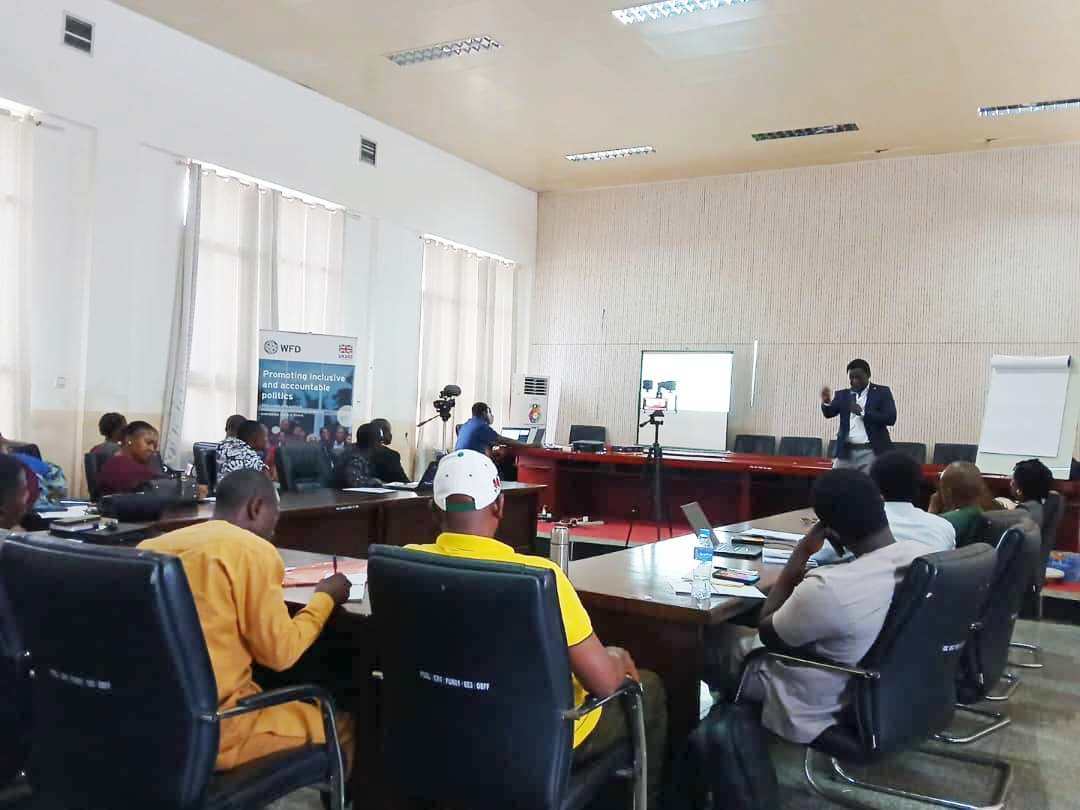
The Acting Country Representative of the Westminster Foundation for Democracy (WFD), Mr. Wurie Bah, has said the essence of the ongoing validation exercise is to ensure the availability of credible data demonstrating the impact of the Gender Equality and Women’s Empowerment Act.
The validation took place on Tuesday 3rd March, 2026, at New Administration Building in the House of Parliament.
He disclosed that since the Act was passed into law by the Parliament of Sierra Leone, notable progress has been recorded in some sections, particularly the 30 percent quota allocation at the local council level. Based on this, WFD conducted an assessment across 22 local councils, working with 16 Civil Society Organizations (CSOs) drawn from districts nationwide, many of which are affiliated with Parliament focused CSO networks.
Mr. Bah explained that the primary objective of the assessment is to determine whether the 30 percent quota has been achieved in the various councils, identify challenges faced by councils in meeting the quota, and examine the barriers and enablers to women’s empowerment at the local level.
According to him, the validation process will also raise awareness about achievements recorded under the Act. He noted that the legislation contains provisions mandating a 30 percent allocation for women in both elected and appointed positions in Parliament, Ministries, Departments and Agencies (MDAs), as well as in local councils.
“We want to make sure the Act itself has impacted women’s roles in local councils,” Mr. Bah stated.
He specifically cited Section 32 of the Act, which provides for the 30 percent allocation at the local council level. He added that WFD’s role is to generate evidence-based findings that will inform future interventions and reforms.
One of the representatives supporting WFD in the analysis, Mr. Mohamed Alpha Jalloh, assured that he is part of the team reviewing the National Gender Issues Paper and examining the implementation of the 30 percent quota from the perspective of local councils.
Speaking on the Act, Mr. Jalloh noted that while certain provisions are clear, the ongoing issue paper seeks to indicate the progress made so far and map out the extent of implementation.
He clarified that data on elective positions is available at the Electoral Commission for Sierra Leone (ECSL). However, he emphasized that the quota applies not only to elected positions but also to appointed and administrative roles, particularly among council staff.
Across the 16 districts covered, 16 CSOs collected and submitted data, which the WFD team has since compiled, cleaned and analyzed. Mr. Jalloh revealed that gaps were identified during the analysis.
He stated that, based on preliminary findings, progress toward achieving the 30 percent quota in elective positions is encouraging.
However, he cautioned that while numerical representation may appear satisfactory, substantive representation such as: women holding influential roles like committee chairpersons, remains a critical area of focus.
“There appears to be some correlation between the 30 percent quota in the Act and women occupying committee chairperson positions, but the validation process is still ongoing to confirm the extent of this,” he said, adding that the final report will provide clearer conclusions.
On administrative positions within councils, Mr. Jalloh noted that the data so far shows limited progress. Although the Act addresses administrative appointments, many of these roles remain male-dominated, even three years after the enactment of the law. He described this as a significant gap requiring further attention.
He assured that the team is in the process of finalizing a comprehensive paper that will outline key findings and recommendations.
Addressing the challenges contributing to the low percentage of women in certain council positions, Mr. Jalloh identified systemic barriers, including lack of mentorship, limited institutional support, cultural constraints, and weak women-to-women solidarity.
He pointed to traditional and secret society dynamics in some districts, including concerns raised in Moyamba District regarding exclusion linked to membership in the Bondo society. Sexual harassment and intimidation of women aspiring to leadership positions were also cited as challenges, including instances where women’s ambitions are suppressed by male dominated cliques.
He stressed that these issues are still being validated as part of the ongoing assessment.
In conclusion, Mr. Jalloh observed that while there appears to be growing synergy between women’s electoral success and their presence in influential positions, significant questions remain regarding their representation in administrative roles within local councils.