
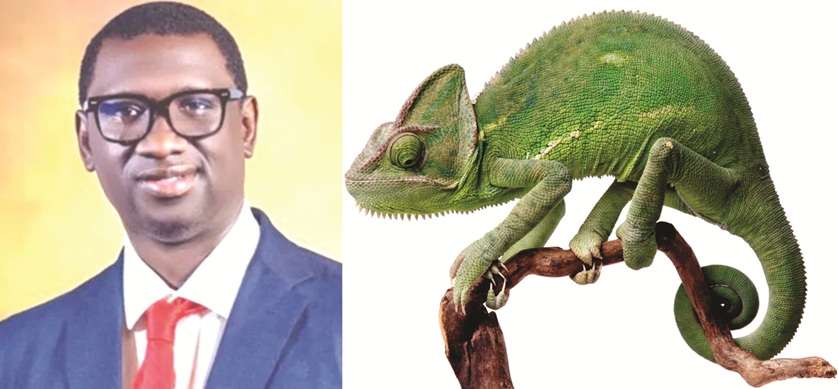
By Nightwatch Newspaper Editorial Team
The race for the All People’s Congress (APC) party’s 2026 presidential flagbearer ticket is already intensifying, and one of the aspirants under scrutiny is Dr. Ibrahim Bangura. Within APC circles, whispers and pointed accusations have emerged branding him as both a stooge of the National Reformation Movement (NRM) and a surrogate of former President Ernest Bai Koroma. These allegations carry significant political weight, given the party’s recent reforms and its struggle to define a cohesive post-2018 identity.
He is therefore perceived by many APC grassroots and elites as a “Chameleon” Candidate giving his alignment with a radical “reformist” group and at the same time being propagated as a “loyalist” as a way currying favour from the traditional support base of erstwhile President, Ernest Bai Koroma. As a politician now, Dr. Ibrahim Bangura is expected to be decisive in his alignment and to keep ambiguities around him. He must either be “a reformist” or “a loyalist” or “an independent” navigating his way to the flagbearer ticket on his own merit and his known positive contributions to the political development and sustainability of the All Peoples Congress (APC) party he now desperately wants to lead.
1: Allegations in Political Context
NRM Connection:
The NRM was born out of internal party dissatisfaction, primarily among younger and reform-minded APC members who challenged the old guard’s dominance and called for constitutional and structural reforms within the party. The movement played a pivotal role in influencing the party’s transition to a more democratic framework following the 2021 court-ordered convention reforms.
Dr. Bangura, being a relatively young and articulate technocrat, has been publicly sympathetic to the spirit of party reform and internal democracy. His alignment—whether ideological or strategic—with NRM principles has thus raised suspicions that he is the movement’s de facto candidate. However, the NRM, now weakened and fragmented, is no longer the force it once was, and the formal structure of the APC has absorbed many of its demands, blurring distinctions between “reformists” and “loyalists.”
The Ernest Bai Koroma Connection:
The more contentious allegation is that Dr. Bangura is a political surrogate of former President Ernest Bai Koroma. This accusation is contradictory on the surface: how can one be both a reformist (aligned with NRM, which challenged Koroma’s influence) and a loyalist to Koroma?
Theories suggest that Koroma might be hedging his bets—projecting influence through multiple aspirants to maintain leverage over the party’s future direction. If Dr. Bangura is indeed his proxy, it would suggest an effort by Koroma to realign with younger reformist factions to retain indirect control.
However, this narrative is not yet backed by conclusive evidence. Dr. Bangura has neither publicly confirmed nor aggressively denied links to Koroma, maintaining a posture of strategic ambiguity—possibly to retain appeal across factional lines.
- Impact on Dr. Bangura’s Electability
Strengths:
Appeal to the Youth and Reformists: His technocratic credentials and relatively fresh face makes him appealing to younger party members and those fatigued by traditional political patronage.
Bridge Candidate: If he truly has some form of blessing from Ernest Koroma, it positions him uniquely as a “bridge” candidate—capable of uniting reformists and establishment figures.
Policy Focus: His campaign discourse so far has emphasized economic revitalization and modern governance, resonating with post-2023 disillusionment among grassroots APC supporters.
Challenges:
Factional Distrust: Being perceived as a chameleon candidate—aligned with both NRM and Koroma—may breed distrust among hardliners on both sides. Delegates loyal to more ideologically defined camps may view him as opportunistic.
Name Recognition and Machinery: Compared to heavyweights such as Samura Kamara or Dr. Kaifala Marah, Dr. Richard Conteh, Chief Alhaji Sam Sumana, Dr. Bangura lacks deep party structural connections and national visibility. Winning the delegates’ vote will require more than vision; it needs a formidable ground game. APC grassroots in particular will like him and his fanfare trumpeters to be telling them those tangible things Dr. Bangura has done for the party, since its resurgence from political obscurity in 1996 moving forward. For these people, words alone are not enough to convince their traditional linkage to the party; what they see or have seen is what they will believe.
Koroma’s Polarizing Legacy: While Koroma remains influential, his polarizing role in the APC 2018 defeat and the 2021 party crisis means that any perceived allegiance may become a liability rather than an asset.
- Juxtaposition with 2026 APC Delegates Convention Dynamics:
The February 2026 convention will likely reflect three key dynamics:
Desire for Party Unity: Delegates will prioritize a candidate who can unify the party and appeal broadly to the electorate.
Battle Between Continuity and Reform: The ideological tug-of-war between establishment continuity and reformist energy will shape the choice.
Electability in 2028: Delegates will calculate who stands the best chance to defeat the SLPP in the 2028 general elections.
In this context, Dr. Bangura’s fate will hinge on how he navigates these perceptions. If he convincingly positions himself as a unifier who transcends factionalism—and if he can demonstrate political viability at the grassroots level—he could be a surprise contender. However, the ambiguity surrounding his allegiances could also cost him dearly if not clarified and controlled.
Conclusion:
Dr. Ibrahim Bangura represents both an opportunity and a paradox for the APC. The allegations of dual loyalty—to both the NRM and Ernest Bai Koroma—may seem contradictory but could also be part of a shrewd political strategy. His chances at the 2026 Delegates Convention remain uncertain but promising, if he can consolidate support without alienating key blocs. In a crowded and factionalized field as the APC Flagbearer arena, the winner may not be the most popular, but the one most capable of navigating internal contradictions with clarity and discipline. The thinking amongst ordinary APC grassroots supporters and intelligentsia in this campaign is encapsulated as thus: We believe what we see or have seen; we are no longer accepting ordinary and empty talks.