
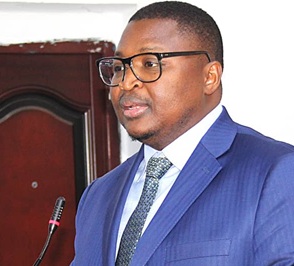
The Minister of Foreign Affairs and International Cooperation, Alhaji Musa Timothy Kabba, has warned that participants in modern-day conflicts are increasingly showing little or no respect for the Geneva Conventions, international humanitarian law, and the Rome Statute, leading to widespread human rights abuses across the globe.
Minister Kabba made these remarks on Thursday, 15th January 2026, during a public lecture held at the Ministry of Foreign Affairs and International Cooperation’s Conference Room at Tower Hill, Freetown.
The lecture was attended by students of International Relations from the University of Sierra Leone, Fourah Bay College (FBC), lecturers, and media practitioners.
Among those present were senior lecturer Dr. Isaac Massaquoi, lecturers from the Faculty of Information and Communication at FBC including Mr. Sheku Putka Kamara and Ms. Mabinty Kamara, as well as seasoned media practitioners such as the Proprietor and Managing Editor of Nightwatch Newspaper, Mr. Emmanuel Christian Thorli, and a representative from Politico Newspaper, Mr. Alpha.
Addressing the gathering, Minister Kabba said the erosion of respect for international law has contributed to instability and hardship in many countries, including Sierra Leone during periods of crisis.
He recalled that when Sierra Leone faced international isolation, the country suffered severe consequences, including the absence of bilateral cooperation, arms embargoes, shortages of essential supplies, and widespread anarchy on the streets.
“Sanctions are meant to be effective tools in diplomacy, but today many sanctions appear harmless and have little impact,” he said. “This shows that the global system is under serious strain. Things are falling apart, international law is being visibly abrogated, and participants in conflicts no longer respect the Geneva Conventions. Human rights abuses continue as though the Rome Statute does not exist.”
The Foreign Minister noted that despite these challenges, nations must adhere firmly to their foreign policies during times of crisis in order to survive and protect their national interests.
Reflecting on global developments, Minister Kabba said that at the dawn of the new millennium, the world was promised decades of prosperity, peace, and stability.
However, he lamented that the world today is witnessing more wars than ever before since the end of the Second World War.
According to him, there are currently 66 active conflicts worldwide, 11 of which are classified as “frozen conflicts” conflicts that persist for years with little hope of resolution. He cited examples including conflicts in the Democratic Republic of Congo, Sudan, Gaza, and other parts of the world.
“What is even more frightening,” he said, “is that the United Nations Security Council, which was once seen as powerful and decisive, now struggles to act decisively. In the past, the Security Council could prevent countries from intervening arbitrarily in conflicts.”
Minister Kabba emphasized that sanctions remain a preventive diplomatic tool, recalling that in earlier years the United Nations effectively used sanctions to save lives in conflict zones. He said sanctions were often imposed on states or individuals responsible for instability, violence, and conflict.
He cited Sierra Leone’s experience in 1997, when the Armed Forces Revolutionary Council (AFRC) overthrew the democratically elected government of late President Dr. Ahmed Tejan Kabba on 25th May. He noted that initial negotiations failed to persuade the AFRC to restore constitutional order, leading to the imposition of full-scale United Nations sanctions and an arms embargo endorsed by the UN Security Council.
In conclusion, the public lecture ended with an interactive question and answer session, during which students engaged the Foreign Minister on diplomacy, international law, and Sierra Leone’s role in global affairs.