
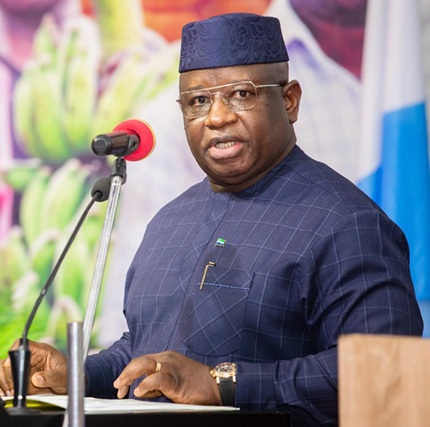
In the corridors of Sierra Leone’s political history, few presidencies have unfolded with as much promise and disappointments as that of President Julius Maada Bio. Once hailed as a reformer and visionary, Bio swept into power in 2018 on a tide of youthful energy, populist rhetoric, and a promise to deliver a “New Direction.” But as the pages of time flip rapidly toward the twilight of his final term, the reality is sinking in fast: President Bio’s last days are running through faster than he can catch — and the unfinished business of a broken nation still lies bare at his feet.
The political hourglass is emptying, and no amount of ceremony, propaganda, or distraction can stop it. The optimism of 2018 has been replaced by exhaustion, disillusionment, and growing national resentment. For many Sierra Leoneans, Bio’s presidency is no longer a source of hope, but a glaring symbol of missed opportunities, broken promises, and declining national morale.
President Bio may have imagined a legacy filled with monuments of progress, but reality paints a much darker portrait. With less than three years to go before the end of his constitutional mandate, time is no longer his friend. In fact, time is his greatest accuser — exposing not just what he has done, but what he has failed to do.
Sierra Leone today is burdened by economic collapse, food insecurity, youth unemployment, a decaying healthcare system, and dangerous levels of tribal politics. The President’s flagship projects — from Free Quality Education to Feed Salone — have not lived up to expectations. Instead of lifting Sierra Leoneans into prosperity, his government has struggled with mismanagement, bloated spending, and policy inconsistencies that have deepened public frustration.
Worse still, the administration now appears trapped in reactive governance. Every new crisis — whether economic, political, or social — is met with deflection, denial, or damage control. This is no longer a government steering the ship of state. It is a crew trying to plug holes on a sinking boat.
What was supposed to be a transformative agenda has crumbled into a political myth. The “New Direction” quickly became a rebranding of old dysfunctions, where the same ethnic favoritism, corruption, and centralized decision-making re-emerged with new slogans.
Take for instance the Free Quality Education initiative. While it was a commendable idea on paper, it was hastily implemented without fixing the structural rot in the educational system. Thousands of classrooms remain overcrowded, teachers are underpaid and undertrained, and school feeding programs are plagued by irregularities and ghost beneficiaries. Today, education is neither truly free nor genuinely of quality — just another political billboard masking educational decay.
And then the Feed Salone, the post-2023 agricultural master plan. With hunger levels rising and rice prices doubling, this initiative was launched as a messianic answer to food dependency. Yet, nearly two years later, little progress has been made. Smallholder farmers remain unsupported, mechanization is absent in most regions, and the rice import bill continues to balloon. The dream of feeding Sierra Leone from Sierra Leone is still a mirage.
President Bio’s legacy is fast slipping into one of ambition without achievement.
One of the greatest tragedies of President Bio’s leadership is how quickly he has lost touch with the people who once believed in him. His early campaign speeches were full of promises to fight corruption, improve lives, and listen to ordinary citizens. Today, those same citizens feel abandoned, spoken down to, or silenced.
Instead of building a bridge between State House and the streets, Bio has allowed a political firewall to rise — with handlers, media crafters, and “advisers” shielding him from the reality on the ground. Ministers play safe to keep their positions. Civil society groups face intimidation. Journalists tread carefully. Dissent is equated with disloyalty.
The result is a presidency increasingly cut off from the truth. Bio speaks of progress, but Sierra Leoneans speak of hardship. He praises his ministers, while the people criticize them. He inaugurates projects, while citizens queue for rice, fuel, and medical care.
Presidents are ultimately remembered not for the speeches they gave, but for the impact they left behind. And if President Bio were to leave office today, that legacy would be deeply contested. For while he has overseen some visible infrastructure projects — roads, bridges, and schools — the deeper national fabric remains torn.
Youth unemployment is rising, with thousands of graduates stuck in economic limbo.
Corruption perception remains dangerously high, despite a well-funded Anti-Corruption Commission.
Public trust in institutions — from the judiciary to the police — continues to erode.
Democracy is under strain, following the controversial 2023 elections and the repeated stifling of political opposition.
These are not the hallmarks of a thriving administration. They are the warning signs of a country in slow decline.
Time, they say, waits for no man — not even presidents. With each passing month, the Bio presidency inches closer to the finish line. Yet the weight of unfinished reforms, unfulfilled campaign promises, and unaddressed grievances grows heavier by the day.
What is worse is the growing perception that President Bio’s final years in office may be consumed more by succession battles within the SLPP than by serious policy implementation. With Chief Minister David Sengeh, First Lady Fatima Bio, and others allegedly maneuvering for 2028, national development risks being sidelined in favor of palace politics.
In this final stretch, the President has two choices: Continue on the current path — surrounded by loyalists, detached from the people, and ending his presidency in quiet disgrace;
Or radically shift gears — listen, reform, clean house, and work tirelessly to at least restore faith in leadership before time runs out.
For Sierra Leoneans, the end of the Bio era cannot come soon enough. The initial euphoria has long evaporated. What remains is a simmering frustration — a quiet but potent resolve among the people that 2028 must not be business as usual.
No amount of media spin, ceremonies, or last-minute groundbreakings will erase the truth. The people are watching, and they will remember; the students who couldn’t pay fees, those women who died giving birth in hospitals that lacked adequate and appropriate facilities; the youths who are fleeing the country in search of dignified living; and those vendors who packed up because of unbearable inflation. They will remember everything.
And they will speak — at the ballot box, in the streets, in history books.
President Julius Maada Bio once stood on a hill of hope, holding the nation’s dreams like a torch. But today, that torch flickers weakly, as the sun sets on a presidency that could have been great, but chose a different path.
The days are running fast. The legacy is crumbling. And the people are ready for something new.
This is simply because Sierra Leone deserves a leader who doesn’t just promise — but delivers. This ‘Tok-N-Do’ mantra has so far by all indications, proven to be sheer political gimmick to fool the people. The country now wants a leader who doesn’t just talks sweet and the country doesn’t want a President who runs away from his shadow. Sadly, for President Bio, time is almost out and he epitomizes a leadership that just talks sweet for the ears of vulnerable Sierra Leoneans.