


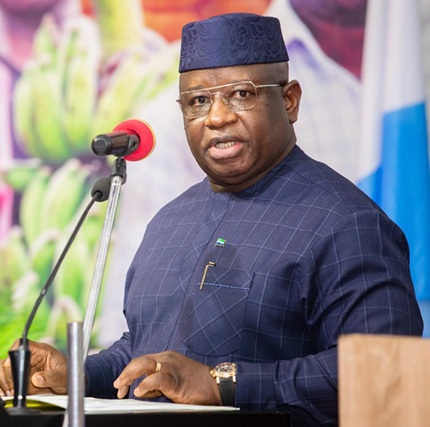
A president’s presence carries enormous symbolic and practical weight. It signals national direction. It tells the people what matters most to the head of state. In this moment of deep economic suffering, Bio’s decision to show up at a nightclub — instead of a rice farm, a community hospital, or a school reopening — speaks volumes about his priorities.
What exactly was President Bio doing at the opening of a nightclub? Couldn’t the Minister of Tourism and Cultural Affairs, or even the Ambassador for Entertainment, have represented the government? What urgent policy directive was delivered there that required the Commander-in-Chief himself? What national interest was served? The answer is simple: none.
This was not leadership. It was a PR stunt, a poorly timed attempt to align with popular culture while the country bleeds. It was a flashy photo-op that insulted the intelligence of the masses who are begging for leadership that feels their pain.
Let’s not pretend this is a normal moment in Sierra Leone. Inflation is suffocating ordinary families. The prices of essential commodities like rice, cooking oil, fuel, and transportation have skyrocketed. Hospitals are under-equipped. Schools are overcrowded. Civil servants are frustrated. Young people are drowning in idleness, turning either to drugs like kush or to crime out of desperation.
So how does a responsible president respond in such a time? By leading a national dialogue on food security? By launching emergency support for struggling communities? By holding ministers accountable for non-performance? No — President Bio chose instead to grace a luxury club launch with his presence and applause, while his people starve and suffer.
This is not only poor optics, it is a moral failure. It is the kind of leadership decision that widens the chasm between rulers and the ruled. It sends a clear message: “I see your pain, but I choose to dance. I hear your cry, but I prefer the music.”
The nightclub is a private investment — a good thing in a struggling economy. But the role of the president is not to champion nightlife while ignoring the lifeless state of public services. There are relevant ministers and ambassadors whose job it is to support such initiatives. Delegation is a hallmark of good governance.
President Bio’s refusal to delegate this event shows one of two things: either that he is desperate to maintain his visible relevance in the eyes of the youth through distraction, or his utter disregard for the optics of his office.
And let’s be honest — what policy outcome came from that speech, nothing! No reforms, no packages for the entertainment and creative industry, nothing of vision. It was just the need for a presence, a speech, and camera flashes. It was vanity dressed in presidential regalia.
Ask the market woman in Moyamba, the fisherman in Shenge, the teacher in Kono, the student in Kenema — they will tell you their lives have not improved. Ask the ghetto youth who sleeps under zinc shacks and survives on daily gambling — he is not impressed by Bio’s speech at a nightclub. He is desperate for hope, not hype. He wants food, not fireworks; the ordinary youths want jobs, not fanfares.
Bio promised “bread and butter” to the people of Sierra Leone. That promise has become a cruel joke. Now, even that bread and butter dream has been replaced with bass and beats.
The presidency must be sacred. It must be thoughtful. It must lead with wisdom and restraint, especially in difficult times. Bio’s actions show a man increasingly disconnected from his people — or worse, indifferent to their plight. The hunger is real. The disillusionment is deep. The silence of the people should not be mistaken for satisfaction — it is a silence of exhaustion.
This was not the moment for presidential presence on a dance floor. This was a moment for solidarity with the poor. If President Bio cannot feel the heat of the suffering masses, then he has no business standing as their leader.
The presidency is not a show. It is not about flashing lights and feel-good moments. It is about hard choices, timely priorities, and dignified leadership. Bio’s decision to open Chapter One nightclub personally was more than just a misstep — it was a slap in the face of a nation in pain.
He should have sent the Minister of Tourism. He should have let the entertainment ambassador handle it. He should have stayed focused on national recovery and citizen welfare.
Bio’s Shift in National Priorities: In a country where the majority of citizens wake up daily to a harsh reality of poverty, hunger, and hopelessness, one would expect a president to embody empathy, urgency, and focus on national priorities. But instead of standing at the frontlines of economic recovery and social healing, President Julius Maada Bio chose to stand at the entrance of a nightclub — Chapter One — delivering a speech with a wide smile, flashy lights behind him, and deafening music echoing over a city crying for bread and butter.
That singular moment — symbolic, disturbing, and utterly tone-deaf — captured everything wrong with the Bio presidency. It was not just the wrong place at the wrong time; it was a public betrayal of the Sierra Leonean people’s daily struggle. While nurses are striking, teachers are demotivated, youths are unemployed, mothers can’t afford baby food, and students lack books and benches, the president of the republic found time to dress up and grace a nightclub opening. Not a hospital, not a food program, not an agriculture project — a nightclub.
Let’s be clear: the opening of a modern entertainment venue is not the problem. Development in the entertainment sector can help with tourism, nightlife culture, and job creation. But what kind of presidential mindset considers the ribbon-cutting of a club more deserving of his presence and oration than addressing the pain of a nation on its knees? What kind of national leader would walk into a space of flashing lights and booming baselines while his citizens are still grappling with the cost of rice, fuel, and transportation?
President Bio came to power with promises of “bread and butter” — the euphemism he used to represent economic relief and improved livelihoods for ordinary Sierra Leoneans. That promise was the lifeline that made many voters believed in him. He promised a shift from grandstanding to grassroots service. Yet, what Sierra Leoneans have received instead is galloping inflation, debilitating youth unemployment, a broken health system, and a worsening gap between the privileged and the poor.
This latest display at Chapter One Nightclub is not just embarrassing — it’s an insult to every struggling family in Freetown, Kenema, Port Loko, and every corner of Sierra Leone. The optics alone are revolting: the Commander-in-Chief sipping speeches under neon lights while market women struggle to sell a few cups of rice under the hot sun. It reeks of privilege, delusion, and disconnection.
A president’s time and voice are national resources. They must be spent wisely, especially during hardship. A mere symbolic message — a speech at a hospital ward, a farm, or a university — could inspire hope. But Bio wasted that power on a space of excess, escapism, and elite fantasy, at a time when the majority can’t even afford transport fare to go to job interviews.
Let’s not forget: Sierra Leone has a Minister of Tourism and Cultural Affairs, an Ambassador for Entertainment, and a host of other officials whose portfolios directly fit such an event. Why weren’t they the ones front and center? Why must President Bio, with all his national obligations, serve as nightclub mascot and promotional speaker?
It reveals a dangerous trend — a presidency addicted to optics and misplaced appearances. Whether it’s dancing at state dinners while hospitals lack gloves or parading in lavish entourages during economic meltdowns, Bio has increasingly shown that he’s more comfortable in performances than policy.
There was no policy announcement at the Chapter One nightclub. No plans to improve the entertainment industry structurally. No commitments to youth employment in music, film, or nightlife. Just a speech, full of praise for private investors, wrapped in pomp, and completely detached from the daily cries of citizens.
In politics, symbolism is substance. Where a leader goes, what they say, and when they say it — all carry weight. Bio’s nightclub appearance, in this time of unprecedented hardship, is a political statement — whether he intended it or not. It says: “I hear your hunger, but I’m choosing celebration. I see your struggles, but I prefer distraction. I know you’re crying, but I want to dance.”
That is the painful message sent to every suffering Sierra Leonean. And the consequences of such tone-deaf leadership go beyond social media anger or newspaper editorials. They erode public trust; widen the disconnection between citizen and state, and fuel frustration that could boil into social unrest.
President Bio’s night at the club should be remembered not for glamour, but for its symbolic betrayal of a hungry people. It should spark national reflection: How did we get here — from bread and butter to bass and beats?
Sierra Leoneans do not hate music. They are not against entertainment. But they are desperately seeking leadership that feels their pain, listens to their cries, and respects their struggles. Bio’s priorities must be recalibrated — fast. There’s nothing wrong with supporting the arts, but doing so while ignoring the hungry and hurting is not just poor judgment — it’s political cruelty.
If there’s a Chapter Two, let it be a new page of genuine leadership, empathy, and seriousness. The people are watching. And they are tired of being made fools of while their president dances under disco lights.