
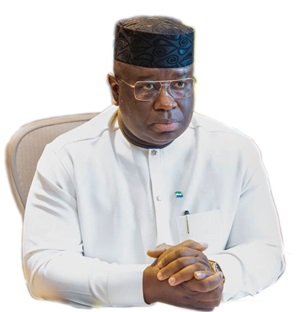
The Founder and flagbearer of the Unity Party Feima Claudius Cole in a radio interview said the Sierra Leone People’s SLPP led administration by President Julius Maada Bio since he assumed power in 2018 to present absolutely lacks inclusivity describing it as an “exclusive government”.
According to Madam Cole, it has deeply extended into a wide range of government institutions which has invariably adversely affected the country at large.
Madam Cole assured that general public that she is not into politics to secure a job for herself, but rather to leave legacies which everyone Sierra Leonean will talk about.
It could be recalled that since President Bio and his team assumed power in 2018, there is ethnic and regional division in Sierra Leone.
Though there have been partial division, but to comes to the limelight in 2018 campaign and it crystal clear during elections 2023 Parliamentary and Presidential elections.
Based on the division, Sierra Leoneans are no longer voting for the right candidate that development oriented due to tribal and regional sentiment.
In addition, most of President Bio’s appointments have often been criticized as being concentrated among individuals from the South-Eastern regions, particularly Mende-speaking communities.
This has fueled perceptions of marginalization among Northern and Western Area groups.
Political Exclusivity:
Opposition parties, especially the APC, have frequently accused the government of sidelining their members from governance structures.
Certain key state institutions (like security agencies, commissions, and parastatals) are seen mostly as dominated by SLPP loyalists.
Of course the civil service and public sector appointments, the recruitment and promotions in the various Ministeries Department and Agencies MDAs and agencies are often viewed as biased toward ruling party affiliates.
This has undermined the principle of meritocracy and reduces inclusiveness in governance.
Women’s Political Participation: Rhetoric vs. Reality:
Gender Quotas Legislation: In January 2023, President Bio enacted a Gender Equality and Women’s Empowerment Bill mandating a 30% minimum quota for women in government and private sector roles, alongside 14 weeks of paid maternity leave and anti-discrimination penalties.
He also signed legislation outlawing child marriage in July 2024, imposing severe penalties for violations.
Criticism from Women’s Advocates: Despite these legal steps, activists cut across the country have argued that implementation remains superficial and falls short of real inclusion. Dr. Nemata Majeks-Walker, leader of the “50/50 Group,” stated.
Freetown Mayor Yvonne Aki-Sawyerr echoed this view, criticizing the government’s announcement-heavy approach as a “cynical exercise” to fulfill check boxes without actual progress.
Economic Hardship & Handling of Popular Unrest:
In 2022 protest crackdown and there were widespread protests erupted in August 2022 owing to soaring cost of living and inflation (~28%). Instead of accommodating broader participation in dialogue, the government imposed nationwide curfews, deployed security forces, and treated demonstrations as “terrorism” or insurrection—undermining inclusive discourse and civic engagement.
Institutional Transparency & Accountability:
Considering the suspension of the former Auditor-General, Lara Taylor-Pearce and her Deputy, Tamba Momoh; One can recall that President Bio’s administration had records of praises for an Auditor-General he and his administration made lusty references to in their Transitional report in which they referred to the former APC Government as “operating a criminal cartel” and they have performed, “egregious acts.” It was this very Lara Taylor-Pearce that President Bio abruptly suspended for “not respecting protocol” because she simply reported the use of fake receipts to cover his unexplained hotel expenses somewhere in an Asian country. That suspension and ensuing tribunal—widely seen as lacking due process—sparked alarm among civil society and lawyers; media speculated the suspension stemmed from her efforts to hold the Office of the President accountable.
Corruption, Nepotism & Governance Concerns:
Critiques of selective Anti-Corruption Measures, there were discussions in Sierra Leonean media landscape and NGOs point to selective enforcement by the Anti-Corruption Commission. It was reported that the Anti-Corruption Boss, Francis Ben Kaifala and his squadron team were busy pursuing political opponents while overlooking alleged misconduct within the current administration and its allies.
Property & Lifestyle Controversies:
Reports indicate that First Lady Fatima Jabbe-Bio continues to hold tenancy of a council flat in London—potentially in breach of social housing rules—despite owning luxury properties in Africa and residing in an opulent presidential lodge.
Additionally, reports of lavish spending on private jets and luxury assets have fed perceptions that government privilege has overshadowed inclusive public stewardship.
Agriculture & Smallholder Exclusion:
The government’s ambition to reduce rice imports by investing in infrastructure and attracting private agribusiness has drawn pushback from farmers and NGOs. Critics say the plan marginalizes the 5 million smallholder farmers who form the backbone of rural livelihoods, creating a dynamic that favors large-scale investors over inclusive rural development.
Women and Youth Representation:
Despite policy promises, women and young people remain underrepresented in leadership and decision-making positions.
Most influential offices are still dominated by older men and party card carriers, thereby limiting inclusivity and that of the division of labour.
Furthermore, dialogue and national cohesion Efforts at national dialogue have been criticized as symbolic rather than genuine.
The opposition All People’s Congress (APC) party and Civil Society Organizations (CSOs) often feel excluded from meaningful participation in shaping national policies.
Conclusively, in terms of socio-economic policies, while flagship programs like Free Quality Education are universal, access to other opportunities (scholarships, contracts, jobs) are often linked to party loyalty and party card carries. This creates perceptions of exclusion among non-supporters.