
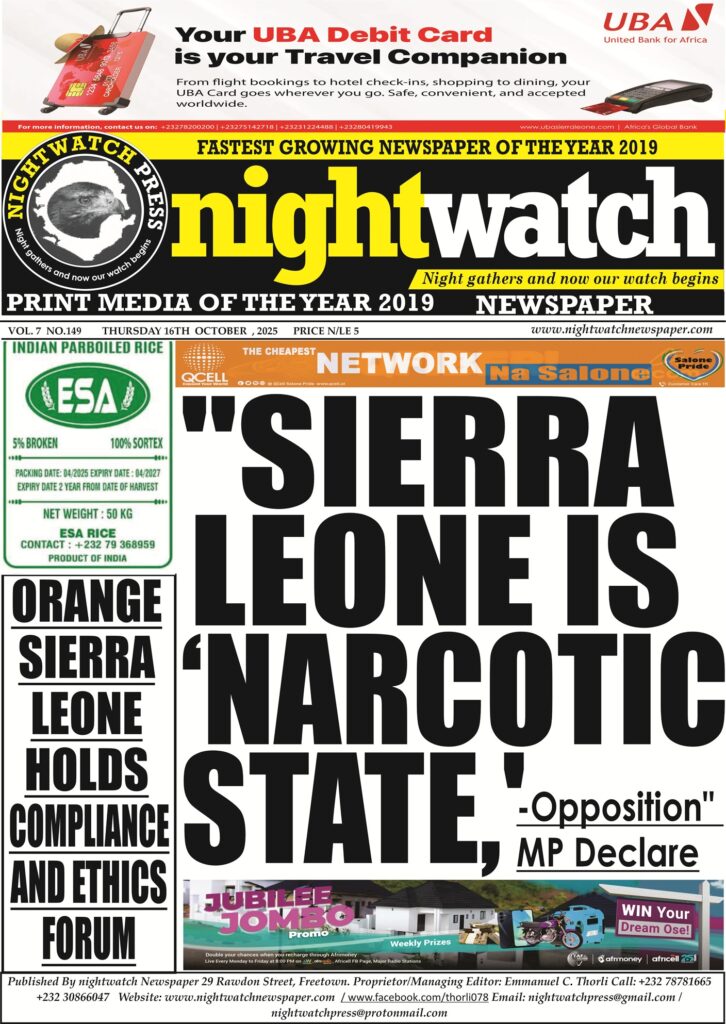
Tensions over Sierra Leone’s growing drug menace have deepened amid mounting warnings from opposition lawmakers and public commentators that the country risks sliding into what they describe as a “Narcotic State.”
The alarm comes as incidents of drug trafficking and abuse particularly involving the synthetic substance known locally as Kush continue to devastate communities nationwide, raising fears of an emerging national security and public-health emergency.
In addition, opposition lawmaker Hon. Abdul Kargbo recently accused the government of failing to tackle the escalating drug crisis, which he says is eroding public confidence and threatening social order.
Hon. Kargbo has called on the government of President Julius Maada Bio to take decisive action against international drug trafficking by facilitating the extradition of Dutch fugitive Jos Leijdekkers, popularly known as “Bolle Jos.”
Speaking during a recent online television interview, Hon. Kargbo accused the government of showing little urgency in addressing the growing menace of drug trafficking and abuse. He stressed that Sierra Leone’s credibility in the global fight against narcotics depends on how swiftly and transparently it handles the Leijdekkers case.
“If the government is serious about tackling the drug crisis, it must begin by extraditing Jos Leijdekkers, who is wanted by Dutch authorities for large-scale cocaine trafficking. We cannot allow Sierra Leone to become a safe haven for international drug criminals,” Hon. Kargbo said
Leijdekkers, a Dutch national, has been on Interpol’s most wanted list for his alleged role in coordinating multi-tonnage cocaine shipments from South America to Europe. Reports suggest that he has connections across several West African countries, heightening concerns about Sierra Leone’s potential exposure to transnational drug networks.
Kargbo’s remarks come amid growing public anxiety over the rise of Kush, a synthetic drug ravaging communities nationwide.
Civil society organizations and social commentators have similarly raised alarms about Sierra Leone’s vulnerability to becoming a “narcotic state” if urgent measures are not taken.
Analysts have argued that Sierra Leone is now a transit point for drugs destined for other nations, emphasizing that the number of Sierra Leoneans who consume cocaine is minimal, hardly reaching 10 percent. One of the analysts noted that international dealers are increasingly using Sierra Leone as a conduit to other countries.
This may have been one of the reasons former U.S. President Donald Trump reportedly refused to speak with President Bio during the United Nations General Assembly (UNGA), citing concerns that Sierra Leone was harboring convicted drug trafficker Jos Leijdekkers.
Allegations have also surfaced suggesting that Leijdekkers maintains close relationships with the current Sierra Leone People’s SLPP government and has ties with President Bio’s daughter, Admire Bio.
While the government has intensified local crackdowns and launched rehabilitation programs, critics argue that these efforts fall short without addressing the international dimension of the drug trade.
“This is about protecting our youth, our institutions, and our national image. Extraditing wanted drug lords is a clear signal that Sierra Leone stands firm against narcotics,”Kargbo said.
Echoing similar concerns, journalist and social commentator Melvin Tejan Mansaray delivered a passionate warning during a weekend broadcast on one of the online TVs.
“If the situation continues unchecked, Sierra Leone risks sliding into what I call a narcotic state a condition where drug money and criminal networks could influence politics, weaken institutions, and corrode the moral fabric of society,” Mansaray said.
He noted that the country’s vulnerability to international trafficking networks poses a grave threat to governance and democracy.
“This is not a political issue it’s a national security emergency,” he emphasized. “We need collaboration between Parliament, law enforcement agencies, and community leaders if we are to save the country’s youth and future.”
Mansaray’s comments have since gained traction on social media, where citizens continue to debate the depth of the crisis and the adequacy of the government’s response.
Responding, the Deputy Leader of Government Business in Parliament Hon. Bashiru Silikie has dismissed the “narcotic state” label as misleading and politically motivated, insisting that it has demonstrated strong resolve in addressing drug abuse and trafficking.
Hon. Bashiru Silikie, Acting Leader of Government Business in Parliament, said the administration of President Bio has “shown unprecedented commitment” through legislative reform and enforcement.
“The claim that Sierra Leone is a narcotic state is false and dangerous,” We have prosecuted smugglers, destroyed illicit drug farms, and strengthened our national drug-control framework,” Hon. Silikie stated.
He cited the Anti-Drug Law Enforcement Act (2023), which established the National Drug Law Enforcement Agency (NDLEA) and expanded the powers of police and customs officers to intercept and investigate trafficking operations nationwide.
According to Silikie, the Bio administration has implemented a Zero Tolerance Policy on drugs and enhanced cooperation with ECOWAS, INTERPOL, and other international partners.
“The fight against drugs requires all-of-society support, not politicization. The opposition should join us in educating the public and helping young people choose rehabilitation over addiction,” he warned.
Considering public outcry, despite these assurances, the street-level reality tells a different story. The drug known locally as Kush a cheap synthetic mixture often laced with unknown chemicals continues to devastate youth populations across Freetown and the provinces.
In communities such as Wellington, Goderich, and Bo, residents say addiction has reached epidemic proportions.
“Every day, you see boys lying helplessly in gutters or under bridges because of Kush. It’s heartbreaking. We need proper rehabilitation centers, not just arrests and slogans,” said community activist Mariatu Kamara.
The Ministry of Social Welfare launched a national rehabilitation initiative in May 2025 to provide counseling and treatment for addicts.
However, civil-society organizations argued that the program remains underfunded and overly concentrated in urban areas, leaving rural districts without meaningful support.
“Many families are dealing with addiction in silence,” said Dr. Francis Conteh of the Network for Community Recovery. “Without investment in mental health services and community rehabilitation, enforcement alone cannot solve this problem.”
Sierra Leone’s strategic coastal location along the West African route used by traffickers moving cocaine from South America to Europe has made the country a recurring transit point.
The U.S. Department of State’s 2024 International Narcotics Control Strategy Report acknowledged progress in enforcement but warned that limited resources and porous borders leave Sierra Leone vulnerable to traffickers.
Political analyst Abdulai Thomas cautioned that the current debate over the country’s drug image has implications beyond domestic politics.
“If Sierra Leone is perceived internationally as soft on drugs, it could harm investor confidence and strain cooperation with partners,” Thomas said. “That’s why both the government and opposition must present a unified front.”
Experts Call for Unity
Criminologist Dr. Isatu Jalloh of the University of Sierra Leone urged national unity in addressing the crisis, warning that partisan battles only deepen the problem.
“Politicizing the drug issue is dangerous,” she said. “Drugs are destroying families, fueling crime, and undermining our youth. We need bipartisan support, stronger community engagement, and real investment in prevention and rehabilitation.”
Dr. Jalloh recommended that Parliament establish a Joint Drug Crisis Committee to monitor implementation of anti-drug laws and oversee rehabilitation programs nationwide.
Across Freetown, opinions remain divided. Some citizens believe that the “narcotic state” label exaggerates the problem, while others say it may finally push authorities into faster action.
“Drugs are killing our youths, yes, but calling the whole country a narcotic state is too extreme,” said trader Ibrahim Conteh at Abacha Street.
But university student Aminata Sesay disagrees: “If our leaders don’t speak up, who will? Maybe this strong language will make the government act before it’s too late.”
As Sierra Leone confronts both internal addiction and external trafficking pressures, experts agree that solutions must combine law enforcement, social investment, and community-based rehabilitation.
Calls are growing for the creation of a National Rehabilitation Fund, the decentralization of treatment centers, and stronger border surveillance.
Whether or not Sierra Leone deserves the “narcotic state” label, one fact is clear: the nation stands at a crossroads. The choices made in the months ahead between denial and decisive action will determine whether the country overcomes its growing drug crisis or succumbs to it.