

By Janet A. Sesay
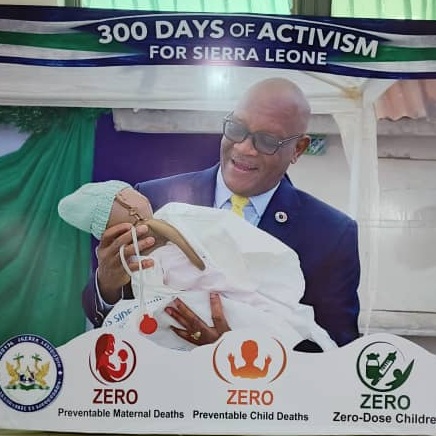
Sierra Leone has launched a bold 300-day campaign to end preventable maternal and child deaths, aligning its efforts with the global push for healthier lives under the United Nations Sustainable Development Goals (UN-SDGs).
The government has pledged to spend the next 300 days working intensely toward what it calls the Triple Zero, such as no preventable maternal deaths, no preventable child deaths, and no child is left unvaccinated or a “zero-dose”.
While the language might sound straightforward, the implications are deeply rooted in Sierra Leone’s vision for development and its commitment to global goals, especially the United Nations Sustainable Development Goal 3 (SDG 3) which is to ensure healthy lives and promote well-being for all.
The launch, which took place at the Miatta Conference Hall in Freetown, on Monday, 2nd March, 2026 was attended by top government officials, healthcare workers and community leaders, signaling a renewed sense of urgency.
The country wants to turn the tide on preventable deaths that have haunted its health statistics for decades. The country considers the battle for a zero child and maternal mortality as a battle to restore the human dignity of Sierra Leonean children and mothers as it is about national progress. Every mother who survives childbirth, every child who receives vaccination, and every family that is spared the grief of losing a loved one, is counted as a step towards Sierra Leone’s broader aspiration of becoming an inclusive, environmentally sustainable middle-income country by 2039.
The Chief Minister, Dr. David Moinina Sengeh, set the tone by linking the campaign directly to Sierra Leone’s national development blueprint.
Minister Sengeh said that the plan envisions a future where the country is not only richer but also fairer and greener. To reach that future, health outcomes must improve substantially. “We cannot get there,” he said, “if we lose mothers and children along the way.”
But according to the Chief Minister, Sierra Leone has made some progress, with maternal mortality falling by 70 percent and immunization coverage getting at 95 percent. “But,” he pointed out, “this progress is still not enough, especially when many preventable deaths still occur in our fold,” the Chief Minister stated.
The Health and Sanitation Minister, Dr. Austin Demby, echoed this sentiment. He emphasized that every mother’s life matters and that the future of every child depends on a robust health system.
According to Minister Demby, the campaign’s focus on the next 300 days is ambitious, as a way of highlighting government’s commitment. He stated that Government plans to ensure that pregnant women receive quality antenatal care; that every delivery is undertaken by a skilled health personnel, and that emergency responses are swifter. “For children, the plan involves establishing functional newborn corners, ensuring the availability of life-saving medicines and managing common illnesses like malaria and pneumonia more effectively,” the Minister assured.
Minister Demby went on to praise President Bio for his vision and foresight in improving healthcare in the country.
According to Minister Demby, one of the key strategies to reach the “zero-dose” that is reaching out to those children that have never received any vaccines is the community mapping. Officials will identify unvaccinated children by name, strengthen cold chain systems to keep vaccines effective, and mobilize community health workers to reach remote areas. This is a shift from passive reporting to active management. Systems like situation rooms and weekly tracking of maternal and child health data will allow authorities to respond quickly to setbacks, the Minister maintained.
For Sierra Leone however, this isn’t just a health ministry initiative. It’s a whole-of-government effort to include the Ministries of Education, Water and Sanitation, Information and others, with each to play vital roles.
The government recognizes that issues like early marriage, adolescent pregnancy, and sanitation are intertwined with maternal and child health. The campaign explicitly calls for cross-sector collaboration, understanding that health outcomes are shaped by education, infrastructure, and social norms.
Community voices have also been brought into focus. Pregnant women like Saccoh, who attended the launch, spoke of the tangible improvements in healthcare services. Madam Saccoh praised the healthcare system, urging fellow pregnant women to seek hospital care instead of traditional medicine, which can sometimes do more harm than good. Her story symbolizes the human aspect of this campaign—real people, real lives, real hope.
Midwives and health workers have a critical role to play. Matron Edwina Florence Conteh called the launch a “defining moment” for maternal and child health in Sierra Leone. She emphasized that the country must no longer accept preventable deaths as inevitable. Instead, it should aim for a healthcare system that is well-funded, well-staffed, and evidence-based. The government’s aim is to sustain investments and ensure strong referral pathways so that no woman or child is left behind.
The campaign’s success will depend heavily on community engagement. Leaders are urging people to register early for antenatal care, deliver in health facilities, ensure children complete immunizations, and support community health workers. Within 300 days, the government expects to see a measurable reduction in maternal and child mortality, and near elimination of zero-dose children. But the campaign’s true goal is to embed these practices into the fabric of daily life, making them a new normal.
This effort also aligns with the SDGs. Goal 3 aims to reduce maternal mortality to less than 70 per 100,000 live births and to end preventable deaths of children under five. Sierra Leone’s campaign is directly working towards these targets. The country is already close—neonatal mortality is down to 29 per 1,000 live births, and under-five mortality has dropped to 94 per 1,000. The next step is to push these numbers even lower, making the SDG targets a reality rather than just aspirational figures.
The campaign is not just about numbers. It’s about the human stories behind those numbers. It’s about mothers like Saccoh, who now feel more confident in the healthcare system and are urging others to follow suit. It’s about midwives and health workers who dedicate their lives to saving others. It’s about building a sustainable health system that can withstand shocks and serve generations.
In many ways, Sierra Leone’s 300 days of activism is a test case for how committed nations can translate global goals into local action. It’s a reminder that behind every statistic is a person, a family, a community. The country’s leaders are clear: preventable maternal and child deaths are neither inevitable nor acceptable. They are preventable, and Sierra Leone is determined to prove it.
Abu Ansumana Conteh, from the Sierra Leone Allied Health Professionals described the launch as a declaration of courageous commitment to service delivery. He promised that in the coming 300 days they will work towards zero maternal and child health in Sierra Leone. He reaffirmed commitment to the national mission to zero maternal deaths in Sierra Leone, stating that “quality healthcare save lives, competence and accountability save lives. And during these 300 days, we will detect high risks pregnancy, improve laboratory services, promote nutrition and reinforce referral systems.”
Speaking on behalf of the Sierra Leone Pediatric Association, Dr. Med Nellie Bell revealed that neonatal mortality drops to 29 out of 1000 live births whiles child under five deaths drops to 94 out of 1000 live births. She noted that the country is close to achieving the sustainable development goals which is 12 per 1000 live births for neonatal and 25 per children under five.
Dr. Bell described the declaration as a transformative effort to strengthen systems, improve healthcare. She spoke on the need for a national guideline to protect children and pregnant women and improve healthcare in the country. She stressed the need for collaboration to address the menace of malnutrition. She assured that their association stands ready to support quality healthcare, promote data use for accountability, support frontline workers to protect children, support capacity building, among other things, assuring that “we will ensure pregnancy safer, birth is protected and every child has opportunity to thrive.”
If the campaign succeeds, it could serve as a model for other countries with similar challenges. It’s a race against time, but with collective effort, clear targets, and a human-centered approach, Sierra Leone might just turn the tide. In doing so, it will also be moving closer to fulfilling its promise to its people and to the world—that no mother and no child should die needlessly, and that health is a right, not a privilege.
Speaking at the launch, the Minister of Gender and Children’s Affairs, Dr. Isata Mahoi, mentioned that there has been progress, but noted that there are challenges remain in combating maternal deaths. Minister Mahoi stressed the need for commitment is both urgent and transformative, to protect lives and secure the future. She said that maternal health is a fundamental human right, adding that “reproductive health and right is central to national development, noting that every mother saved is family strengthening.”
The Minister of Information and Civic Education, Chernor Bah recounted on the negative story in the health sector before this time, noting that the narrative has changed significantly. Minister Bah recounted on several instances in which the country’s healthcare has proven to be developing and providing quality healthcare to it citizens. “I am proud of the new story which the country is now telling,” he said.
The Chief Executive Officer (CEO) of FOCUS 1,000 Alhaji Bailor Jalloh spoke of the high impact intervention which FOCUS 1,000 and the government of Sierra Leone has made but unfortunately he said people are not making good use of these interventions. He stressed the need for collaboration to support the Ministry to ensure that communities will make good use of the services. He also calls for strong community engagement, noting that “when you involve communities you have a greater impact.”
The launch also featured a panel discussion and a question and answer session in which health professionals shared their perspectives on the country’s health sector and proffer solutions to the challenges that are facing the country’s health sector.