
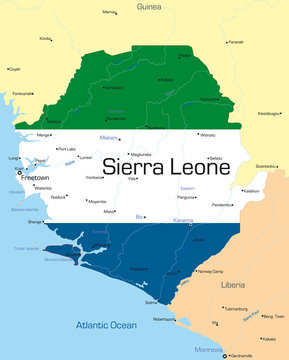
Three days from today, Sierra Leone will be 64 years old as a nation state. On 27 April 1961 the nation was granted Independence from Great Britain. Despite the initial fast progress of the pre and early post-independence years, after 64 years, Sierra Leone is a figment of its former glorious image on all indicators of economy, national, and social progress. It has just taken us two generations to drag down to the dust an experimental society that was supposed to be the hope for free black people living in the diaspora under various laws and customs that limited them from realizing their true and God-given abilities.
The Sierra Leone that we know today under Julius Maada Bio is not what the rest of the world know or remember us for. We are not known for the corruption, drug dealing and smuggling, lawlessness, hardship and suffering that are dominating our national politics.
By 1961 Sierra Leone was so progressive that the city was called “the Athens of West Africa” where anyone in colonial Africa looking for a serious training in the western education that was sweeping across the colonised world would come to study.
For a people that never used to want for anything, the people of Sierra Leone are among the poorest and most needy in the world with millions of our people going to bed hungry every day. Due to poor handling of the nation’s economy and the public purse, today Sierra Leone is the darkest country in the world with access to electricity supply eclectic at best. Despite promises to deliver a new narrative, the current government of Sierra Leone headed by Julius Maada Bio has dragged the country down in terms of healthcare delivery, lawlessness, extreme suffering and runaway hardship, endemic public corruption by a regime that promised to change our direction in terms of public theft.
From 2018 to present we have seen a rise in recreational drug abuse with the government of Sierra Leone complicit in cocaine smuggling and money laundering, something that has gone to tarnish our image in the international community.
Sierra Leone is widely considered to be one of the most politically and economically corrupt nations in the world and international rankings reflect this. Transparency International’s 2024 Corruption Perceptions Index scored Sierra Leone at 33 on a scale from 0 (“highly corrupt”) to 100 (“very clean”).
The new economic update for Sierra Leone points to worsening food insecurity against the backdrop of magnified economic vulnerabilities due to external shocks and domestic economic policy slippages. These vulnerabilities resulted in slower economic growth and soaring food inflation.
Sierra Leone’s economy from 1961 to 2025 has been characterized by significant fluctuations, including periods of growth, economic decline, and the impact of the civil war. Initially, it was strong. Then it faced challenges including corruption and the devastating civil war. Since the 1990s, there have been efforts to diversify the economy and improve governance, leading to some growth but also facing on-going challenges like fiscal deficits and reliance on mining.
1961-1980s Independence and Initial Growth:
Sierra Leone gained independence in 1961 and experienced initial economic growth, partly due to its mineral resources, particularly iron ore.
In the 1970s and 80s, economic growth slowed, and corruption became a significant issue. The first oil price shock in the 1970s had an impact on Sierra Leone’s economy, despite the country’s strong fundamentals.
The Civil War and its Aftermath (1990s):
Civil War (1991-2002):
The Revolutionary United Front (RUF) launched the civil war in 1991, leading to widespread destruction of infrastructure, displacement of people, and economic decline. During the 90s power changed hands six times resulting to unchecked recoding of how the national purse was spent.
Economic Contraction:
The civil war severely disrupted economic activity, leading to a significant contraction in 1997 and further declines in 1998 and 1999.
Post-War Recovery:
After the civil war ended in 2002, Sierra Leone began to recover, with some sectors showing signs of growth.
Recent Developments and Challenges (2000s-2020s):
Post-Civil War Growth:
In the early 2000s, the economy experienced a period of growth, with GDP growth reaching a high of 26.4% in 2002.
Economic Diversification and Governance Reforms:
Efforts have been made to diversify the economy beyond mining and improve governance.
Mining Sector Dominance:
The mining sector, particularly iron ore and diamonds, continues to be a major driver of the economy.
Fiscal Deficits and Debt:
Sierra Leone faces challenges with fiscal deficits and debt, which are partly financed through domestic short-term securities.
Inflation and Exchange Rate Management:
The Bank of Sierra Leone (BSL) plays a role in managing inflation and the foreign exchange market.
Challenges in 2024:
In 2024, economic growth slowed to 4.0%, largely due to falling global iron ore prices and slower mining production.
Future Projections:
Trading Economics projects a GDP growth rate of 4.60% for Sierra Leone by the end of 2025.
Key Trends and Challenges:
Mining Sector Dominance:
The economy is heavily reliant on the mining sector, making it vulnerable to global commodity price fluctuations. Mining is a major source of revenue for the Sierra Leonean economy, contributing to GDP, export earnings, and government revenue. Mineral exports, particularly diamonds and iron ore, account for a significant portion of the country’s total exports. The mining sector provides employment, although its capital-intensive nature means it employs a relatively small percentage of the labour force. A large portion of gold and coltan production comes from artisanal mining operations, which also provide livelihoods for many citizens. Sierra Leone is rich in various mineral resources, including diamonds, iron ore, rutile, and bauxite.
The sector has faced challenges, including declining production in some areas, and the need for better resource management to ensure long-term benefits for the country. The government has been focusing on developing the mining sector, including increasing its contribution to GDP and promoting transparency and reinvestment in local communities. While mining generates revenue, there are also concerns about the impact on local communities, including environmental degradation and social issues.
Fiscal Deficits:
Large fiscal deficits pose a challenge to sustainable economic growth and development. In 2023, Sierra Leone’s fiscal deficit, the difference between government revenue and expenditure, was 6.5% of GDP. This deficit has narrowed from 9.6% in 2022 and is projected to continue shrinking to 2.8% of GDP in 2024 and 2.4% in 2025, according to the African Development Bank. The improvement is attributed to increased tax revenue.
Debt Management:
Managing debt levels and ensuring sustainable borrowing practices is crucial for long-term economic stability. Sadly the present borrowing trend of the Bio led regime is to borrow as much money to pay the government wage bill as opposed to using such money to develop the nation.
Economic Diversification:
Diversifying the economy beyond mining is essential to reduce vulnerability to global price volatility and promote sustainable growth. The nation has economic potential in agriculture, a sector that used to play a significant role in our food sufficiency. At one point Sierra Leone was a net exporter of surplus rice. Today, the nation spends over $300 million annually to import rice. The hope of diversifying the economy away from mining can only work if the nation develops a love or relationship with the soil.
Governance Reforms:
Strengthening governance and reducing corruption are key to attracting investment and improving the business environment. Government is about continuity hence the need to quantify progress per regime. Since corruption is the bane of our governance narrative seeking out the corrupt in our government must not be about tribe, party or region. To get rid of public corruption anyone that steals publically must be sanctioned publically. There cannot be any sacred cows where the fight against corruption is concerned.