
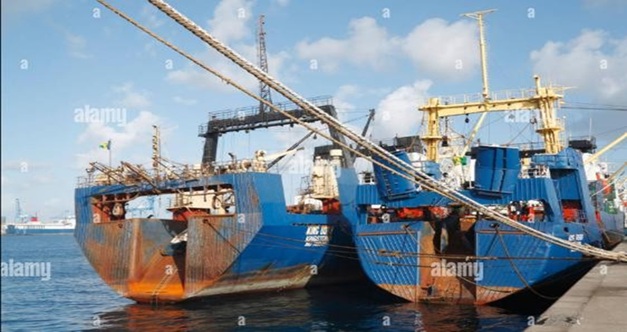
The announcement of a fisheries agreement between the Sierra Leone People’s Party (SLPP) government and Russia has sparked outrage across the country—and rightly so. Behind the glossy promises of revenue and international cooperation lies a deal that is rotten to its core. It was cooked up in secrecy, negotiated without the consent of the people, and structured in ways that put food security, livelihoods, and our marine environment at grave risk. In truth, this deal is not about national development—it is about political survival, elite enrichment, and the continuation of “resource-for-entourage politics” that has plagued Sierra Leone for decades.
At its heart, the Russia–Sierra Leone fisheries deal allows up to twenty Russian trawlers to harvest forty thousand tonnes of fish annually from our waters. On paper, it is supposed to bring in license fees and revenue of about $8–10 million per year. But when examined critically, the flaws are glaring, the dangers are overwhelming, and the supposed benefits vanish into thin air.
Secrecy and Exclusion: A Betrayal of Democratic Principles:
The first and most fundamental flaw is the way this agreement was conceived. It was negotiated in the shadows, far from public scrutiny, with no parliamentary debate, no environmental and social impact assessment, and no consultation with the people who depend on fish for survival. Sierra Leone’s Fisheries Act is clear—stakeholders, especially fishing communities and women fish processors, must be involved in decisions that directly affect their livelihoods. Yet the SLPP government brushed all of this aside, treating the country’s marine resources as if they were personal property to be bartered away.
A government that shuts its citizens out of such a critical decision is a government that fears accountability. And when secrecy becomes the norm, corruption is never far behind.
Food Security on the Chopping Block:
Fish is not a luxury in Sierra Leone—it is life. For 64–80% of Sierra Leoneans, fish is the main source of protein. Children in schools, families in villages, and the urban poor in Freetown all rely on fish as the cheapest, most accessible food. By giving away forty thousand tonnes a year to Russian industrial trawlers, the government is playing recklessly with the nation’s food supply.
The likely outcome is predictable: shortages in local markets, skyrocketing prices, and worsening malnutrition among children. For a country already battling with poverty and food insecurity, this is not just irresponsible—it is dangerous. A government sworn to protect its citizens should not be the one pushing them closer to hunger.
Elite Capture: When the People Get the Crumbs:
The SLPP’s defenders may argue that the deal brings revenue. But history teaches us otherwise. Over ninety percent of fisheries revenue in Sierra Leone has consistently gone to industrial operators and elites, with an abysmal quantity trickling down to coastal communities, artisanal fishers, or the women who process and sell fish. There is no evidence that this deal will be any different.
Instead of building infrastructure, funding schools, or equipping hospitals, the money will likely vanish into the Consolidated Fund and be swallowed up by the same patterns of waste and mismanagement we have seen before. In effect, the deal ensures that ordinary Sierra Leoneans get the crumbs while the political class feasts.
A Convenient Fund for Presidential Extravagance:
Perhaps the most insulting dimension of this deal is its timing. The projected $8–10 million revenue from the licenses is barely enough to cover the annual cost of President Bio’s extravagant foreign travel budget—estimated at around $12 million. In other words, Sierra Leoneans are being asked to sacrifice their protein supply so that the President and his entourage can continue globe-trotting in style.
This is not development. This is plunder disguised as policy. It is an insult to the suffering people of Sierra Leone who cannot afford basic food, while their leaders fly first-class around the world at their expense.
Overfishing and Environmental Destruction:
Even if food security and revenue mismanagement were not concerns, the environmental risks alone should make Sierra Leoneans reject this deal outright. Allowing twenty Russian trawlers to sweep our waters with industrial gear is a recipe for ecological disaster. There are no safeguards in place against destructive bottom trawling, no protections for endangered species like turtles, and no limits to prevent stock depletion.
The consequences will be irreversible: overfishing, collapsing fish populations, and the destruction of marine ecosystems. Worse still, the fuel emissions from these trawlers are projected to exceed the carbon output of all road traffic in Sierra Leone combined. At a time when climate change is already battering our coasts, the SLPP has chosen to accelerate environmental destruction for the sake of a few dollars.
Sierra Leone lacks the patrol boats, trained observers, and technological systems necessary to monitor foreign fleets effectively. Without such capacity, violations of our six-mile artisanal fishing zone are inevitable. Russian trawlers will encroach on local fishing grounds, destroying the livelihoods of artisanal fishing communities who already struggle against illegal fishing.
By signing this deal without first strengthening monitoring capacity, the SLPP has effectively invited lawlessness into our waters. It is an open invitation to plunder.
Neglected Local Industry and Women:
The tragedy is compounded by the fact that Sierra Leone already has its own idle National Industrial Fishing Company fleet, capable of producing twenty thousand tonnes annually. Instead of reviving this local capacity, the government has handed over the opportunity to foreigners.
Women, who process and trade eighty percent of fish in Sierra Leone—are also invisible in this deal. There are no provisions for new cold storage, processing hubs, or access to credit. Once again, the very backbone of the sector has been ignored.
A Long-Term Economic Disaster:
Ghana requires fifty-one percent local ownership in foreign fishing ventures; Sierra Leone requires nothing. By giving away access rights with no guarantee of local participation, skills transfer, or job creation, we are not building our economy—we are hollowing it out. The jobs, profits, and value-added industries will end up abroad, leaving Sierra Leoneans with depleted seas and deepening poverty. This is not investment. It is economic sabotage.
The SLPP’s Shame:
In sum, this fisheries deal is one of the clearest examples of the SLPP government’s misplaced priorities and reckless governance. Instead of protecting the food security of its citizens, safeguarding the environment, and empowering local industries, the government has chosen to mortgage our marine wealth for political convenience.
This is not leadership—it is betrayal. It is proof that the SLPP is more interested in feeding the appetites of the political elite than in feeding the people of Sierra Leone.
The People Will Remember:
Deals like this have consequences. Not just for the seas and the fish, but for the lives of millions of Sierra Leoneans who depend on them. When families cannot afford fish, when artisanal fishing communities lose their livelihoods, when women traders are pushed into bankruptcy, the anger will be real.
The SLPP should remember that elections are not far away. And Sierra Leoneans will not forget who sold their seas, who starved their children, and who chose foreign trawlers over their own people.
The Russia–Sierra Leone fisheries deal is fatally flawed. It is secretive, reckless, and unjust. It undermines food security, enriches elites, fuels presidential extravagance, and destroys our marine environment. It ignores local industries, disempowers women, and robs future generations of their rightful inheritance.