


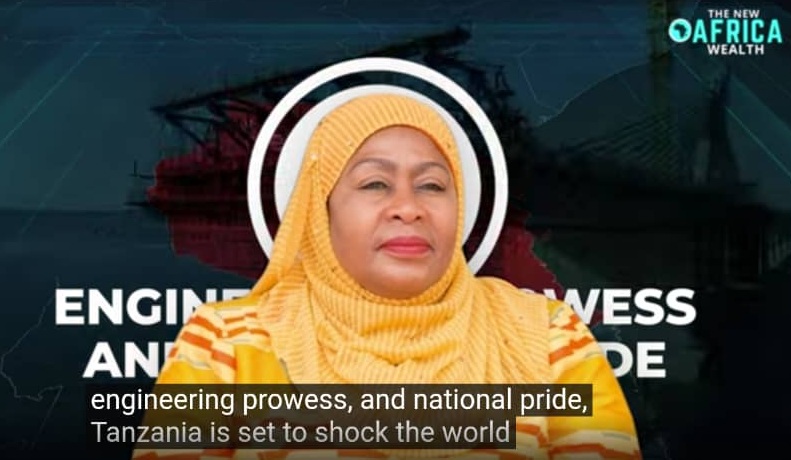
In the era of rapid infrastructural development across Africa, Tanzania has stunned the continent and the world by delivering one of the most ambitious engineering marvels in East Africa: a $300 million, state-of-the-art bridge project that now holds the record as the longest bridge in East Africa. This masterpiece is not just a testament to civil engineering and international cooperation; it is a bold statement of political will, national vision, and an unshakable commitment to progress. The bridge spans approximately 3.2 kilometers, connecting the city of Dar es Salaam to Kigamboni—a coastal area previously accessible only through ferry crossings or long detours.
As applause pours in from regional and international observers, one must ask: if Tanzania can achieve such a transformative milestone, why not Sierra Leone? Why can’t the long-promised Lungi Bridge—one of Sierra Leone’s most discussed infrastructural possibilities—become a reality? The answer lies not in impossibility, but in political will, visionary leadership, and the courage to act decisively.
The Tanzanian Triumph: Bridging Development and Destiny:
Tanzania’s bridge is more than just a physical structure—it is a symbol of national pride and unity. Completed at a cost of $300 million, this bridge now drastically shortens travel time between Dar-es-Salaam and Kigamboni from nearly an hour to mere minutes. Equipped with modern road infrastructure, pedestrian lanes, street lighting, and surveillance systems, it reflects a level of sophistication and forward-thinking rarely seen in many parts of Africa.
What makes this project especially remarkable is that it was achieved not in a distant, resource-rich Western country, but right here in Africa—by an African government that believed in its own capacity to deliver. It shows that Africa does not need to outsource its hope or bury its dreams. With the right leadership, partnerships, and fiscal discipline, transformational projects are indeed possible on the continent.
Tanzania’s success was fueled by a combination of local government resolve, foreign investment (including support from the Chinese government), and detailed long-term planning. The execution was efficient and professional, reflecting a system where institutions work and accountability is taken seriously. It is no wonder that this bridge has become a national landmark and a beacon of infrastructural advancement.
The Lungi Bridge: Sierra Leone’s Unfulfilled Promise:
Sierra Leone has for decades toyed with the idea of building a bridge to link the capital city, Freetown, with Lungi, home to the country’s only international airport. Today, travelers must still rely on ferries, water taxis, or helicopters to make this journey—a frustrating, often unsafe ordeal that casts a shadow over the nation’s image and hampers economic growth. For a capital city to remain disconnected from its main international gateway in the 21st Century is, quite frankly, a developmental embarrassment.
Multiple governments in Sierra Leone have pledged to deliver the Lungi Bridge. Feasibility studies have been conducted. Consultants have been paid. Groundbreaking ceremonies have been announced. But years later, there is still no bridge. What we have instead is a graveyard of broken promises and faded political rhetoric. The key ingredient missing is not money—because funds can be raised through bilateral partnerships, international financing, and public-private ventures. What’s missing is political will.
Why Sierra Leone Must Act Now?
The success of Tanzania’s bridge should serve as a thunderous wake-up call for Sierra Leone. It shows that such projects are not pipe dreams; they are possible, practical, and profoundly beneficial. A Lungi Bridge in Sierra Leone would revolutionize transportation, stimulate trade, enhance tourism, create jobs, and serve as a lasting legacy for any government bold enough to execute it.
Imagine shaving off hours of water travel with a 5-10 minute drive over a modern bridge. Imagine emergency medical evacuations becoming easier, tourists flowing directly into Freetown’s vibrant economy, and businesses moving goods faster and more efficiently. The spillover benefits would be monumental.
Moreover, the project would attract regional and international admiration. Just as Tanzania is now being applauded globally for its infrastructure push, Sierra Leone could position itself as a leader in West African innovation. It would restore public confidence, demonstrate serious governance, and signal that Sierra Leone is ready to play in the big league.
The Role of Leadership and Vision:
What Tanzania has taught us is that transformational development is not about political slogans or recycled campaign promises. It’s about intentional leadership—leaders who think beyond their election cycles, who prioritize the public good over partisan gain, and who are willing to make difficult decisions for long-term rewards.

Sierra Leone must find this kind of leadership; leaders who will not just commission feasibility studies, but actually implement them; leaders who understand that nation-building requires bold, visible projects that uplift generations.
It also demands institutional reform and capacity building. Transparent procurement processes, public accountability, stakeholder engagement, and consistent policy direction are non-negotiable if we are to avoid the mismanagement and inefficiencies that have plagued similar projects in the past.
Financing the Dream: It Can Be Done:
Critics may argue that Sierra Leone cannot afford such a project. But the reality is, with the right financing model, the Lungi Bridge can become a reality without destabilizing.