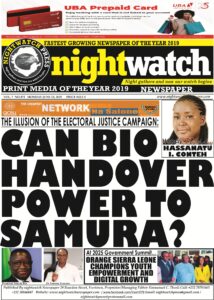
By Sayoh Kamara
Since the outcome of the 2023 presidential election, which saw President Julius Maada Bio controversially re-elected for a second term, Sierra Leone’s political landscape has been charged with claims of electoral injustice. At the heart of this storm is Dr. Samura Mathew Wilson Kamara, the defeated presidential contender from the main opposition All People’s Congress (APC) party, who has consistently called for what he describes as “electoral justice.” In essence, Dr. Kamara’s perception of electoral justice is the handing over of power to him by President Bio and the addressing of the attendant issues that culminated into the flawed results announced by the Electoral Commission of Sierra Leone (ECSL).
Dr. Kamara and his supporters are contending that the 2023 elections were deeply flawed and that justice demands President Bio hand over power to him—an idea that has significantly gained traction among APC grassroots supporters and some of its elites. But how realistic is this demand within the framework of Sierra Leone’s 1991 Constitution and attendant electoral laws?
The Act No. 6 1991 Constitution of Sierra Leone, which governs all aspects of political power and transitions, offers clear and unequivocal procedures for the assumption and transfer of presidential authority. Once the ECSL declares a candidate winner and no successful legal challenge is mounted against that result, the declared winner assumes office with full constitutional legitimacy.
President Bio’s victory, while it was, and is still contested in the court of public opinion, was never taken to the preferred court of adjudicator to for determination of its authentication and has not been overturned in any such court of law in Sierra Leone.
According to the Constitution of Sierra Leone, the Supreme Court holds exclusive authority to adjudicate disputes relating to presidential elections. This is the outlined role of the Supreme Court in a circumstance of adjudicating election disputes or petitions.
“The Supreme Court of Sierra Leone plays a crucial role in adjudicating election disputes, particularly those concerning the presidential election. It serves as the final arbiter in such cases, ensuring the integrity and legality of the electoral process.
The Supreme Court has exclusive jurisdiction to hear and determine petitions challenging the validity of presidential elections.
Petitions must be filed with the Supreme Court within seven days after the declaration of the presidential election results. Any Sierra Leonean citizen can challenge the validity of the presidential election through a petition to the Supreme Court.
The Supreme Court also has supervisory jurisdiction over all other courts and adjudicating authorities in Sierra Leone, allowing it to ensure proper conduct and enforcement of electoral laws.
The Supreme Court’s decisions in election-related cases can be declaratory, meaning they can set legal precedents and clarify the application of electoral laws.
The Supreme Court interprets the Constitution and electoral laws when resolving disputes, ensuring they are applied correctly and fairly and to provide a mechanism for resolving disputes, the Supreme Court helps to maintain public confidence in the electoral process and mitigate the risk of electoral violence.
In essence, the Supreme Court acts as the final safeguard for the integrity of Sierra Leone’s electoral system, ensuring that elections are conducted according to law and that disputes are resolved fairly and transparently.
To date, there has been no Supreme Court ruling nullifying the 2023 election and it is this inertia and a couple of other previous inactions that have consequently, positioned Julius Maada Bio as legally unassailable and therefore, the President of Sierra Leone.
Dr. Samura Kamara, the APC party nor any citizen took the 2023 election dispute to the Supreme Court. Perhaps, as suggested by this inactions, the public confidence that this court is supposed to uphold, may have dissipated in the hearts and minds of the party and all those who had that intention, on ground that whatever declaration it would make, would not have been popular with the aggrieved petitioners. Therefore, Dr. Samura and the APC decided to let go thereby giving the ECSL and President Bio a clean bill of health as far as the election results were concerned despite repudiations from international and local election observers.
On this basis and to any conscious mind therefore, the calls for President Bio to voluntarily hand over power to Dr. Samura Kamara two years on are not supported by any provision in the Constitution. The 1991 Constitution of Sierra Leone is very clear as to the situations that will warrant a transfer of power from a sitting President. But even for the purpose of vaguely agreeing with the postulations of the “electoral justice” campaign, even if President Bio wants to do so under the so many self-professed pressures from the international community, it is also quite impossible because of the want of power and its systemic dynamisms in political parties. Backed by constitutional authority, it is an acceptable practice that the first option for such transfer of power will be to the Vice President.
However, given the circumstances the electoral justice campaigners are postulating, Sierra Leone’s Constitution has in its bosom in Sections 43, Section 50-51 and 54, the scenarios under which a sitting President can be lawfully removed or replaced before the end of a term are, these include: voluntary resignation (Section 43), incapacity or death (Section 43), impeachment or misconduct (Sections 50–51) and a successful election petition resulting in an annulment (Section 54).
Unfortunately, none of these conditions currently apply. Therefore, there is no constitutional route through which Dr. Kamara can assume executive power based solely on political assertions or public pressure.
It must be noted here that while the pursuit of electoral justice is legitimate in a democratic society, it must follow legal and institutional pathways. If Dr. Kamara and his campaigners believe the 2023 elections were compromised, the judiciary which they blatantly neglected due to assertion that it is compromised and its ruling would be influenced by the power-that-be, was morally and legitimately the sole arena for redress. Political rhetoric, however compelling, does not equate to constitutional authority.
Without a court ruling that overturns the declared results of the 2023 election, President Bio cannot—legally or constitutionally—hand over power to Dr. Kamara. Any such act would not only undermine the rule of law but could be interpreted as an unconstitutional transfer of power through bi-partisan coup d’état.
Sierra Leone’s democratic stability rests on respect for the Constitution and the rule of law, even though these have over the years been egregiously impugned upon with impunity. The public has a right to demand transparency and fairness in electoral processes, but those demands must be pursued within the legal frameworks that underpin the state.
That is why talk of President Bio handing over power to Dr. Samura Kamara remains as illusionary as it is constitutionally baseless and unfounded. Dr. Samura Kamara as leader and Flagbearer of the APC party in the 2023 elections had the fullest of supports from both the national executive and the general membership. The actions and intentions of the ECSL has come under the public spotlight and there was widespread resentment and disenchantment against those actions and what it intended to do all aimed at granting Julius Maada Bio and second term tenure. The country in the most part was on tenterhooks, Dr. Kamara and the APC were aware of the infractions as they were deliberate, calculatedly planned for execution. Even when majority of the grassroots he is now toying with were agitated against those planned manipulations and results-fixing and demanded a direct and open ‘No’ to the processes, Dr. Kamara could not bulge. Instead he was insisting that the election itself was “not a-do-or die affair.” At one point in a social video message that went viral, he stated in parable: “Given the circumstance, when two elephants fight, it is the grass below that gets shredded.” This statement and the inaction of himself and the party to seek redress in the courts killed the actual fight for electoral justice in the majority of the people, mostly APC supporters.
True electoral justice could have been sought through that eminent pressure and protests, to invite independent arbitration on conditions that either the elections are differed or the rules of the game revisited to impress fair and transparent processes. That right to challenge the suspicious conduct of the ECSL and by all indications the conspiracy of related election bodies and indeed the security sector is guaranteed in the Sierra Leone Constitution.
Meanwhile, the persistent rhetoric from Dr. Samura Kamara and his supporters—that President Julius Maada Bio will “hand over” power to him in the name of electoral justice—carries broader political and national implications that can extend well beyond the 2023 election outcome and has the proclivity of impeding the chances of the APC party if not strategically handled by the party and its supporters in the quest to claw back power from the SLPP.
These implications could touch on national unity, internal party dynamics, and the party’s prospects at both its 2026 National Delegates Convention and the 2028 general elections.
Implications for National Unity: The continued insistence on an alternative electoral reality—despite constitutional finality—risks deepening political polarization. It fosters a parallel narrative that delegitimizes not just the presidency, but also the institutions that underpin the democratic process, including the judiciary and the electoral commission. This erodes trust in state institutions and weakens national cohesion.
Inflame ethno-regional tensions: In Sierra Leone’s highly ethno-regional political landscape, rhetoric of electoral injustice can inflame latent tensions. When framed as a “stolen mandate,” such messaging may resonate emotionally with regional or ethnic bases, potentially aggravating divisions and undermining peaceful coexistence. The risk is not merely political discontent, but possible social instability.
- Implications for the APC’s Internal Politics (2026 National Delegates Convention):-
Leadership Bottleneck: Dr. Samura Kamara’s continued assertion of his moral claim to the presidency beyond the 2023 elections, is a ploy to seek moral sympathy from the APC Delegates with the expectation of his re-endorsement at the 2026 Convention. This expectation, by all indications is surreptitiously suppressing internal democratic competition within the APC and discouraging contention and also brewing a battlefield for litigations against the very APC party from those contesting for the Flagbearer ticket and who may feel ostracized by a decoy inter-party system.
To this end, it is possible to lead to: stagnation of the party’s renewal, frustration among the party’s base, especially the youth wing, and a possible splintering or internal rebellion if factions feel sidelined or disenfranchised.
De-legitimization of Internal Democracy: By centering the party’s political future on a single narrative and a single personality, the APC risks reducing the 2026 convention to a symbolic exercise rather than a genuine contest of ideas and leadership. That could disillusion delegates and supporters who seek reform, transparency, and a competitive edge in 2028.
- Implications for the 2028 General Elections:-
Strategic Disadvantage: Clinging to a post-2023 grievance without advancing a forward-looking national agenda may cost the APC dearly in 2028. Voters—especially swing and first-time voters—tend to respond more to pragmatic visions than to historical grievances. An over-reliance on a “stolen election” narrative may alienate moderate voters looking for policy clarity and national reconciliation.
Opposition Fatigue: There is also the risk of fomenting opposition fatigue among the electorates. If Dr. Kamara continues to dominate the APC ticket without fresh strategic direction or broad-based appeal, voters may perceive the party as lacking innovation or adaptability—particularly in contrast to a ruling party that may present a rebranded or new candidate in 2028.
In conclusion, Dr. Samura Kamara’s persistent rhetoric around electoral injustice reflects real grievances felt by many in the APC and its support base. However, if this narrative becomes the party’s defining identity, it risks: undermining national unity, stalling internal party renewal, and weakening the APC’s competitive advantage in the 2028 elections.
Therefore, for the APC to remain viable and credible in 2028, it must use the 2026 convention not as a coronation, but as a platform for strategic renewal, policy articulation, and internal democratization. Dr. Kamara himself, as a senior statesman, may better serve both party and country by fostering a transition toward unity, generational inclusion, and institutional reform, rather than solely anchoring the party’s future on himself and on the past.
On the basis of this illusion of electoral justice campaign, there is no way President Julius Maada Bio can or will hand over power to Dr. Samura Kamara. It is not possible and it has no solid constitutional authority. It is just clay-legged with the hidden agenda by the surrogates to undermine the APC party’s chances at the polls in 2028.