


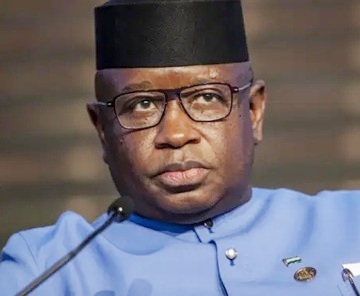
In June 2023, following his controversial re-election, President Julius Maada Bio launched what he described as a bold, visionary roadmap for national development — “The Big Five Game Changers.” They were packaged as the blueprint that will propel Sierra Leone into a future of self-reliance, innovation, and equity, the agenda promised everything from agricultural revolution to technological innovation and transformation.
Yet, two years later, as Sierra Leone continues to grapple with deepening poverty, food insecurity, youth unemployment, and political uncertainty, the question being asked across every region and sector is brutally simple: Will Bio’s Big Five Agenda survive — let alone deliver?
From the bustling chaos of Freetown to the quiet despair of rural villages, citizens are not feeling the pulse of any meaningful transformation. The slogans are loud, the fanfare is plenty, but the reality is stark: there is no tangible evidence that the Big Five are lifting lives or reshaping the foundations of the nation.
The “Big Five” agenda is built around five central pillars:
Feed Salone – A commitment to achieve food self-sufficiency and end dependency on rice imports.
Human Capital Development – Enhancing education, skills, and public health.
Youth Employment Scheme – Creating job opportunities for Sierra Leone’s growing youth population.
Revamping the Public Service Architecture – Reforming governance systems to make them efficient, accountable, and performance-driven.
Technology and Infrastructure for Economic Growth: Using digital tools and physical infrastructure to power the economy.
In theory, this is a brilliant model — a perfect blend of social uplift, economic empowerment, and institutional reform. But governance is not about theory. It is about implementation, delivery, and results. And herein lay the crisis.
Perhaps the most urgent and visible failure is Feed Salone — the flagship of the Big Five. With rice prices more than doubling since 2023 and over 80% of households reportedly food insecure, the promise of food self-sufficiency now feels like a cruel joke.
Instead of large-scale land transformation, access to machinery, or farmer cooperatives, the agricultural sector remains underdeveloped and largely manual. Inputs are scarce, rural roads are still broken, and irrigation is virtually non-existent. Worse still, many farmers claim they have never seen the government’s promised support. There is a growing sense that Feed Salone is more of a political gimmick than a practical pathway to food security.
What has been the outcome? Sierra Leone still imports over 70% of its rice — spending millions in foreign exchange while rural farmers remain poor and underutilized.
The second pillar — Human Capital Development — is anchored in continuing the Free Quality Education program and improving health services. However, despite the hype, education quality remains poor, with teacher strikes, exam malpractice, overcrowded classrooms, and under-resourced schools dominating the sector.
Yes, more students are enrolled — but are they learning anything meaningful? Are they graduating with employable skills? Most public schools across the country are in dire condition. Teachers are demotivated. And the technical and vocational education sector — a crucial component for youth empowerment — remains neglected.
Healthcare, the other half of human capital, is no better. Hospitals lack basic medicines, maternal deaths remain high, and rural clinics operate with no electricity or trained staff. If this is the revolution in human capital, the people have yet to see it.
Youth unemployment remains one of the most explosive social time bombs in Sierra Leone. With over 60% of the population under the age of 35, job creation should be a national emergency. But two years into the Big Five, there is no coordinated youth employment scheme on the ground.
Graduates are roaming the streets. Vocational trainees are idle. Many have resorted to riding okadas, gambling, or falling into the dangerous trap of drug addiction, including the deadly kush epidemic. What young people see is a government filled with aged elites, recycling themselves in high offices, while the next generation is locked out of opportunity.
There is no clear policy, no skills-to-employment pipeline, and no job growth in the private sector. This is not just failure; this is abandonment.
Bio’s fourth pillar — revamping public service — remains largely rhetorical. There has been no major civil service overhaul, no downsizing of bloated ministries, no crackdown on ghost workers, and no transparent performance-based system.
Instead, appointments are still heavily influenced by party loyalty and regional affiliation. Meritocracy is sacrificed at the altar of tribal politics. The public sector continues to bleed resources through inefficiency, corruption, and overstaffing.
For a president who promised to “discipline the state,” very little has been done to actually reform the machinery that drives governance. Sierra Leoneans continue to encounter long queues, missing documents, slow services, and bribery in nearly every government office.
The final pillar — technological and infrastructure-driven economic growth — remains ambitious but mostly superficial. There is talk of digitization, innovation, and smart governance, but no national tech policy has materialized into scalable solutions.
Internet is still unaffordable for most Sierra Leoneans. Power supply remains erratic. Road projects are either incomplete or stalled. And the national dream of building a digitally competent economy remains a distant illusion.
Even the much-celebrated Chief Minister David Sengeh, a tech enthusiast, has not translated his ideas into national scale. It all feels like isolated pilot projects, not systemic change.
At this point, the Big Five Agenda looks more like a branding campaign than a development roadmap. Two years in, and there is no evidence of impact, no progress reports, no public accountability, and no grassroots awareness.
If the agenda is to survive or deliver, it needs more than rhetoric. It needs political will, technocratic competence, grassroots involvement, and above all, transparency. But unfortunately, time is no longer on President Bio’s side. The clock is ticking. The people are growing more disillusioned. The economy is choking. And faith in government is rapidly eroding.
President Bio’s Big Five could have been a transformational agenda — a national rebirth moment. But without results, it risks becoming a house built on paper promises, washed away by the harsh winds of public discontent and policy failure.
Unless drastic reforms and honest execution take place immediately, the Big Five Agenda will not be remembered as Sierra Leone’s turning point, but as yet another missed opportunity — and a footnote in the history of broken dreams.