



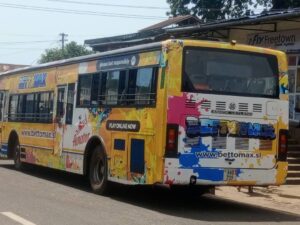
The Monkey Pox or M-Pox public health emergency is about to take an ugly turn in Sierra Leone if the newest commercial bus sensation “Waka Fine” continues to ply the city streets overloaded with passengers.
Concerned citizens and members of the public including non-citizen residents who regularly use the commercial bus service have complained to this medium that the administrators of the bus service are not setting a good example as a public service provider on the prevention of the spreading of M-Pox.
In the midst of the global M-Pox health scare, Sierra Leoneans who say they are worried about contracting the highly contagious M-Pox are pleading with the management of the Waka Fine buses to urgently and immediately decongest the buses by allowing for the maximum seating and standing capacities without overcrowding the buses.
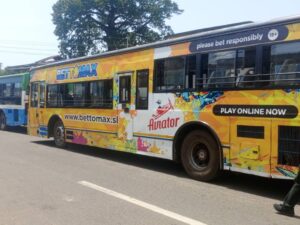
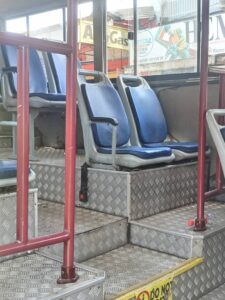
“If we have M-Pox as we are being informed we do and have some of the highest prevalence rates on the continent, then Waka Fine and other members of the public have a serious decision to make: either decongest the buses down to the 70 maximum (40 seated 30 standing) or cut down on that figure when you have to factor in social distancing protocols. We are worried that the Waka Fine buses are more congested that the private commercial vehicles. This is not time to consider making a profit where people’s health and their lives are under peril from a global pandemic. The statistics for M-Pox cases in Sierra Leone can be considered as skyrocketing even alarming considering the low level or scale of sensitisation,” a concerned non-citizen resident complained at the bus station at Wallace Johnson Street in Freetown.
According to the Africa Centre for Disease Control (Africa CDC), Sierra Leone is the latest addition to the Incident Management Support Team (IMST) list of the most MPOX-hit nations. Skyrocketing cases are triggering concern across Africa. The country recorded its first case on 10 January, 2025. Immediately after, Minister of Health Dr Austin Demby declared a Public Health Emergency, saying at the time the move was necessary to prevent the virus from further spreading.
Sierra Leone reported a rising number of confirmed M-Pox cases, with over 200 new confirmed cases reported in April, highlighting the increased transmission in the country. In early May, it had half of Africa’s confirmed cases, with its outbreak expanding over the past six weeks and cases rising 71 per cent last week compared to the week before. The country was averaging about 100 new cases a day, he said.
Speaking during a recent online weekly media briefing, Dr Ngashi Ngongo, who leads Africa CDC’s M-Pox Incident Management Support Team (IMST), said, “Of great concern is that in just one week the number of notified cases has increased by 71 per cent, and the number of confirmed cases has increased by 61 per cent. That is to say that it is really an epidemic that is on the upward trend. We are still concerned about the exponential growth in Sierra Leone.”
With such alarming statistics in a country that is not unfamiliar with epidemics and pandemics it is worrisome that a public bus service is presently being seen as a possible incubator for M-Pox.
“For a people that are familiar with epidemic or pandemic prevention strategies members of the public not limited to Waka Fine and other bus services public service providers should know that no measure aimed at preventing the further spread of M-Pox would be too difficult for the people to adapt to. This is why we are concerned that the administrators of the Waka Fine buses including members of the nation’s epidemic control team to start instituting measures aimed at decongesting the buses to save lives. This is not time for them to consider profit motive over saving lives,” a Sierra Leonean passenger stated at the central Freetown bus station.
Commenting on his fears about the overcrowding of the Waka Fine buses one of the drivers said they are scared of complaining about the situation to management for fear of losing their jobs in a country where jobs are hard to come by.
“This worries us but what can we do or say that will make management to start considering our health and safety instead of making money. We should decongest the buses to half capacity to show that we are serious about keeping our M-Pox cases down,” the driver who spoke on condition of anonymity informed nightwatch.
According to the Ministry of Health, signs and symptoms of M-Pox include rash, muscle pains and tiredness, swollen lymph nodes, and fever. At points of entry including but not limited to Waka Fine buses, other public commercial transport vehicles, offices, schools, prisons, the whole works, the ministry encourages frequent hand washing or use of alcohol-base sanitizer, social distancing, avoid touching people, and not to touch people with fever and rash.
“So how can we respect such protocols if we are packed in these Waka Fine buses like sardines? Sierra Leone’s statistics are too crazy for public service providers to ignore prevention protocols and continue overcrowding the buses,” a female member of the passengers complained.
The concerned citizens said according to statistics sixty-eight (68) per cent of patients are male, mostly 30 to 35 years old, with seven (7) per cent of the illnesses are in people who have HIV, a high-risk group seen in other African countries during the outbreak.
In April this year, IMST conducted a mission in Sierra Leone and found that the country’s health system was overstretched and overcrowded, with grossly inadequate bed capacity to accommodate more than 1,000 patients in M-pox treatment facilities. The nation’s treatment centres only had 60 M-Pox isolation beds and most of the patients were receiving home care, which makes it difficult to ensure compliance with isolation. The assessment also revealed that surveillance in Sierra Leone is mostly passive surveillance. That is why the positivity rate is far above 50 per cent. It means that the people come when they are already very advanced. They come on their own to seek care, instead of being found through active surveillance that can pick them up early and shorten the exposure of the population.
“So if people are walking around sick not knowing that they are because we cannot effective trace such contacts, what if they get in one of our Waka Fine buses?” asked one of the bus attendants.
Since the start of last year, 24 M-Pox-affected African countries have reported 129,711 cases. Of these, 29,609 were confirmed and about 1,751 related deaths were recorded.
The National Public Health Agency (NPHA) has said all 16 districts in Sierra Leone are now affected by M-Pox. Authorities have expressed concern about the escalating cases, as well as the severity of the cases, especially in people living with HIV.
Sierra Leone is one of 10 countries that have received vaccine supplies with support from partners like Gavi, UNICEF, and the Africa CDC. However, with a population of 8 million people and just over 61,000 doses of the vaccine available, those at highest risk will be prioritised, according to government officials.