


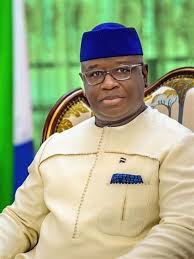
From 1992 to date, President Julius Maada Bio is considered an unsung hero that will leave indelible marks in Sierra Leone politics vis-à-vis, the Agreement for National Unity (ANU) popularly Known as the Tripartite.
The Agreement builds peace and stability at a time many people think that walls would come down amid a post-election controversy in post-war Sierra Leone.
The inverse however occurred as President Bio tightly holds the forte and his heroism transcends the bounds of his political entity, the ruling Sierra Leone People’s Party (SLPP) to the national corridors although critics may hold contrary views.
The decision to stay put until the pillars of peace are strengthened and pillars of conflict weakened is a calculated move to preserve the continued existence of the state of Sierra Leone.
Tempers were high, fists were tight and teeth firmly clenched seen as visible signs of an all-out conflict that might shock the world again as it is in the case of the civil war (1991-1992), the country’s dark days.
The undercurrents of the war of the 90s loudly reverberated in the 1970s and 80s as combustibles were well set waiting for the slightest spark to burst into conflict. Alas, there was no visionary leadership to prevent Sierra Leone from the slide into the war.
Suffice it to state that those undercurrents and combustibles constitute elements of disorder in the evolution of the State of Sierra Leone resulting into a war that was tragic in nature and devastating in consequence. Over 50, 000 people were hacked to death, hundreds amputated, millions displaced, women and girls raped and social infrastructure vandalised among other evils.
But, in June, 2023, there is a vision and foresight that has kept the country safe from such horror with President Bio being the man on the driving seat.
His contribution to peace, security and stability to the country in the face of the lingering post-election controversy is encapsulated in six thematic areas in this article.
Ensuring Peace, Security and Stability Amid Post-Election Stalemate
The announcement of the results of the June, 2023 election would have pushed irate youth into an orgy of violence and thuggery across the country owing to hopes and imaginations that the incumbent, would lose the election to the main opposition, All People’s Congress (APC).
But, President Bio who was announced winner of the election with over 56% votes avoiding a run-off or second-round voting. Being in charge of state security, President Bio thought it wise to restrain his men in uniform from the use of force and allowed the voters to vent out their anger and disappointment.
Subsequently, he invited the international community through his brainchild agency, the Independent Commission for Peace and National Cohesion to broker a peace deal between his party, SLPP and the APC resulting into an 8-resolution communique of October, 2023.
The third resolution calls on parties to the ANU (SLPP, APC and Development Partners) to set up a cross-party committee to look into alleged irregularities of the June, 2023 polls. President Bio was ably represented by his Chief Minister, Dr. David Moinina Sengeh who signed the peace document on behalf of government.
Dr. Samura Kamara, on the opposition side, signed for the opposition party, APC.
The Tripartite Committee has completed its work and proffered 80 recommendations that would create a framework to right the wrongs of the past, a framework to which President Bio is fully committed although his party holds some reservations.
The SLPP Secretary-General, Umar Paran Tarawally said in a media interview, few days back, that his party, SLPP would not accept the terms of the ANU and the recommendations. Paran’s stance towards the ANU seems to a big surprise to the Sierra Leonean public, but President Bio is leads the way with humility and diplomacy.
Despite the criticisms from his party, the ANU was the main strategy President Bio employed to keep the state sane and alive although socio-economic challenges occupy a part of the public debate.
Calm, Composure And Diplomacy
President Bio’s show of calm and composure even in difficult moments is unparalleled, and with it, he navigates Sierra Leone’s rough and rugged political terrain with ease.
When opposition politicians throw spanners at him, he remains unruffled scratching his head about policies, programmes and activities that move Sierra Leone forward.
He showed such calmness while he was opposition leader of the SLPP particularly before, during and after the election of March, 2018.
When some APC political hardliners who trained in weaponry fired shots at his residence during the elections, he peacefully picked the bullet shells and complained to the international community and election observers.
He hardly takes part in tit-for-tat attacks on opposition politicians even when he came under pressure from his party members.
In his early days of state governance, President Bio was harassed by some top-notch SLPP members to discontinue most of the policies of the past government with a particular focus on the closure of the toll gates between Freetown and Masiaka town in the North.
He rebuffed such overtures except that he would stop only those that pose a big financial burden on the country’s coffers.
President Bio, on several occasions, has been harassed by his SLPP comrades to hound his political opponents through the Commissions of Inquiry.
But, he also declined to bow to such harassment convincing them that the wheels of justice must move to arrive at the truth.
He believes that effort at seeking the truth is a slow and painful process, but such pain must be accepted so that when justice is delivered, it is delivered at first instance.
President Bio manifested such notion on justice following raids on police and military armouries during the attempted coup of November, 2023 a day before the election probe would commence.
The alleged coupists including ex-president Ernest Bai Koroma were treated humanely based on the cardinal principle of presumption of innocence except that force was proportionately directed at those who pulled the trigger to topple the regime. Since he knew that a trial of the former President would threaten public peace and security, he accepted a request by ECOWAS to send him into exile alongside payment of his benefit and the protection of his property.
Apart from his calmness, President Bio is highly diplomatic and he displayed such diplomacy throughout his presidency.
In one of his famous media interviews marking his second anniversary in power during first term, President Bio was asked about whether he was friend to the former President, Ernest Bai Koroma.
His response to that question was a BIG NO saying “the former President is not my friend,” a statement that attracted several interpretations among people from different backgrounds.
But to political analysts and commentators, the statement never fell short of a diplomatic timing as it was a time ex-President Koroma was going through some struggles in the hands of APC comrades for merely handing over power to President Bio.
It was clear that matters would have worsened had President Bio responded in the affirmative.
Reduction Of Armed Cliques On The Streets
Before President Bio took up power in April, 2018, incidents of killings and robberies by armed cliques was routine in Sierra Leone’s capital, Freetown and other provincial towns.
Mount Aureol and Fourah Bay communities were badly affected by activities of thugs and clicks with many losing their lives in the process. Women and girls, the most vulnerable groups, were the hardest-hit victims.
Freetown saw a fundamental turning point in the occurrence of such crimes after President Bio took over power owing to some crime prevention strategies he adopted.
Even phone snatching and unlawful attacks by some school boys from various secondary schools in Freetown came to a sudden halt.
Critics may argue that the methods used to police the city and some parts in the provinces were extreme owing to heavy military and police presence on the streets, but others say they were the ultimate means to preserve the state.
Successful Bid For The ECOWAS leadership
At a time when many Sierra Leoneans were expecting the worst to happen in Sierra Leone, President Julius Maada Bio was made Chairman of the sub-regional bloc, ECOWAS (Economic Community Of West African States), the first Sierra Leonean President to lead the entity since its formation in 1975.
It was a quite a tactical move to rise to such international fame and prominence which also helped to improve Sierra Leone’s image abroad.
ECOWAS is an interstate body that improves trade, commerce and security in the West African sub-region, but maintenance of peace security appeared to have taken centre stage in recent times owing to incidents of serious crime and military coup d’etats.
The inter-state body achieves this objective through its military wing, ECOMOG (ECOWAS Monitoring Group) with its legacies of restoration of democracy and peace still glitters in Sierra Leone, Liberia and the Gambia among others.
Taking up such appointment also immensely contribute to Sierra Leone’s stability as he is committed to the full implementation of the 80 recommendations of the Tripartite Committee.
Deep Commitment To Democracy
President Bio’s commitment democracy in Sierra Leone is second to none and it will continue to echo through the ages.
Sierra Leoneans saw such manifestation in April, 1992 when he and other loyal soldiers kicked out the government of President Joseph Saidu Momoh through the force of arms ending APC’s one party-rule for decades.
The single and brave act marked the erection of a strong foundation stone for democracy enjoyed today by Sierra Leoneans.
A new government known as the National Provisional Ruling Council (NPRC) was installed with Captain Valentine Strasser presiding.
President Bio, a man of patience took somewhat moderate and inferior position in the new NPRC dispensation but later rose to the post of Vice Chairman when Solomon Musa, the second gentleman, fell out with his boss, Strasser.
President Bio however never hesitated to be at loggerheads with his former boss, Captain Strasser for the sake of Sierra Leone’s democracy, peace and development.
Such commitment to Sierra Leone’s peace and democracy crystallised in 1996 when Sierra Leone woke up to the leadership of a new, young and vibrant military Head of State President Bio.
He took over from Captain Strasser in a cool palace coup to expedite the multi-party democratic process provided for by the Constitution of Sierra Leone, 1991.
In his late 20s at that time, President Bio oversaw the conduct of the 1996 presidential and parliamentary elections that brought SLPP to power under President Ahmed Tejan Kabba.
In a show of unprecedented political maturity, President Bio peacefully relinquished power and left the shores of Sierra Leone for U.S. and later UK where he spent a great chunk of his time.
Little wonder that many Sierra Leoneans regard him ‘Father of Democracy’ for his effort in ushering democratic order in Sierra Leone.
Ending The War And Consolidation Of Peace And Democracy In Sierra Leone
The maintenance of peace and security is the traditional function of any viable political institution be it military or civilian.
As a military ruler, President Bio worked hard to end Sierra Leone’s civil war by getting then rebel leader, Corporal Foday Saybana Sankoh to the negotiation table and sign the Abidjan Peace Accord in 1996, the first step towards the end of the armed conflict in Sierra Leone. It was the first time and opportunity for Sierra Leoneans to catch a glimpse of the rebel leader.
Subsequently, he created the governance framework for another signing of a Peace Agreement in the Togolese capital, Lome known as the Lome Peace Accord, 1999 which finally ended the war.
The military leader, President Bio was never disappointed as his successor, President Ahmed Tejan Kabba turn to building of state institutions after the end of the war.
Such institutions as the Anti-Corruption Commission, National Revenue Authority, the Human Rights Commission, National Social Security and Insurance Trust among others were all post-war creation championed by the Kabba regime.
Of course, the National Commission for Democracy was created during the NPRC regime to which President Bio immensely contributed.
Bringing SLPP Twice To Power
Of all sons from South-East regions, President Julius Maada Bio has shown the deepest commitment to SLPP, the party of his forefathers.
Out of love for SLPP, he brought the party to power after three decades in opposition (1967-1996).
He left the country after he gave up power to his successor and returned in 2012 to take up the party again after then flag-bearer, Solomon Ekuma Berewa lost to former President, Ernest Bai Koroma.
He graciously accepted defeat and went back to the UK where he developed fresh political strategy for a second coming.
In 2018, he became President bringing SLPP twice to power to the amazement and admiration of many Sierra Leoneans.
He ruled smoothly and successfully in his first term with the Free Quality Education being his flagship project, a scheme that benefited school kids and parents.
He emerged winner of the controversial June, 2023 elections for which a probe was mounted by way of a Tripartite Committee with a three-way leadership. Resultantly, 80 recommendations have been put forward for implementation and has assured the people of Sierra Leone that he is committed to the process.
One can say anything about President Bio, but nobody can take away his strong commitment to democracy peace and stability of the state.
He demonstrated such commitment in 1996 and will also do it this time since he is aware that the art of being a good guest is knowing when to leave.
Thanks, President Bio.