


The United States is facing mounting criticism over its decision to impose sanctions against the International Criminal Court (ICC), with the European Union (EU) strongly condemning the move and warning Washington against using political and economic pressure to undermine international justice.
In a strong diplomatic rebuke delivered in Freetown on 22nd of October, 2026, the EU made it categorically clear that attacks, threats and intimidation directed at the ICC are unacceptable, insisting that no country, regardless of its military, economic or political influence, should be allowed to weaken an institution established to prosecute individuals responsible for the gravest crimes under international law.
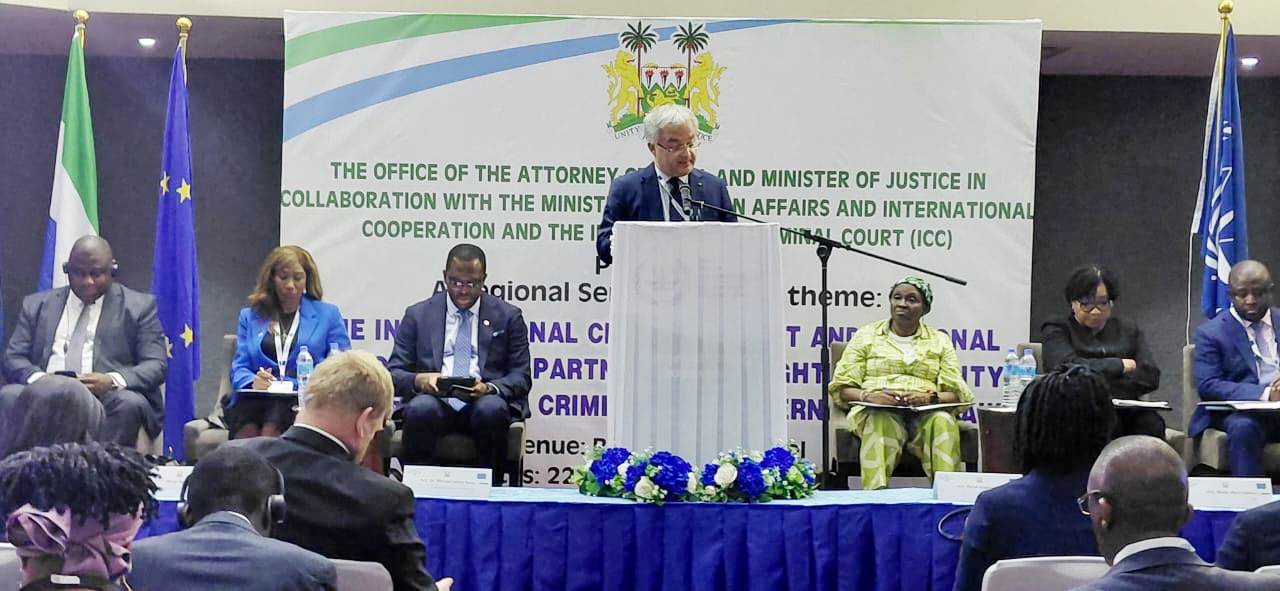
The EU’s position was delivered by Emilio Rossetti, Chargé d’Affaires head of the EU Delegation to Sierra Leone, during a seminar organised by the Government of Sierra Leone and the International Criminal Court under the theme, “Strengthening Cooperation and Complementarity with the International Criminal Court: A Partnership in Fighting Impunity for the Gravest Crimes Under International Law.”
Rossetti’s intervention amounted to a direct diplomatic challenge to Washington’s decision, as he expressed the EU’s deep regret over the announcement by the United States to impose sanctions against the Court as an institution.
While the United States may have concerns about the ICC and its activities, the EU’s position raises a fundamental question: should a powerful country be permitted to use its influence to intimidate an international judicial institution simply because it disagrees with its decisions or investigations?
For the European Union, the answer is clear: international justice must not operate under the shadow of political intimidation.
Rossetti warned that pressure against the Court threatens its independence, impartiality and ability to carry out its mandate. He stressed that the EU would continue supporting the ICC through political, diplomatic, financial and practical means to protect its operations from external interference.
The EU also condemned threats against ICC officials, elected representatives, personnel and individuals cooperating with the Court, including civil society organisations and service providers.
The message was particularly significant because the ICC was established to ensure that individuals accused of the most serious international crimes can be held accountable, irrespective of their positions, nationalities or political connections.
The principle that nobody should be above the law remains central to international criminal justice. Allowing powerful nations to undermine that principle through sanctions and intimidation risks creating a dangerous precedent in which international accountability becomes dependent on political power rather than legal responsibility.
The United States occupies an influential position in global politics, diplomacy and international security. However, that influence should not translate into the power to weaken institutions responsible for promoting accountability and justice.
The ICC represents an international commitment to confront impunity, particularly where national judicial systems are unwilling or unable genuinely to investigate and prosecute serious crimes within its jurisdiction.
Although the United States is not a State Party to the Rome Statute, the treaty establishing the ICC, that position does not remove the importance of respecting the Court’s independence or the broader international legal framework.
The EU’s intervention therefore serves as a reminder that international institutions cannot be expected to function independently if powerful countries are allowed to threaten their officials, restrict their operations or punish those who cooperate with them.
More troubling is the possibility that sanctions against the Court could affect not only its leadership but also investigators, prosecutors, legal professionals, civil society organisations and other individuals whose work supports international accountability.
If those working with the ICC become targets of political or economic punishment, the consequences could extend far beyond the institution itself.
It could discourage witnesses from cooperating, weaken investigative processes and create fear among individuals who provide information about alleged international crimes.
Interestingly, the EU delivered its strong message in Sierra Leone, a country whose painful civil war history demonstrates why international criminal justice matters.
Rossetti reminded participants that Sierra Leone took two important decisions in 2000 that helped shape modern international justice.
On 12 June 2000, former President Ahmad Tejan Kabbah wrote to the United Nations Secretary-General requesting assistance in establishing a strong and credible court capable of delivering justice and ensuring lasting peace.
Following that request, the United Nations Security Council adopted Resolution 1315 on 14 August 2000, paving the way for the establishment of the Special Court for Sierra Leone. On 15 September 2000, Sierra Leone also ratified the Rome Statute, having signed it in October 1998.
The Special Court subsequently made significant contributions to international criminal law, including its decisions on the recruitment of child soldiers, forced marriage as a crime against humanity and the question of immunity for sitting heads of state.
The prosecution of former Liberian President Charles Taylor demonstrated that holding a powerful political figure accountable for international crimes was not beyond the reach of international justice.
For Sierra Leone, therefore, the ICC debate is not merely a diplomatic disagreement between Washington and Brussels. It concerns the international principles that helped the country confront the consequences of its devastating civil war.
The EU’s defence of the Court also reinforces the importance of Sierra Leone’s continued commitment to international accountability.Despite its strong criticism, the EU has not completely closed the door to diplomatic engagement with Washington.
Rossetti urged the United States to reverse its latest measures and welcomed its readiness to discuss its concerns with States Parties to the Rome Statute.
He also acknowledged the US decision to delay the entry into force of its latest measures, describing the development as an opportunity for diplomacy aimed at securing their prompt reversal and preventing further actions that could undermine the ICC.
The EU further pledged to work closely with the Court and the 125 States Parties to the Rome Statute to preserve its independence and ensure that it continues investigating and prosecuting war crimes and crimes against humanity within its jurisdiction.
EU High Representative for Foreign Affairs and Security Policy, Kaja Kallas, also reaffirmed the bloc’s position, describing the ICC as the cornerstone of the international criminal justice system.
Her message was that protecting the Court remains an EU priority and that the organisation has options to ensure it continues its vital work.
In the end, the controversy surrounding the United States and the ICC goes beyond diplomatic disagreements. It raises serious questions about the future of international law and whether accountability can survive when powerful nations use their influence against institutions established to uphold justice.
The United States, like every other country, is entitled to express concerns about international institutions and challenge decisions through legitimate diplomatic and legal channels. However, disagreement should not become an excuse for intimidation or measures that threaten judicial independence.
An international justice system that can be weakened whenever powerful countries become uncomfortable with its activities is not truly independent.
The EU’s strong intervention in Freetown has therefore placed an important issue before the international community: international justice must be protected from political interference, regardless of where that interference originates.
For victims of war crimes, crimes against humanity and other grave violations, justice should never depend on whether the accused is politically powerful, economically influential or diplomatically connected.
If the world genuinely believes in equality before the law, then the ICC must be allowed to perform its responsibilities without intimidation.
No country should be powerful enough to stand above international justice, and no international court should be forced to surrender its independence to satisfy the political interests of a powerful government.