


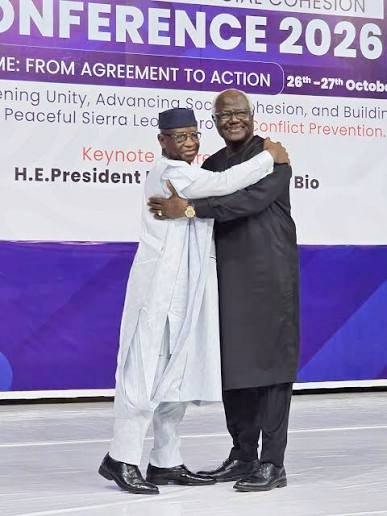
At a time when Sierra Leone is making renewed efforts to strengthen national peace, political tolerance and reconciliation, the appearance and body language of political leaders at public gatherings can attract considerable attention. At the national peace and cohesion conference organised by the Independent Commission for Peace and National Cohesion (ICPNC) at the Bintumani Conference Centre in Aberdeen, Freetown, former President Ernest Bai Koroma’s black attire and perceived body language stood in contrast to the white clothing worn by President Julius Maada Bio, former Vice President Alhaji Chief Samuel Sam Sumana and other participants.
The contrast raises a provocative question: did Koroma’s black attire and body language communicate the spirit of peace and reconciliation the conference sought to promote, or did they create a different impression?
While clothing alone cannot establish a person’s political position, the symbolism of colours and the non-verbal communication of public figures can influence how their messages are received. At a conference dedicated to peace, unity and national cohesion, the appearance and demeanour of prominent political leaders inevitably become part of the public conversation.
White is commonly associated with peace, purity, hope and reconciliation. In many settings, it represents a desire for calm, understanding and a fresh beginning. Black, on the other hand, can symbolise mourning, grief, resistance, protest or seriousness, although it is also worn for formal occasions and can represent strength and authority.
Against this background, Koroma’s decision to wear black while several other prominent figures appeared in white created a noticeable visual contrast. To some observers, the contrast may have appeared inconsistent with the conference’s central message of peace. His perceived body language may also have contributed to the impression that he was not fully reflecting the atmosphere of unity the gathering sought to create.
Nevertheless, an appearance that does not visibly communicate peace is not proof that the person wearing it opposes peace. There is no established evidence that Koroma deliberately selected black clothing to express disagreement with the conference or its objectives. Similarly, body language can be interpreted differently depending on the circumstances, and a photograph or brief public appearance cannot reliably establish a person’s intentions.
The distinction is important. While the former president’s appearance may invite questions, it would be unfair to conclude solely from his clothing and demeanour that he does not believe in peace. The more reasonable argument is that his appearance did not convey the same immediately recognisable symbolism of peace associated with the white clothing worn by several other participants.
In politics, however, symbolism matters. Leaders are not judged only by what they say but also by how their words, conduct and public appearances are perceived. When political figures attend a conference designed to promote reconciliation, their actions and demeanour can either reinforce the message or leave room for questions about their commitment.
During the conference, Koroma reportedly expressed his willingness to support President Bio in maintaining peace in Sierra Leone. Drawing on his experience as a Member of Parliament and his years as president, he reportedly emphasised the importance of peace and stability as the country approaches the 2028 general elections.
Such a message from a former head of state deserves serious consideration. Former presidents retain considerable influence within their political parties and among their supporters. Their willingness to encourage dialogue, reject violence and promote democratic competition can contribute significantly to national stability.
However, the reported suggestion that Koroma would support Bio politically in 2028 raises a separate question. Does supporting peace mean supporting a political opponent’s electoral ambitions?
The answer is no. A former president can support peace without endorsing the governing party. He can encourage dialogue, condemn political violence, respect democratic institutions and accept legitimate electoral competition while remaining committed to his own political party.
Koroma is a prominent figure associated with the All People’s Congress (APC), while Bio leads the Sierra Leone People’s Party (SLPP), the APC’s principal political rival. In a multiparty democracy, political leaders are expected to compete for power while maintaining respect for one another and the democratic process.
Therefore, Koroma’s reported commitment to peace should not automatically be interpreted as an endorsement of Bio’s re-election unless his actual words clearly establish that position. National reconciliation and electoral support are two different matters.
The real test is whether both leaders can encourage their supporters to engage in peaceful political competition, challenge one another’s policies without hostility and accept credible electoral outcomes.
Beyond clothing and body language lies a more difficult question: how can reconciliation become meaningful when political relationships have been strained by investigations, arrests and criminal proceedings?
Koroma’s relationship with the Bio administration has been complicated by various legal and political developments, including investigations connected to the Commission of Inquiry process and his arrest and prosecution following the November 2023 attempted coup.
On 3 January 2024, Koroma appeared before Magistrate Santigie I. S. Bangura at the Pademba Road Magistrate Court in Freetown, where he faced charges that included treason.related offences. The proceedings marked an extraordinary moment in Sierra Leone’s political history because of his status as a former president.
However, allegations must not be confused with proven guilt. Criminal charges are matters to be determined through due process, and the law must be applied fairly, irrespective of a person’s political position or former office.
For Koroma, these developments may complicate the process of rebuilding political trust. For Bio, the challenge is to ensure that the pursuit of accountability is conducted fairly and that legal institutions are not perceived as instruments of political persecution. For Sierra Leone, the priority must be to protect the independence of institutions while preventing political differences from becoming a source of lasting instability.
It would be speculative to claim that Koroma cannot forgive Bio or that his public statements about peace are insincere. Only Koroma can explain his personal intentions.Nevertheless, the history of tensions between the two political figures makes it reasonable to ask what practical steps will turn their public commitments into lasting reconciliation.
Forgiveness is personal, but reconciliation requires more than personal goodwill. It demands trust, accountability, mutual respect and consistent action.
The ICPNC and other institutions promoting national cohesion have an important responsibility to encourage political leaders to move beyond symbolic gestures and make concrete commitments to peaceful coexistence.
Such commitments should include rejecting political violence, discouraging inflammatory rhetoric, respecting freedom of expression, protecting democratic rights and resolving electoral disputes through lawful channels.
The SLPP and APC must also demonstrate that political competition does not have to become a struggle for personal survival. Leaders should be able to disagree strongly without treating their opponents as permanent enemies.
Koroma’s influence within the APC could be valuable in encouraging supporters to embrace peaceful political participation. Equally, Bio, as president, has a responsibility to promote an environment in which opposition figures can exercise their democratic rights without fear of arbitrary treatment.
These responsibilities are not mutually exclusive. Both leaders can defend their political interests while contributing to national peace.
As Sierra Leone approaches the 2028 elections, the country needs more than conferences, white clothing and speeches filled with promises of unity. It needs political leaders whose conduct consistently reflects the values they publicly endorse.
If Koroma’s intention was to promote peace, his subsequent actions and engagement with other political actors can help make that commitment clearer. If Bio is equally committed to national cohesion, his administration must demonstrate fairness, respect for political pluralism and confidence in the rule of law.
The same standards must apply to every political leader, regardless of party affiliation. So, do Koroma’s black attire and body language symbolise peace?
Visually, they may not have conveyed the same immediate message of peace and reconciliation associated with the white clothing worn by several other participants. To some observers, his appearance and perceived demeanour may have seemed out of step with the spirit of the gathering. But that impression should not be mistaken for conclusive evidence of opposition to peace.
The more important question is whether Koroma’s words and subsequent conduct, alongside those of Bio and other political leaders, will reinforce the message delivered at the conference.
Peace is not determined by the colour of a person’s clothing. Neither can reconciliation be measured by a single facial expression, gesture or public appearance. These may influence public perception, but the real evidence lies in how leaders behave when political interests clash, when criticism becomes uncomfortable and when disagreements threaten to undermine national stability.
Sierra Leone needs a political culture in which opponents can disagree without becoming enemies, investigations can proceed without political intimidation, and former presidents can participate in national life with dignity and respect for the law.
Eventually, Koroma’s black attire and perceived body language may raise questions about the symbolism of his appearance at a peace conference, but they cannot provide a definitive answer about his commitment to reconciliation.
The true colour of peace is not found in a leader’s wardrobe. It is revealed through conduct, fairness, tolerance and a willingness to put the interests of Sierra Leone above partisan rivalry. That is the standard against which Koroma, Bio and every other political leader should be judged.