


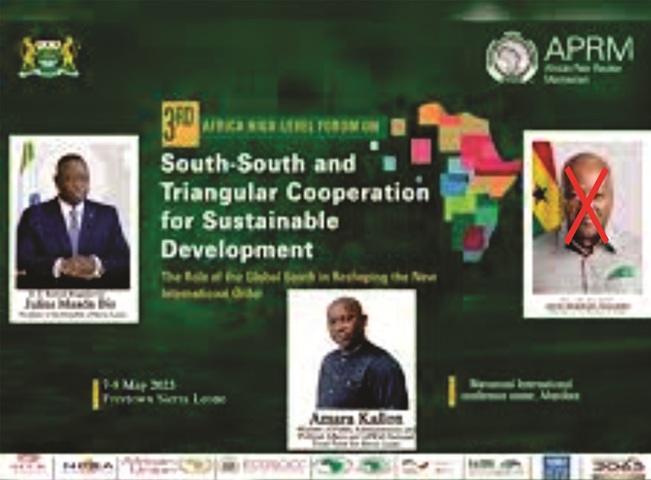
Sierra Leone will today host the Third Africa High-Level Forum on South-South and Triangular Cooperation for Sustainable Development (HLFSSTrC) on the theme: ‘The Role of the Global South in Reshaping the New International Order’ from today, 7 to 9 May, 2025 at the Freetown International Convention Centre.
The African Peer Review Mechanism as a leading peer-review body of the African Union is a unique tool in the global south context for governance promotion. In collaboration with the Islamic Development Bank (IsDB), USAID, Saudi Development Fund, GIZ and other partners, the ARM successfully conveyed The Africa High-Level Forum on South-South and Triangular Cooperation since 2021 to offer an institutional platform for promoting SSTrC in Africa.
The High-Level Forum on SSTrC brings together policy makers, Ministers and senior experts along with youth and NGOs representatives to raise awareness and understanding on the state of SSTrC in Africa. Challenges, lessons learned and comparative advantage of SSTrC in African countries and impactful initiatives are shared. It equally strives for strengthening APRM partnerships with countries from the global south.
The Forum aims to constantly assess the implementation of BAPA+40 outcome document and institutional arrangements for SSTrC in Africa. Further, it provides a consistent and inclusive platform to share good practices and experiences in strengthening African countries’ institutional capacities and national ecosystems, through a range of case studies.
Acknowledging the above, the 2023 APRM Heads of States Forum took with a lot of appreciation the APRM efforts to enhance SSTrC in Africa and noted the government of Sierra Leone’s request to host the third Africa High-Level Forum on South-South and Triangular Cooperation in Freetown, Sierra Leone from today, 7 to 9 May 2025.
According to the APRM secretariat, the ‘Third Edition of Africa High-Level Forum on SSTrC’ will be taking place in a critical period of global and continental transformation as the forum aims to address the following issues: Significance of SSTrC in promoting the second-ten-year implementation plan of Agenda 2063 within the current global and continental transformation (G20, BRICs, etc.); Assessing the current transformation of the global financial architecture and its impact of Africa’s progress including the establishment of Credit Rating agencies, blended finance and public-private partnerships; Implementation of BAPA+40 outcome document in Africa Building national-eco system for SSTrC at national levels and contribution to APRM/AU mandate in good governance promotion; Fortifying Partnerships with countries of global south to address governance challenges including food security, education, industrialisation and health; Providing a continental platform for youth and young females to share domestic initiatives on SDGs and Agenda 2063 implementation.
The African Peer Review Mechanism (APRM) is Africa’s Self-Assessment for Good Governance. This Specialised Agency of the African Union (AU) was initiated in 2002 and established in 2003 by the African Union in the framework of the implementation of the New Partnership for Africa’s Development (NEPAD).
APRM is a tool for sharing experiences, reinforcing best practices, identifying deficiencies, and assessing capacity-building needs to foster policies, standards and practices that lead to political stability, high economic growth, sustainable development and accelerated sub-regional and continental economic integration.
Member countries within the APRM undertake self-monitoring in all aspects of their governance and socio-economic development. African Union (AU) stakeholders participate in the self-assessment of all branches of government – executive, legislative and judicial – as well as the private sector, civil society and the media. The APRM Review Process gives member states a space for national dialogue on governance and socio-economic indicators and an opportunity to build consensus on the way forward.
The APR Forum of Heads of State and Government adopted the 2016-2020 Strategic Plan and the APRM Statute at the 25th Summit of the APR Forum held in Nairobi, Kenya. The 28th AU Assembly of Heads of States and Government further extended the APRM’s mandate to include tracking of the implementation and overseeing the Continent’s key governance initiatives. The AU Assembly further extended the mandate of the APRM to include monitoring of the implementation of the African Union (AU) Agenda 2063 and United Nations Sustainable Development Goals (SDGs), Agenda 2030.
In addition, the January 2018 Assembly, amongst other things, welcomed steps taken to position the APRM as an early warning tool for conflict prevention in Africa, in the context of harmony and synergy between the APRM, African Peace and Security Architecture, and the African Governance Architecture. There are four types of country reviews: Base Review – carried out immediately after a country becomes a member of the APRM; Periodic Review every four years; Requested Review – requested by the member country itself outside the framework of mandated reviews; A Review commissioned by the APR Forum when there are early signs of pending political and economic crisis.
Meanwhile, the reviews work on four thematic areas: Democracy and Political Governance (DPG); Economic Governance and Management (EGM); Corporate Governance (CG); Broad-based Sustainable Socio-economic Development (SED).
THE FIVE STAGES OF A PEER REVIEW
CONSULTATION The APR Secretariat and the Country under review consult on the process overview and terms of the Memorandum of Understanding (MoU). The Country under review creates a Focal Point to liaise with the Secretariat and provide it with relevant laws, treaty ratifications, budgets and development plans. The Secretariat prepares a background assessment document. At the same time, the Country under review independently completes the APR Self-Assessment Questionnaire, gathers inputs from civil society and drafts a paper outlining the nation’s issues and a National Programme of Action (NPoA) with clear steps and deadlines on how it plans to conform to APRM codes and standards, the African Union Charter, and UN obligations. The Country Review Team that is set up writes a report outlining issues to be focused on during the review mission.
THE REVIEW MISSION visits the Country under review and conducts broad-based consultations with government, officials, political parties, parliamentarians, and representatives of civil society organisations (e.g. media, academia, trade unions, professional bodies), and the private sector. The mission typically lasts two-and-a-half to three weeks.
DRAFT REPORT: The APR Country Review Team drafts a report on the Country under review.
THE PEER REVIEW takes place at the level of the APR Forum, using the APR Panel’s report on the team’s findings as a basis. The APR Forum discusses these recommendations with the Reviewed Country’s leadership.
FINAL REPORT Within six months, after the peer review, the published Country Review Report must be tabled in sub-regional institutions (Pan-African Parliament, African Commission on Human and Peoples’ Rights, AU Peace and Security Council, Economic, Social and Cultural Council of the African Union [ECOSOCC AU]). The report is then made publicly available.
THE SECOND GENERATION REVIEW
The objective of the APRM Second Generation Review is to assess progress made in Governance and Socio-economic Development in Member States in the period since the Base Review. The specific objectives are to: reinvigorate, rationalize and institutionalize the APRM in governance reforms within a
Member State; appraise to what extent the National Programme of Action (NPoA) is implemented and its continued relevance, on the basis of which a new NPOA with a few key actions will be proposed;
facilitate the development of a second NPOA with greater focus and based only on key actions; and make the APRM Review process more relevant to citizens’ needs, more cost-effective and in tune with the Agenda 2063 priorities and goals.
WHAT HAPPENS AFTER THE COUNTRY REVIEW?
The National Programme of Action (NPoA) is divided into short-term, medium-term and long-term goals and is continuously monitored by the National Governance Commission/Governing Council, or a smaller body of state and non-state representatives. Progress Reports on implementation are presented annually to the APR Forum. The APR Secretariat follows up on commitments made, holds regional workshops to share best practices identified in the reviews, and offers technical support to fulfil APRM plans.
It must be recalled that on Wednesday, 30 April 2025 president Julius Maada Bio officially inaugurated the National Governing Council of the African Peer Review Mechanism (APRM) at State House, reinforcing Sierra Leone’s commitment to good governance, transparency, and democratic accountability.