



By Janet A. Sesay
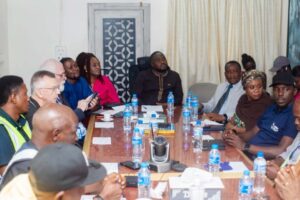
The Director General of the Sierra Leone Ports and Harbours Authority (SLPHA), Yankuba Askia Bio, has said congestion at the Port has significantly eased, urging importers with containers at the terminal to proceed with the necessary clearance procedures and collect their goods. He made the statement on Wednesday, September 23, 2026, during a press conference held at the Ports’ Conference Hall in Freetown.
Director Bio said the Ports Authority, together with other stakeholders, had adopted a collaborative approach to addressing congestion, following reports and concerns circulating on social media about conditions at the Ports.

He explained that stakeholders had held extensive engagements, signed Memoranda of Understanding (MOUs), established Inland Container Depots (ICDs), and introduced measures aimed at improving the movement of containers into and out of the Port.
According to him, Sierra Leone was among ports reportedly experiencing congestion the previous week, but the country had since been removed from the list of congested ports circulating on social media.
He cited ports in Tema, Ghana; Apapa and Onne in Nigeria; Abidjan, Côte d’Ivoire; Dakar, Senegal; Lomé, Togo; and ports in Guinea as locations currently experiencing varying levels of congestion.
Director Bio said the removal of Sierra Leone from the list demonstrated progress made through the collective efforts of stakeholders.
He urged importers whose containers are ready for clearance not to delay collection, warning that unnecessary delays could create another queue at the terminal.
“Once a person has a container, they should proceed with the necessary clearance processes and arrange to have it collected,” he said.
Bio stressed that his assessment was based not merely on social media reports or individual perceptions, but on information and developments arising from engagements among the various stakeholders operating at the Port.
“As a stakeholder myself, and also as the landlord of the Port, my responsibility is to create an enabling environment for all stakeholders to operate effectively,” he said.
Clarifies Port Authority’s Role
Director Bio also used the press conference to explain the changing role of the Sierra Leone Ports and Harbours Authority following the concessioning of the Port.
He said the Port was established by an Act of Parliament in 1964 and operated as a service port until 2010. During that period, the Authority directly performed functions that are now undertaken by private concessionaires.
According to him, the Government subsequently concessioned parts of the Port to private operators between 2010 and 2011, resulting in the involvement of two major concessionaires.
He identified Africa Global Logistics (AGL), formerly associated with Freetown Terminal Limited (FTL) and commonly referred to as Bolloré, as the concessionaire responsible primarily for containerised cargo operations.
He said the other major concessionaire, the National Single Buoy Terminal (NSBT), a British company, focuses primarily on bulk and breakbulk cargo.
Bio explained that the respective concessionaires operate within clearly defined areas and under concession agreements with the Government of Sierra Leone.
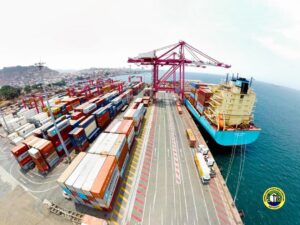
He said AGL/FTL operates across Berths 3, 4, 5, 6 and 7 and is responsible for handling containerised cargo within its concession area, alongside certain bulk and breakbulk operations.
He further said the terminal operator has equipment required for its operations, including ship-to-shore cranes, rubber-tyred gantry cranes, tugboats, flatbeds, forklifts, front loaders and other machinery.
Bio said perceptions that there is insufficient equipment at the terminal should be considered against the equipment and facilities available to the concessionaire.
He added that both concessionaires are expected to operate professionally and in compliance with Sierra Leonean laws, regulations and the terms of their respective agreements with the Government.
Cargo Handling Responsibilities
The Managing Director stressed that the Port Authority no longer performs cargo-handling functions in the same manner as it did when the Port operated as a service port.
He said those operational responsibilities have largely been transferred to the concessionaires, while the Authority continues to perform its role as the landlord and regulator within the framework governing Port operations.
He noted that each stakeholder has a defined responsibility, including the concessionaires, shipping lines, Customs, clearing agents and other agencies involved in the cargo-clearance process.
Bio said approximately 80 percent of cargo handled at the Port consists of imports, although the exact responsibilities for handling depend on the nature of the cargo and the concession under which it falls.
Director Bio also rejected claims that the Port was shut down at night and that dockworkers were instructed to leave the facility while management secretly took over terminal operations.
He said such an arrangement would not be consistent with the established structure of Port operations.
“The management cannot simply decide to shut down the Port, ask the terminal operator to leave, and then secretly take over the terminal operations. That is not how the Port operates,” he said.
Bio explained that cargo clearance is a multi-agency process involving several interconnected stakeholders, making it impossible for one institution to independently complete the entire process.
He said shipping lines, terminal operators, Customs and clearing agents each have specific functions that must be completed before a container can be released.

He also distinguished between pre-clearance procedures, which begin before a container arrives for discharge, and post-clearance procedures, which take place after the container has arrived and the relevant requirements have been fulfilled.
Customs Wish List Required for Container Release
Explaining the clearance process, Bio said a clearing agent first approaches the shipping line with the relevant Bill of Lading and obtains a Delivery Order before proceeding to the terminal and Customs to complete the required procedures.
He said Customs processes the declaration and, once the applicable duties and charges have been paid, generates a “wish list” identifying containers that are eligible for release.
“Without the Customs wish list, there is no way a container should be loaded onto a truck for release from the Port,” he said.
Bio added that the Port has several layers of documentation and controls, including Customs documents, terminal records, cargo scanning and inspection records, container-tracking systems, security records and CCTV footage.
He therefore rejected suggestions that containers could be removed from the Port secretly without leaving an operational or documentary trail.
24-Hour Operations Introduced in 2026
Director Bio disclosed that the Port only commenced 24-hour operations earlier this year following an increase in cargo volumes and activity at the terminal.
He said the move was agreed upon by stakeholders and formalized through an MOU, transitioning operations from the previous half-day arrangement to a 24-hour system.
He noted that there were no midnight operations at the terminal between 2022 and 2025, with round-the-clock operations introduced in 2026 as part of measures to respond to increased activity and reduce congestion.
Single Window System Expected by March 2027
Looking ahead, Bio announced that the Port expects to launch its Single Window system by March 2027.
He said the Authority was also working on an access-control system that would enable management to monitor movements within the Port more effectively.
He disclosed that vehicles had been procured for enhanced security patrols, while other equipment had been sent for rehabilitation and improvement.
Bio also highlighted the ongoing development of an administrative building and Port Police facilities.

“I will not leave this office without making sure that the administrative building and the Port Police facilities are addressed,” he said.
“When the next administration comes into the Port, I want them to understand that the improvements we are making today are part of the foundation we are putting in place for the future.”
Bio Clarifies His Appointment
Director Bio also addressed reports suggesting that he was serving as Director-General of the Port in 2022.
He described the claim as inaccurate, explaining that he became General Manager of the Port in 2023 and that his appointment subsequently went through the parliamentary approval process, with Parliament approving his appointment in October 2024.
He said the clarification was necessary to correct what he described as inaccurate information concerning his tenure.
Calls for Collective Responsibility
In his concluding remarks, Bio called for greater cooperation among all stakeholders involved in Port operations.
He said responsibility for the development of the Port does not rest solely with the Ports Authority, terminal operators, concessionaires, Customs or any other single institution.
According to him, every stakeholder has a role to play in ensuring that Port operations remain organised, efficient and transparent.
He encouraged members of the public and stakeholders with concerns about Port operations to seek clarification and verify information through the appropriate channels.
Bio said the Authority’s primary responsibility was to create an enabling environment in which concessionaires and terminal operators could upgrade their facilities and conduct their operations effectively. He expressed confidence that continued collaboration among stakeholders would contribute to the development and efficiency of the Port and, ultimately, Sierra Leone’s economy.
Explaining further about the Port, John Brima Scanning Manager Integrated Trade Service Sierra Leone in his statement said the Integrated Trade Services (ITS) is predominantly Sierra Leonean owned and employs 100% Sierra Leoneans.

He said ITS has a government contract to provide scanning inspection services and its mandate includes classification, valuation, and non-intrusive inspection of goods crossing Sierra Leone’s borders.
Brima further said at the seaport, locally known as Water Quay, ITS operates a mobile gantry-type scanner and the scanning process uses dual-energy X-ray technology to examine containerised import and export goods.
He said ITS compares the scanner image with importers’ and exporters’ declarations and the process involves check analysis and re-check analysis, working in collaboration with Customs which
operation is described as forming part of the requirements under the International Ship and Port Facility Security (ISPS) Code for port security.
Vandy Fullay Port Manager Logistics Solution Services wants the public to know that this company is mandated to facilitate Cargo Tracking Notes (CTN), describing the service as a mandatory pre-clearance requirement for cargo being shipped into the country.
According to him, the CTN is a mandatory loading document required for cargo originating from ports of loading and destined for the port of arrival.
He said importers, import agents and freight forwarders are expected to obtain the certificate before the arrival of the vessel or cargo. Fullay explained that applicants are required to provide supporting documents, including a commercial invoice and a copy of the Bill of Lading (BL), in order to obtain the CTN certificate.
Fullay further explained that where there is a misclassification or variation in the information declared, amendments can be made.
He said the importer or agent would have to return to the shipping line to obtain a revised Bill of Lading before applying for a revised CTN certificate.
He, however, stressed the importance of truthful declarations, warning that false declarations constitute a breach of the applicable requirements.
He gave an example of an importer declaring that a shipment contains salt when the actual cargo is flour, saying such a discrepancy would amount to false declaration and would require compliance action.
“Our job is fully based on compliance to make sure that what you declare is the right thing that actually came in,” he said.
Fullay also disclosed that Logistics Solution and Services is involved in transit operations, including the deployment of tracking devices on containers destined for neighbouring countries.
He said the company provides tracking devices for transit containers and issues transit tracking certificates through its office at the port. He added that the company has also established an operational point at the main border and is awaiting approval from the Commissioner-General to commence operations there.
Fullay said the company maintains a working relationship with various stakeholders operating at the port, including Customs and other relevant agencies.
According to him, the company’s activities are ultimately focused on cargo tracking, transparency and compliance, ensuring that the goods declared by importers correspond with the actual cargo arriving at the port.
Kpana M Conteh, Assistant Commissioner Custom Operation at the National Revenue Authority in his statement explains the meaning of
Customs, Trade and Border Management which he said trade is the impact it has on the economy and society.
He said custom is as old as trade itself but if we look at it from the Sierra Leonean context, we can relate its establishment to the first law promulgated in the country to regulate customs, which was in 1948.
He said from 1948 to date, customs have therefore been in existence for more than 75 years and it has specific mandates which is what they carry out at all points of entry.
Initially, Customs was part of the Civil Service and operated directly under the Ministry of Finance even though they are still under the Ministry of Finance they now operate within a larger institution as the National Revenue Authority (NRA), which coordinates the collection and management of various taxes, including the work of the Customs Department.
He said they have six broad mandates, which guide their operations.
He said the first and perhaps most important is the collection of government revenue, adding that the revenue they collect comes largely from imports.
He said another important mandate is trade facilitation, adding that working with the other companies are essentially part of the same system as they do supports Customs, either directly or indirectly, to ensure that the government receives its revenue and that legitimate trade is properly facilitated and coordinated and they also undertake border control.
He said in Customs terminology, when we refer to a border, we are not necessarily talking only about the physical boundary of a country, a border can be the first designated point of entry where goods are introduced into an economy and once a particular location is designated as a point where international trade will take place, all the relevant stakeholders move there and this includes terminal operators, custodians of goods, shipping and vessel service providers, and other agencies involved in the process.
He said therefore, in the broader Customs sense, such designated points are considered borders or points of entry, even if they are physically located in the middle of the country.
He said they also participate in border control and management, working with other regulatory agencies to ensure that those involved in international trade are operating legitimately and that government revenue is properly collected.
He said another important area is what they call social protection, which means working with other government institutions and regulatory organisations to ensure that goods entering the country do not pose a danger to society or result in harmful consumption.
He said the government has a responsibility, particularly through its health and other regulatory laws, to ensure that certain goods are not freely imported, distributed or consumed as they may pose a risk to the public.
He added that ultimately, Customs plays a critical role in regulating the movement of goods, protecting society, facilitating legitimate trade and ensuring that the government receives the revenue due to it.
Siauiba Kamara General Manager NSBT in her statement said their organization go through all the customs processes again before cargo is discharged, including all the necessary documentation and procedures.
She said they implement global safety, security and environmental standards to ensure that their clients and cargo are handled safely and discharged properly.
Madam Kamara further states that they also work closely with the relevant authorities, and they have their full support in carrying out their activities.
She said although they are the concessionaires managing the terminal, they do not work alone but they collaborate closely with Customs and other relevant agencies to ensure that operations run smoothly.
She said one of the major challenges they face is congestion at the terminal and Congestion does not only affect their clients, it also affects them as terminal operators. She said when vessels remain at the port for extended periods, it affects productivity and turnaround time.
She further states that ultimately, these delays translate into additional costs for both the clients and the terminal operators and that is why all stakeholders including terminal operators, Customs, shipping agents and other authorities have to work together to make port activities as seamless and efficient as possible.
She said When they do that, the benefits will extend to everyone involved, adding that they have successfully handled various types of cargo, including cement, rice, fertiliser and project cargo and however, the successful handling of these cargoes requires close collaboration with shipping agents, logistics companies and the clients themselves.
Through this collaboration,she said they have continued to improve their productivity year after year and their turnaround time has also improved, and they hope to build on these achievements going forward.
“As terminal operators, our responsibility is to ensure that operations are conducted safely and efficiently, while also contributing to the smooth functioning of the terminal and the port as a whole” she stated.
Madam Kamara further states that they have established procedures for the discharge of cargo, with particular emphasis on safety, efficiency and achieving good turnaround times. She said they also engage labourers and work closely with other service providers involved in the discharge and handling of cargo.
Madam Kamara said their overall objective is to ensure that cargo is discharged safely, efficiently and in accordance with the required procedures, while maintaining effective coordination among all stakeholders.
Marow Abi AAD General Manager Freetown Terminal Limited in his statement said the Licence Agreement of their organization covers their operations relating to breakbulk and general cargo, while the Concession Agreement covers their operations relating to containers.
He said they have been operating since 2011 and both their License Agreement and Concession Agreement were ratified by the Parliament of Sierra Leone and therefore have the force of law.
Director ADD said their operations are conducted within the framework of these agreements, as well as the rules and regulations of the Sierra Leone Ports and Harbours Authority (SLPHA), the National Maritime Administration (NMA), the Customs authorities, and the Government of Sierra Leone.
He said it is also important to mention that they are partners with the Government of Sierra Leone and APM holds an 80 percent share in the company, while the Government of Sierra Leone holds a 20 percent share.
He said they also have a regular Board of Directors, which includes representatives from the Ministry of Transport, the Ministry of Finance, and the National Commission for Privatisation (NCP). He added that during these board meetings, they discuss their strategy, investments, and financial position, among other issues relating to the company’s operations. He said their main activity is cargo handling and their responsibility begins when a vessel berths at the quay.
Director ADD said they are responsible for discharging the cargo, storing it safely in their yard, and keeping it secure until it is delivered to the importer. He said Similarly, for export cargo, they receive the goods from the exporter, keep them safely in their yard, and subsequently load them onto the vessel.
He said their main customers are the shipping lines that bring vessels into the port, as well as importers and exporters or their representatives, including customs brokers. In summary, he said their core responsibilities are to receive, handle, discharge, store, load, and deliver cargo.
However, he said they are not responsible for the inspection of cargo or the declaration of cargo, adding that those responsibilities fall under the mandate of the Customs authorities.
He said their operations are therefore governed by their Concession Agreement and Licence Agreement, together with the applicable rules and regulations of the Sierra Leone Ports and Harbours Authority and Customs.