


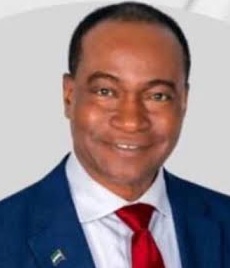
By Musa Paul Feika
A fresh political controversy is emerging within Sierra Leone’s opposition landscape following comments attributed to a senior All People’s Congress (APC) member, Hon. Kemoh Sesay Sesay, who has expressed strong confidence that former APC presidential candidate, Dr Samura Kamara will become President of Sierra Leone “soon.”
The comments have generated questions about what exactly he means by “soon” and, more importantly, what political, constitutional or institutional process he believes could lead to Dr Kamara becoming President before the next scheduled presidential election.
In the discussion, Sesay was asked whether he and others would participate in the 2028 presidential election if Dr Samura Kamara were not made President. His response was direct: he said they would not participate if Dr Kamara was not made President.
Pressed further on whether he genuinely believed Dr Kamara would become President before the next election, Sesay maintained that he truly believed it would happen and insisted that it would happen “shortly.”
The most intriguing part of the exchange, however, came when he was asked how such an outcome could occur.
Sesay reportedly linked his expectation to the implementation of reports and recommendations arising from previous political and electoral processes. He suggested that if relevant reports were accurately implemented by the Government and Parliament, the eventual outcome could result in Dr Kamara becoming President.
That explanation has raised more questions than answers.
Sierra Leone’s Constitution establishes the procedures through which presidential power is acquired and transferred. Therefore, any suggestion that an individual could become President outside the constitutionally recognised process naturally demands a clear explanation of the legal and political mechanism being contemplated.
Sesay’s remarks therefore deserve public scrutiny not necessarily because political actors are prohibited from expressing hopes or expectations, but because statements about a possible change in the presidency can have significant consequences in a politically sensitive environment.
The APC has previously challenged aspects of Sierra Leone’s electoral and political processes, while its supporters have continued to demand accountability and the implementation of recommendations from national and international processes. The question now is whether Sesay is referring to a specific report, agreement, judicial process or constitutional mechanism that he believes could produce a change in political leadership.
His reference to the implementation of reports appears particularly significant.
If the argument is that implementation of a particular report could lead to Dr Kamara becoming President, the public is entitled to know which report, what specific recommendation it contains, who is expected to implement it, and how its implementation would constitutionally result in a change of President.
Without those details, the statement remains a political assertion rather than an established constitutional outcome.
Sesay also appeared to point to recent developments that he considers signs of a changing political environment. He referenced the Government’s decision to return a matter to the Supreme Court, describing the development as evidence that President Julius Maada Bio may be moving in a different direction.
For Sesay, such developments appear to strengthen his belief that political circumstances could change in ways that ultimately benefit Dr Kamara.
But political developments and constitutional outcomes are not necessarily the same thing.
A government can take steps towards dialogue, justice, reconciliation or institutional reform without those actions automatically resulting in a change of presidency. Similarly, the implementation of recommendations from an inquiry, election review or political agreement would depend on the precise legal status of those recommendations and the constitutional mechanisms available for implementation.
This distinction is important as Sierra Leone approaches another politically significant period.
The debate surrounding Dr Samura Kamara’s political future has remained one of the major issues within the APC and among its supporters. He remains a prominent opposition figure and was the APC’s presidential candidate in the 2018 and 2023 elections.
However, whether he will contest a future election, become the APC’s flagbearer, or assume the presidency through any other constitutional process remains a matter for the relevant political and constitutional processes.
Sesay’s categorical confidence therefore presents an interesting political puzzle.
Is he expressing an expectation based on information not yet publicly disclosed? Is he referring to the implementation of recommendations from a particular report? Or is he simply expressing his political belief that circumstances will eventually favour Dr Kamara?
Those questions remain unanswered.
For now, the most striking aspect of his comments is his apparent willingness to go beyond predicting an APC victory at the next election. He is suggesting that Dr Kamara could become President “shortly,” while also saying that he would not participate in the next presidential election if that outcome does not occur.
That position could potentially deepen debate within opposition circles over electoral participation, political strategy and the meaning of recent national developments.
Ultimately, political change in Sierra Leone must be anchored in law, constitutional procedure and credible democratic processes.
If Kemoh Sesay Sesay’s prediction is based on a specific report or legally recognised process, the public deserves to hear the details. Until then, his claim that Dr Samura Kamara will soon become President remains a striking political assertion one that has raised more questions than it has answered.