


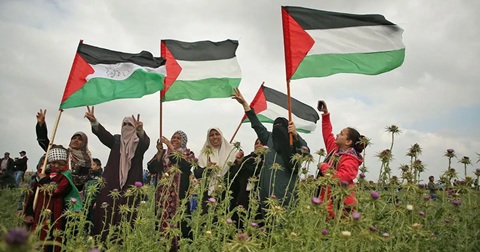
The idea of the Palestinian Liberation Organization, PLO was first initiated at a summit meeting in Cairo, Egypt in 1964. The Arab League thought it fit to create an organization representing the Palestinian People. The Palestinian National Council comprising 422 members convened in Jerusalem on 28th May, 1964. At the end of the meeting, the Palestinian Liberation Organization was founded on 2nd June 1964.
HEADQUATERS: The headquarters of the Liberation movement is Al- Bireh, West Bank.
IDEOLOGY: Palestinian nationalism, Arab nationalism, Pan-Arabism, Arab socialism, Secularism, Anti imperialism.
FACTIONS: One state solution. Anti-Zionism. Ba’athism. Maxism. POLITICAL POSITION: Leftwing MEMBERS: (1) Fatah (2) Popular Front for the Liberation of Palestine (PFLP) (3) Democratic Front for the Liberation of Palestine (DFLP) (4) Palestinian Peoples Party (PPP) (5) Arab Liberation Front (ALF) (6) As-Sa’iqa (7) Palestinian Democratic Union (FIDA) (8) Palestinian Popular Struggle Front (PPSF) (9) Palestinian Arab Front (PAF) (10) Popular Front for the Liberation Palestine—General Command (PFLPGC).
Founded in 1964, it initially sought to establish an Arab state over the entire territory of the former mandatory Palestine, advocating the elimination of Israel. Mediated talks between the Israeli government and the PLO in 1993 (the Oslo 1 Accord) resulted in the PLO recognizing Israeli’s legitimacy and accepting the United Nations Security Council Resolution 242, which mandated Israeli’s withdrawal from occupied territories, while Israel recognized the PLO as a legitimate authority representing the Palestinian people.
THE BALFOUR DECLARATION: This declaration was a public statement issued by the British Government in 1917 during the First World War announcing its support for the establishment of a “national home for the Jews people” in Palestine, then an Ottoman region with a small minority Jewish population. The declaration was contained in a letter dated 2nd November, 1917 from Arthur Balfour, the British foreign secretary, to Lord Rothschild, the leader of the British Jewish community, for transmission to the Zionist Federation of Great Britain and Ireland. The text of the declaration was published in the press on 9th November, 1917.
THE SIX DAY WAR: This war was also known as the June war that was fought in 1967. This war was tabbed the Arab-Israeli war because it was fought between Israel and a coalition of Arab states, principally Egypt, Syria, and Jordan from June 5 to 10 1967. Israel became victorious and seized territory from Syria (The Golan Heights), from Jordan (The West Bank, including East Jerusalem) and from Egypt (The Gaza Strip and The Sinai Peninsula).
YASSER ARAFAT AND THE PLO: Yasser Arafat was the longtime leader of the Palestine Liberation Organization (PLO). He served as the chairman of the PLO’s Executive Committee from 1969 until his death in 2004. Arafat also served as the first president of the Palestinian Authority (PNA) from 1994 to 2004 and the first President of the state of Palestine from 1989 to 2004. EARLY INVOLMENT WITH THE MOVEMENT: Arafat, initially a leader of the Fatah movement, became the chairman of the PLO in 1969.
FROM GUERILLA WARFARE TO DIPLOMACY: Under Arafat’s leadership, the PLO evolved from a group primarily focused on armed struggle against Israel to a political entity seeking a negotiated solution.
KEY FIGURE IN PEACE NEGOTIATIONS: Arafat played a crucial role in the Oslo Peace Accord, signing the declaration of the principles with Israeli Prime Minister Yitzhak Rabin in 1993. NOBEL PEACE PRIZE: For his efforts in the Oslo Accords, Arafat was awarded the Nobel Peace Prize in 1994, along with Rabin and Shimon Peres.
CHALLENGES AND CRITICISMS: Despite his peace negotiations, Arafat faced criticism for his past association with violence and for his perceived ambiguity regarding the use of terrorism.
LEGACY: Arafat’s legacy remains complex, with some remembering him as a freedom fighter, and others as a terrorist. His death on November11 2004, marked the end of an era for the Palestinian national movement.
Military hostilities broke out amid poor relations between Israel and its Arab neighbors, which had been observing the 1949 Armistice Agreements signed at the end of first Arab-Israeli war. In 1956, regional tensions over the Straits of Tiran (giving access to Eilat, a port on the southeast tip of Israel) escalated in what became known as the Suez Crisis, when Israel invaded Egypt over the Egyptian closure of maritime passageways to Israeli shipping. Ultimately, this resulted to the re-opening of the Straits of Tiran to Israel as well as the deployment of the United Nations Emergency Force (UNEF) along the Egypt- Israel border.
In the months prior to the outbreak of the six-day war in June 1967, tensions again became dangerously heightened: Israel reiterated its post-1956 position that another Egyptian closure of the Straits of Tiran to Israeli shipping would be a definite casus belli. In May 1967, Egyptian president Gamal Abdel Nasser announced the Straits of Tiran would again be closed to Israeli vessels. He subsequently mobilized the Egyptian military into defensive lines along the border with Israel and ordered the immediate ultimate withdrawal of all UNEF personnel.
On June 5 1967, as the UNEF was in the process of leaving the zone, Israel launched a series of air strikes against Egyptian airfields and other facilities in what was known as Operation Focus. Egyptian forces were caught by surprise, and nearly all of Egypt’s military aerial assets were destroyed, giving Israel air supremacy. Simultaneously, the Israeli military launched a ground offensive into Egypt’s Sinai Peninsular as well as the Egyptian-occupied Gaza Strip. After some initial resistance, Nasser ordered an evacuation of the Sinai Peninsula. By the sixth day of the conflict, Israel had occupied the entire Sinai Peninsula. Jordan, which had entered into a defense pact with Egypt just a week before the war began, did not take an all-out offensive role against Israel, but launched attacks against Israeli forces to slow Israel’s advance. On the fifth day, Syria joined the war by shelling Israeli positions in the north.
Egypt and Jordan agreed to a ceasefire on 8 June, and Syria on 9 June, and it was signed with Israel on June 11. The six-day war resulted in more than 15,000 Arab fatalities, while Israel suffered fewer than 1,000. Alongside the combatant casualties were the deaths of 20 Israeli civilians killed in Arab forces air strikes on Jerusalem. 15 UN peacekeepers killed by Israeli strikes in the Sinai at the outset of the war, and 34 US personnel killed in the USS Liberty incident in which Israel claimed responsibility.
Despite the Israeli- PLO letters of mutual recognition, in 1993, in which PLO leader Yasser Arafat renounced violence against Israel, the PLO engaged in militant activities during the second Intifada, (2000-2005). On 29 October 2018, the PLO central command suspended the Palestinian recognition of Israel. As the officially recognized government of the de jure state of Palestine, it has enjoyed United Nations observer status since 1974. Prior to the Oslo accords, the PLO’s militant wings engaged in acts of violence against both the Israeli military and civilians, within Israel and abroad. The United States designated it as a terrorist group in 1987, though a presidential waiver has permitted American-PLO contact since 1988.
SUMMARY OF ARAB-ISRAELI WARS: Military conflicts fought between various Arab forces and Israel, most notably in 1948-49, 1956, 1967, 1973, 2006, and the present Hamas war-2023.
1948 ARAB-ISRAELI WAR: The first war, in 1948—49, began when Israel declared itself an independent state following the United Nations’ partition of Palestine and five Arab countries—Egypt, Iraq, Jordan, Syria, and Lebanon—attacked Israel. The conflict ended with Israel controlling all of the Negev up to the former Egypt-Palestine frontier, except for Gaza Strip.
SUEZ CRISIS: The 1956 Suez Crisis began after Egypt nationalized the Suez Canal. A French, British and Israeli coalition attacked Egypt and occupied the Canal Zone but soon withdrew under international pressure
SIX-DAY WAR: The six day war of 1967 began when, in response to Arab neighbors’ apparent readiness and mobilization for war, Israel attacked and destroyed Egypt’s and Syria’s air forces. Israel also defeated Jordanian attacks. The war ended with Israel in control of the Gaza Strip, the Sinai Peninsula, the West Bank, and Jerusalem.
YOM KIPPUR WAR: Egypt and Syria attacked Israel in 1973, and fighting continued for several weeks. In 1979, Egypt made peace with Israel, formally ending 30 year state of war between the two countries.
THE 1982 LEBANON WAR: In 1982 Israel invaded Lebanon in order to expel the Palestine Liberation Organization from its bases there. Israel withdrew from Lebanon by 1985.
2006 LEBANON WAR: In 2006 Hezbollah launched an operation against Israel and, over the ensuing month, fought Israeli forces to a standstill and Hezbollah backed down.
WHAT LED TO THE OCTOBER 7 INCURSION OF ISRAEL BY HAMAS: In 1948, the state of Israel was created on land inhibited by both Jews and Arab Palestinians. Hostilities between the two communities became a daily recurrence that led to a mass displacement of Palestinians. Many of them became refugees in the Gaza Strip, a narrow swath of land roughly the size of Philadelphia that had come under the control of Egyptian forces during the 1948-49 Arab-Israeli war. The status of the Palestinians remained unresolved as the protracted Arab-Israeli conflict brought recurrent violence to the region, and the fate of the Gaza Strip fell into the hands of Israel when it occupied territory during the six-day war of 1967.
Since 2007, the Gaza Strip has been governed by Hamas, an Islamist militant group, while the West Bank remained under the control of the Fatah-led Palestinian Authority. After Hamas takeover, Israel imposed a blockade of the Gaza Strip that significantly damaged its economy. These conditions became unbearable for the Palestinian people and they thought it was time for action against Israel. The President of the Palestinian Authority, Mahmoud Abass, and the man in charge of the militant group of Hamas, Muhammad Ismail Darwish summoned a meeting of all their commanders. In that gathering, they made a proclamation to attack Israel.
The war began on October 7, 2023, when Hamas launched a land, sea and air assault on Israel from the Gaza Strip. The attack by Hamas resulted in more than 1,200 deaths, primarily Israeli citizens, making it the deadliest day for Israel since its independence. More than 240 Israelis were taken hostage during the attack. The next day, Israel declared itself in a state of war for the first time since the Yom Kippur War of 1973.
The following day, the Israeli Defense Forces (IDF) started conducting air strikes on the Gaza Strip, followed later by the incursion of ground troops and armored vehicles. A brief ceasefire and a series of hostage exchanges took place between late January and early March, but hostilities resumed after negotiations for a second phase of the ceasefire failed to hold root. By early June 2025, more than 54,000 Gazans, about 2 percent of the territory’s population had been killed according to official figures. And more than two-thirds of the buildings and infrastructures in the Gaza Strip had been damaged or destroyed that led to humanitarian crisis. About 1,700 Israelis had been killed, including those killed in the October 7 attack. Although the agreement led to more than a month of pause in the conflict in the Gaza Strip, its implementation was shaky from the start, and in mid-March the conflict resumed again at a larger scale.
The governments of 44 countries denounced the attack and described it as terrorism, while some Arab and Muslim-majority countries blamed Israel’s occupation of the Palestinian territory as the root cause of the attack. Hamas said its attack was in response to the continued Israeli occupation, the blockade of the Gaza Strip, the expansion of illegal Israeli settlements, rising Israeli settler violence, and escalations in tensions between the two communities. The day was labeled the “bloodiest in Israeli history and the deadliest for Jews since the Holocaust”by media outlets in the west. Many figures, including then US president Joe Biden made similar sentiments. Some have made allegations that the attack was an act of genocide or a genocidal massacre against Israelis.