

By Alie Badara In Bo, Southern, Sierra Leone
A growing number of inquiries have been directed towards Liberia’s Social Security and Welfare Corporation (NASSCORP) following serious allegations of financial misconduct involving public funds meant for the Social Security system.
Yet despite repeated attempts to obtain answers, the Director General, Dewitt Vonballmoos, and associates linked to the disputed transactions have failed to provide any response.
As these concerns continue to spread my investigation-rooted in investigative reporting across the region-has traced what appears to be a disturbing pattern: the movement of large sums of money through multiple overseas banking channels, and the awarding of business arrangements to a newly formed foreign-linked entity, despite the existence of established local partners.
In the course of reporting, I reached out to NASSCORP seeking clarity regarding its dealings with an Italian national, Mr. Diego Pol, who is accused of receiving an astonishing amount of US$ 3.2 million under circumstances that raise serious red flags about possible money laundering and misuse of Social Security funds.
Despite every effort to engage – including formal attempts to request documentation and written explanations-NASSCORP and the individuals implicated remained silent.
This lack of transparency is especially troubling given the public nature of the funds at issue and the duty of the agency to protect the Social Security system for ordinary Liberians.
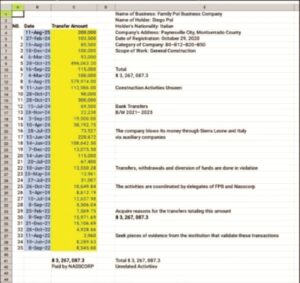
Our investigation has uncovered financial records detailing transactions attributed to dealings between NASSCORP and Mr. Diego Pol, totaling:
US$3,267,087. 30 (Three million, two hundred sixty-seven thousand, eighty-seven dollars, and three cents).
What makes the alleged transactions particularly alarming is the absence of any documented evidence showing legitimate work-related services performed in exchange for such a significant payment.
In other words, the records indicate substantial withdrawals and transfers out of Liberia while failing to show credible, verifiable services that would justify the sums paid.
We obtained transfer-related information, including transfer details and SWIFT code indicators, suggesting that large amounts were sent internationally through several banking institutions-among them:
* Citibank (USA)
* National Commerce Bank (Tanzania)
* UniCredit S.p.A. (Italy)
These details raise further questions about the legitimacy, purpose, and oversight of the transfers, particularly when the funds involved appear tied to social security resources.
Records further indicate that Mr. Diego Pol established “Family Pol Business ” on October 27, 2020, following a dispute with CESAF Liberia. CESAF Liberia had previously partnered with Pol, but collaboration allegedly became difficult.
The concern intensifies when it was later reported that the Social Security Director of Liberia made a controversial decision to terminate a contract with CESAFLiberia, a company said to have a well-documemted record of achievements and reliable expertise-only to award business to the newly formed Family Pol Business.
On the surface, business decisions are expected to follow procurement and contractual rules.

However, based on the broader financial trail revealed in this investigation, the sequence of events appears consistent with a scenario in which millions could be extracted into overseas accounts through a structure that offers little to no verifiable operational value inside Liberia.
In conversation with a former business partner of Mr. Pol-whose name I am withholding to protect identity and safety-the reaction was one of shock and frustration.
He expressed disbelief that an Italian national would be prioritized over established local companies and suggested that Pol’s alleged arrangement appears designed to extract funds without delivering corresponding tangible services.
It is both bewildering and unacceptable that this Italian national was preferred over established local companies.
It seems he has the means to extract millions from NASSCORP under pretenses while offering absolutely no tangible services.
This is incredibly frustrating for Liberian businesses, and I am throughly disappointed in Dewitt’s decision-making. ”
Whether or not all allegations are ultimately proven in court, the level of concern voiced by people close to the situation reflects a wider public fear: that institutions meant to protect citizens’ Welfare are being undermined from within.
This investigation is not simply about one individual or one company.
It is about system integrity-and what happens when Social Security funds meant for workers and beneficiaries are handled without accountability, documentation, and transparency.
It also raises serious contradictions with Liberia’s Liberianization Policy, a framework intended to ensure that key economic activity promotes Liberian participation and empowerment.
While the policy does not automatically prevent foreign engagement, it is designed to reduce undue reliance on foreign actors and strengthen local capacity.
The allegations presented here-if substantiated-appear to contradict the intent of the policy and instead show a pathway by which national resources may have been diverted to benefit foreign-linked interests.
This information will not remain confined to media platforms. I will ensure the relevant evidence and supporting documents-including transaction details referenced in our records-are formally submitted to the Commissioner of Liberia’s Anti-Corruption Commission, along with a request for investigation.
Further, I will make the information available to other relevant state actors and civil society organizations in Liberia.
* The establishment of oversight mechanisms,
* a potential commission of inquiry, and
* a deeper unearthing of the hidden truth surrounding NASSCORP finances and procurement decisions.
NASSCORP’s silence is not a neutral position-it is part of the story.
If allegations are false, transparency should be simple: documents should be provided, questions answered, and the rationale behind payments and transfers explained.
But if the concerns are accurate, then accountability must follow.
Liberian workers deserve more than explanations. They deserve protection.
Liberia deserves institutions that serve the public-not undermine it.
See transfer details.